Whether the Rowdy Line Is a Third Malamute Strain
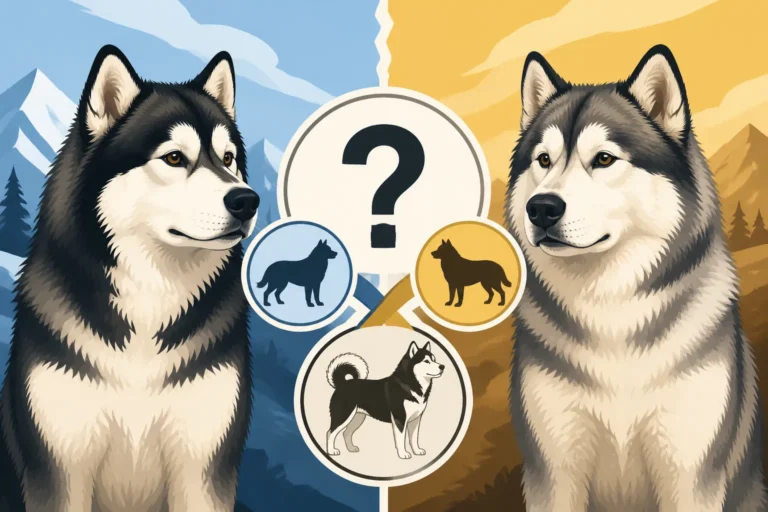
When Malamute pedigrees mention a “Rowdy line,” it can sound as if the breed has a recognized third strain alongside the Kotzebue and M’Loot lines. The history is less tidy: Rowdy is a name associated with particular ancestry, while “strain” usually describes a broader historical breeding group. This guide explains the difference and what the label can—and cannot—tell you about a dog.
Is the Rowdy line a recognized Malamute strain
The short answer is that “Rowdy line” is not generally treated as a third, clearly separate foundational strain in the same way people discuss Kotzebue and M’Loot. It is a phrase you may meet in pedigree conversations, kennel histories, or accounts of the breed’s development, but its meaning can vary with context.
What breeders mean by a strain
In breed history, a strain is a group of dogs developed through a particular set of breeders and ancestors, often with a recognizable breeding history or type. It is not necessarily a formal category recorded on a dog’s registration papers. The term is useful for describing how different groups contributed to the modern breed, but it can get fuzzy when dogs from those groups were bred together over time.
That matters because people sometimes use “line,” “strain,” and “family” as if they mean exactly the same thing. They do not always. A line might refer to descendants of a specific dog or kennel. A strain usually points to a wider historical population. And a pedigree can show ancestry without proving that a dog belongs exclusively to one neatly bounded group.
The two names most often used to describe the major early Malamute strains are Kotzebue and M’Loot. Their histories, breeders, and typical physical characteristics are discussed in The Kotzebue and M'Loot Lines Behind Every Modern Malamute. Neither label should be treated as a complete description of an individual dog’s temperament, working ability, or health.
Where the Rowdy name fits
“Rowdy” is associated with a dog and a strand of Malamute ancestry discussed in some breed-history accounts. The name may appear in discussions of early breeding, including accounts that describe a third historical group or line. This is one reason the question keeps coming up: readers see “Rowdy” mentioned beside the better-known strain names and reasonably wonder whether it belongs in the same category.
The catch is that a named dog or family is not automatically a distinct strain. For that claim to be useful, there would need to be a reasonably consistent definition of the group: which dogs founded it, which breeders maintained it, how it was distinguished, and how its descendants relate to the other populations. Discussions of Rowdy do not always use the term with that level of consistency.
So, if someone says a Malamute has “Rowdy blood,” the sensible follow-up is not simply “Which strain is it?” Ask which dog or pedigree branch they mean, and what records support the description. The answer may refer to a particular ancestor or family rather than a separate, formally recognized breed population.
Why the wording varies
Historical breeding records can be incomplete, and early Malamute breeding did not operate like a modern database with every family neatly separated. Dogs moved between kennels, breeders selected for different qualities, and later generations combined ancestry from multiple sources. Over time, a term that once had a specific local meaning can become shorthand for a broader or less precise pedigree story.
That does not make the term meaningless. It means the label needs context. A knowledgeable breeder may use it to describe a known branch in a dog’s ancestry, while another person may use “Rowdy line” more loosely. When you encounter the phrase, check whether the speaker can connect it to actual ancestors and records instead of treating it as a universally agreed category.
How Rowdy relates to the Kotzebue and M’Loot histories
The Kotzebue and M’Loot labels are often used to explain how distinct early breeding populations contributed to the modern Alaskan Malamute. They are helpful historical reference points, but they do not mean today’s dogs fall into two perfectly separate boxes. The breed’s later development involved broader mixing.
The two best-known foundational groups
The Kotzebue group is associated with a more compact type in many historical descriptions, while M’Loot dogs are often described as larger or taller. These are broad tendencies reported in discussions of the early populations, not rules that allow you to identify ancestry just by looking at a dog. Size, coat, build, and expression vary within families, and modern Malamutes reflect many generations of breeding.
For an overview of the Kotzebue group, see What the Kotzebue Malamute Line Is. The M’Loot history is covered in What the M'Loot Malamute Line Is. Those explanations can help make sense of why old strain labels remain part of Malamute conversations, even though they are not simple labels for every dog alive today.
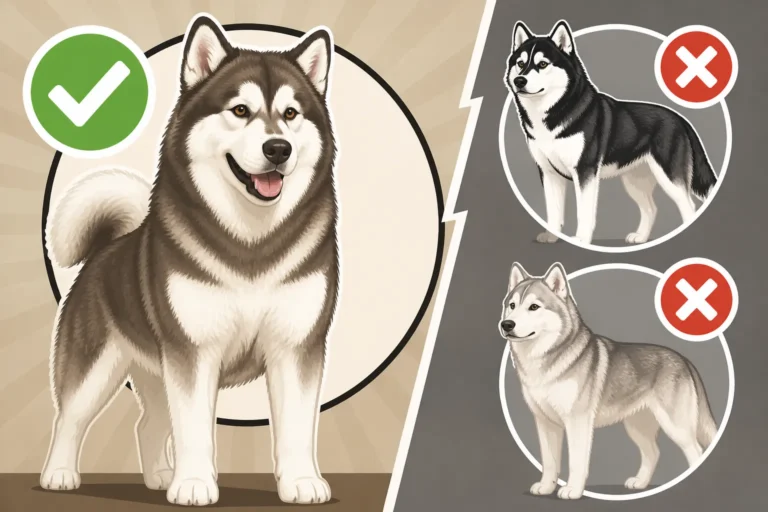
It is also worth remembering that “looks like” is not the same as “comes from.” A tall Malamute is not automatically M’Loot, and a more compact dog is not automatically Kotzebue. Physical traits can be influenced by many ancestors, and judging a pedigree by appearance alone is guesswork.
The groups did not remain sealed off
As breeders worked to establish and develop the breed, dogs from different backgrounds were brought into breeding programs. That kind of mixing is normal in the development of a breed. It also makes a clean, permanent division between historical populations less realistic as generations pass.
The relationship between the early groups is explored in Whether the Two Malamute Lines Were Ever Merged. For a present-day pedigree, the practical point is simple: a dog can have ancestry connected to more than one historical group. A strain label, when used, describes part of a story—not necessarily the whole ancestry.
This is why an old family name may turn up in several connected pedigrees without establishing a separate strain. Dogs can share ancestors, and a particular dog’s descendants can spread across breeding programs. The more those descendants are bred into other families, the harder it becomes to treat the original group as an independent population.
A third label does not make a separate modern type
Even if a history describes a third early group or uses a name associated with Rowdy, that does not mean there is a distinct modern “Rowdy-type” Malamute with a reliable set of traits. The words might identify a historical contribution, but they do not guarantee a particular adult size, personality, working style, or health profile.
Think of it like a family tree. A branch can be important without being a separate species—or even a fully separate modern family. The branch tells you something about descent. It does not predict every feature of each descendant. The same caution applies to claims that a strain is naturally healthier, more powerful, or more suitable for a particular job.
How to evaluate a Rowdy-line claim in a pedigree
If a breeder or owner uses the phrase “Rowdy line,” treat it as a prompt to ask for details, not as a conclusion by itself. A useful pedigree discussion connects the label to identifiable dogs, dates, kennels, and documented parentage.
Ask for the specific ancestors
Start with a practical question: “Which dogs in this pedigree are you referring to as the Rowdy line?” Ask the person to point to the names on the pedigree and explain how the term is being used. If they can describe the relevant ancestors and their place in the family, you have something concrete to investigate.
You can then compare the explanation with broader breed histories, including Whether Every Malamute Traces to Kotzebue or M'Loot. The key is not to force every dog into a simple category. It is to understand what the pedigree actually records and what the speaker is inferring from it.
A pedigree can support claims about parentage and ancestry, but it cannot automatically validate a kennel’s informal terminology. If a breeder says “Rowdy” means a particular working family or historical branch, ask how they define that branch and whether the term is used consistently across their records. Clear answers are more useful than an impressive-sounding label.
Separate ancestry claims from promises about the dog
A strain or family name should not be used as a shortcut for predicting temperament or performance. A dog’s behavior and working suitability depend on many influences, including inherited traits, early development, socialization, training, health, and the environment in which the dog lives.
The same goes for health. A claim that a line is “healthier” needs evidence specific to the conditions being discussed, not just a historical name or reputation. Ask what health screening the parents have had and what information the breeder can share about close relatives. Which Malamute Line Is Healthier is a useful companion topic for separating broad lineage stories from health evidence.
If you are considering a puppy, look at the whole picture: the parents’ health records, the breeder’s decisions, the puppy’s early care, and how well the dog’s likely needs fit your home. A historical line name may add context, but it should not replace those checks.
Use pedigrees as records, not rankings
It is easy for strain labels to turn into a ranking system: one group is described as more authentic, another as bigger, and a third as more desirable. Those claims may reflect personal preference, old kennel rivalries, or an oversimplified reading of history. They are not a sound way to judge the quality of an individual dog.
If you are comparing pedigrees, keep the questions specific. What are the documented ancestors? What characteristics does the breeder select for? What work, if any, have related dogs done? What health information is available? Those questions tell you more than asking whether one label is “best.”
A pedigree’s complexity is not a flaw. A modern Malamute may descend from multiple historical groups, and that mixed history is part of how the breed developed. Whether Breeders Still Distinguish the Two Malamute Lines offers more context on how the old labels are used today.
What the Rowdy label can tell you
The phrase may point toward a meaningful piece of a dog’s family history, but the label alone does not tell you exactly what that history is. Its usefulness depends on whether the person using it can explain the specific dogs and breeding records behind the claim.
| Pedigree phrase | What it may refer to | What it does not prove by itself |
|---|---|---|
| Kotzebue | A historically discussed Malamute breeding group | That a dog has a guaranteed size, temperament, or health profile |
| M’Loot | Another historically discussed breeding group | That a dog belongs exclusively to a separate modern population |
| Rowdy line | A dog, family, or ancestry branch discussed in some historical accounts | That there is a universally defined third strain or a distinct modern type |
| Mixed ancestry | Descendants of dogs from more than one historical group | That the pedigree is less valuable or less informative |
What to remember when you hear “third strain”
Some accounts may describe three historical groups, and the Rowdy name may appear in discussions of that history. But the phrase “Rowdy line” is not consistently used as a clearly defined third foundational strain on par with Kotzebue and M’Loot. It is safest to ask what the speaker means and which dogs the label refers to.
This careful wording avoids two opposite mistakes. One is dismissing any mention of Rowdy as nonsense, even when a speaker is referring to a real ancestor or pedigree branch. The other is treating the label as a universally recognized strain with predictable characteristics. The details matter more than the shorthand.
What the label means for a puppy buyer
For a prospective owner, the Rowdy label should be background information rather than the deciding factor. It can lead to an interesting conversation about a Malamute’s ancestry, but it does not replace an evaluation of the breeder, the parents, the puppy’s health, or the match between the dog and your household.
A thoughtful breeder should be able to explain their terminology without turning it into a guarantee. If the label is presented as proof that puppies will be unusually large, especially healthy, or naturally suited to a particular job, ask what evidence supports those promises. A pedigree can show lineage; it cannot make every outcome certain.
Ultimately, the most helpful question is not “Is Rowdy a third strain?” in isolation. It is “What does this particular breeder mean by Rowdy, and what can the pedigree verify?” That keeps the conversation grounded in records and gives you a clearer picture of the dog in front of you.
Disclaimer
This article is for general informational purposes only and does not constitute professional advice. Laws, prices and regulations vary by location and change over time. Consult a qualified professional for guidance on your specific situation.