Whether a Samoyed Is Friendlier Than a Malamute
A Samoyed may rush to greet visitors while a Malamute hangs back, or the reverse may happen in the same household. That makes “friendlier” a slippery comparison: it can mean warmth toward people, ease with other dogs, or enthusiasm for strangers. This guide separates those traits so you can compare the breeds realistically and choose the kind of companionship that fits your life.
What “friendlier” means in a Samoyed and a Malamute
Friendliness toward people
Both Samoyeds and Alaskan Malamutes can be affectionate, social family dogs. Neither breed is best understood as a dependable guard dog, and a friendly individual may welcome visitors rather than act suspiciously toward them. Still, there is no reliable rule that every Samoyed is more outgoing or every Malamute is more reserved.
Samoyeds are often described as sociable and people-oriented. A Samoyed may seek attention from familiar people and greet a visitor with obvious excitement. Malamutes can be just as warm with their families, but some are more selective about when they want attention or less inclined to perform a cheerful greeting for everyone. These are tendencies people may encounter, not guarantees about a particular dog.
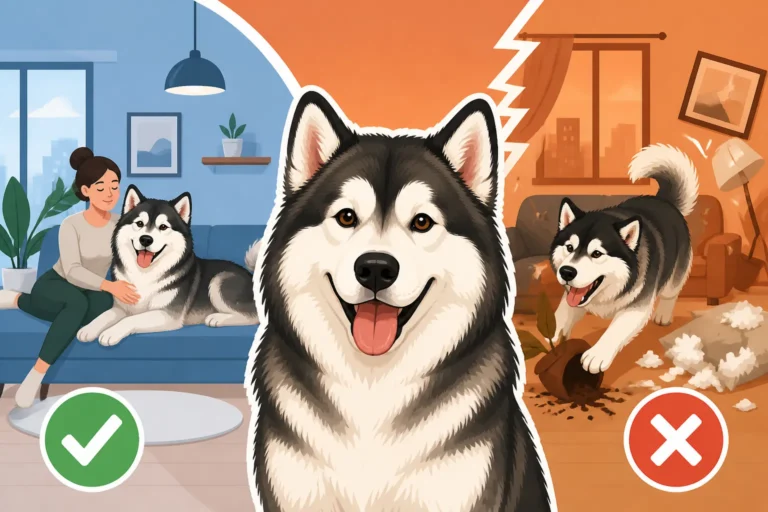
It helps to separate friendliness from manners. A dog that jumps on guests, mouths hands, or barrels into a child may be enthusiastic, but it is not necessarily easier to live with. A calm dog that waits for an introduction may be just as friendly, even if its greeting looks less exuberant. For a closer look at the Malamute’s typical approach to visitors, see How an Alaskan Malamute Greets Strangers.
Sociability with other dogs
The comparison can change when “friendly” means comfortable around other dogs. Many Samoyeds enjoy canine company, but individual dogs still vary, and sociability is not a promise that every dog-park encounter will go smoothly. Malamutes may be more challenging in some multi-dog homes, especially when conflict develops between dogs of the same sex. That possibility does not mean every Malamute will fight, but it is important to consider before choosing a breed or adding another dog.
A dog’s behavior also depends on its history, social experiences, health, and the situation. A Samoyed that has had frightening encounters may become wary around unfamiliar dogs. A Malamute that has grown up peacefully with a compatible companion may be relaxed at home, yet uncomfortable with unfamiliar dogs in a crowded setting. Familiarity with one dog is not proof of universal dog sociability.
This is why “friendlier” should not be used as a shortcut for predicting safe interactions. Introductions need planning, supervision, and enough space for both dogs to move away. If a multi-dog household is part of your decision, Whether an Alaskan Malamute Should Be an Only Dog and Why Malamutes Fight Dogs of the Same Sex offer useful context about the Malamute’s potential challenges.
| What you mean by friendly | Samoyed tendency | Malamute tendency | What matters most |
|---|---|---|---|
| Warm with family | Often affectionate and people-focused | Often affectionate, though some are more independent | The individual dog and daily relationship |
| Welcoming to visitors | May greet people enthusiastically | May greet people warmly, but enthusiasm varies | Socialization, training, and visitor management |
| Comfortable with unfamiliar dogs | Can be sociable, but not universally | May require more careful dog-to-dog management | Compatibility, past experiences, and supervision |
| Easy for a first-time owner | Friendliness does not guarantee easy handling | Strength and independence can make management demanding | Training needs, exercise, and the owner’s experience |
| Gentle around children | Possible with thoughtful supervision | Possible with thoughtful supervision | Child behavior, dog temperament, and adult supervision |
Why the individual dog matters more than the breed label
Socialization is not a personality guarantee
Early, positive experiences can help a puppy feel more at ease around everyday sights, sounds, people, and animals. But socialization does not mean forcing a dog to greet everyone or exposing it to overwhelming situations. A puppy that is allowed to observe calmly, approach at its own pace, and retreat when it needs to is learning that new experiences can be manageable.
A friendly adult dog can still have limits. It may be comfortable with familiar neighbors but uneasy around a crowd, or relaxed with calm dogs but uncomfortable with a dog rushing directly into its space. Pay attention to the dog’s body language instead of assuming that a breed reputation means it will enjoy every interaction. Turning away, becoming stiff, trying to leave, or repeatedly avoiding contact can be signs that the dog needs more room.
For people comparing puppies, ask how the breeder introduces puppies to handling, household sounds, visitors, and other dogs. Ask what the parent dogs are like in ordinary situations, not just whether they are “friendly.” A description such as “loves people” is less informative than a specific account of how a dog behaves when a guest enters, when a child moves quickly, or when another dog approaches on leash.
Age, health, and experience can change behavior
A young dog may greet people with unfiltered excitement, while an adult may be more measured. Adolescence can bring new testing of boundaries and changes in how a dog responds to other dogs. That does not mean an adolescent suddenly has a bad temperament; it does mean that an owner may need to revisit routines, supervision, and training rather than relying on puppy behavior to predict the future.
Pain or illness can also affect a dog’s tolerance. A dog that once welcomed handling may pull away if a sore joint, skin irritation, or other discomfort makes touch unpleasant. If a dog’s behavior changes abruptly, especially if it becomes unusually withdrawn or reactive, a veterinary check is a sensible first step. It is unfair to label a dog unfriendly before considering whether something is making it uncomfortable.
Rescue dogs bring their own histories, and not every detail will be known. Give a newly adopted dog time to settle before arranging lots of visitors or dog introductions. Predictable routines, quiet resting space, and patient observation make it easier to see what the dog actually enjoys. For more on a Malamute’s relationship with smaller canine housemates, see How a Malamute Treats a Small Breed Housemate.
Which breed may fit your household better
Choose based on daily life, not greeting style
If you picture a dog that eagerly seeks out attention from many people, a Samoyed may match that image more often. But a highly social dog still needs training to greet politely, settle when attention ends, and cope with being left alone. Enthusiasm can be delightful in a large yard and less convenient when a strong, excited dog meets guests in a narrow entryway.
A Malamute may suit someone who appreciates an affectionate companion with a more independent streak. That independence can be mistaken for aloofness when the dog is simply not interested in constant interaction. Malamutes are powerful, active dogs bred for work, and their needs extend well beyond being pleasant company. Exercise, secure management, enrichment, and consistent training all matter; friendliness alone will not make the breed easy to handle.
Both breeds need owners prepared to guide interactions rather than assuming that a naturally social dog will manage itself. A sturdy harness, a well-fitted collar, and comfortable walking equipment can help make outings more controlled. When comparing equipment, focus on fit, construction, and whether you can manage the dog safely; a retailer such as Chewy may be one place to compare basic walking supplies, but the right item depends on the individual dog and how it behaves on leash.
Children, visitors, and shared spaces
Either breed may live successfully with children when the match is thoughtful and adults supervise. Neither should be left to manage a child’s rough handling, chasing, hugging, or attempts to take food and toys. A dog’s affectionate nature does not remove the need to give it a quiet place where children cannot follow it. Read more about the factors involved in Whether an Alaskan Malamute Is Safe With Children and Whether an Alaskan Malamute Is Gentle With Its Own Family.
Consider the daily environment as carefully as the dog’s temperament. Frequent visitors, busy sidewalks, shared hallways, and nearby dogs create more opportunities for greetings and close encounters. A dog that is comfortable meeting people in a quiet home may find a crowded event stressful. A household with children needs routines for feeding, play, resting, and keeping the dog’s space undisturbed.
A useful question is not only “Will this dog like my family?” but also “Can my family respect this dog’s needs?” Teach children to invite interaction rather than demand it, and show them how to recognize when the dog wants a break. For visitors, use a gate, leash, or separate room if the dog is too excited or unsure. These practical arrangements protect the dog and make social moments more relaxed for everyone.
How to assess friendliness before and after bringing a dog home
Questions to ask a breeder or rescue
Ask for examples rather than broad labels. “Friendly” can mean a dog calmly tolerates people nearby, actively seeks petting, or becomes overexcited when someone arrives. Ask how the dog behaves with unfamiliar adults, familiar children, other dogs, handling, and time alone. Ask what situations make the dog uncomfortable, too; a responsible answer should acknowledge limits rather than promise that every dog is perfect with everyone.
If you are meeting a puppy, observe how it responds to a new person without pressuring it to interact. Does it recover after a surprising sound? Can it explore and then settle? Does it accept gentle handling, or does it seem overwhelmed? A brief meeting is only a small sample of behavior, so consider the puppy’s broader environment and the temperament of its relatives as well.
For a rescue, ask what is known about the dog’s behavior in a home, on leash, around other animals, and with visitors. If information is incomplete, plan for a gradual transition rather than treating uncertainty as proof of a problem. A careful introduction process can help reveal compatibility without putting the dog or anyone else in a difficult position.
Build social confidence without forcing contact
Start with manageable experiences. Let the dog watch people from a comfortable distance, reward calm attention, and leave before it becomes overwhelmed. For dog introductions, choose a neutral, spacious area when appropriate, keep the dogs under control, and avoid forcing nose-to-nose greetings. A parallel walk can be a less intense first step than placing two dogs face-to-face in a confined space.
At home, give the dog predictable routines and reward the behaviors you want: four paws on the floor, checking in with you, or settling on a mat while a guest arrives. If your dog is too excited to greet visitors safely, use a barrier or leash while it calms down. Manage the situation first; do not expect the dog to learn good manners while it is already over threshold.
Enrichment can help a dog settle, especially when visitors or household activity make the day busy. Food puzzles and chew items should be chosen for the dog’s size, chewing style, and safety, and given in a place where the dog can enjoy them undisturbed. Chewy is one place owners may browse for enrichment supplies, but introduce any new item under supervision and remove it if the dog tries to swallow pieces or guards it. For broader expectations about the breed’s everyday demands, see What Alaskan Malamute Owners Wish They Had Known.
The most realistic answer is that Samoyeds are often perceived as especially outgoing, while Malamutes can be affectionate but more independent and may need more careful management around other dogs. Neither label predicts an individual dog. Look for the temperament, history, and needs that fit your home, and judge friendliness by relaxed, safe behavior—not by how loudly or quickly a dog greets someone.
Disclaimer
This article is for general informational purposes only and does not constitute professional advice. Laws, prices and regulations vary by location and change over time. Consult a qualified professional for guidance on your specific situation.