Whether a Malamute Escapes Less Than a Husky
A Malamute may look too substantial to slip away, but strength and size do not make one easier to contain than a Husky. Both breeds can dig, climb, squeeze through a weak spot, or ignore a recall when something exciting catches their attention. This guide compares their escape habits and explains how to reduce the chances of a successful getaway.
Do Malamutes escape less than Huskies
The short answer depends on the individual dog
There is no reliable rule that Malamutes escape less than Huskies. Both are independent northern breeds with a strong capacity for problem-solving and a history of working away from people. A Malamute may be less inclined to dart around in some situations, while a particular Husky may be content to stay near home—but those tendencies are not guarantees of safe containment.
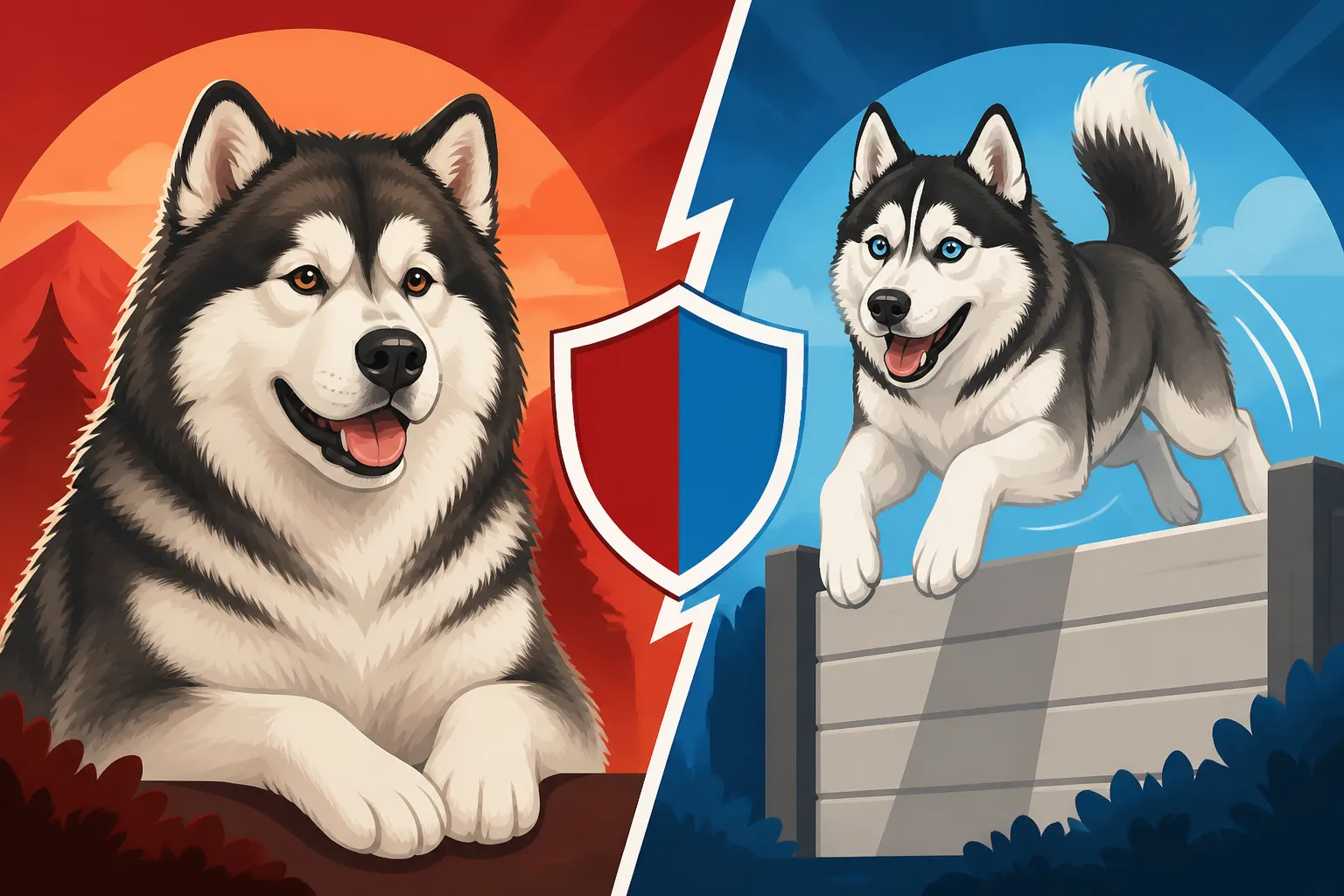
The type of escape can differ. A Husky may be especially persistent about finding a route out, squeezing through an opening, or roaming once loose. A Malamute’s greater mass and strength can make a fence, gate, or leash test more physically demanding. But a determined dog of either breed can make a weak barrier fail. Thinking “my dog is too big to get through” or “this breed is calmer” can leave an owner surprised by a hole under the fence or an open gate.
Personality, age, training, daily activity, and the environment all matter. A young dog with hours of unused energy may experiment with the fence more than an older dog who has a routine and enough enrichment. A dog that sees rabbits, cats, or another dog beyond the yard may be more motivated to leave than one with no obvious distraction. Previous escapes also matter: once a dog discovers a route, it may try that spot again.
For a broader look at the Malamute’s independent nature, see Why an Alaskan Malamute Will Never Have a Reliable Recall. Even a dog that responds well in a quiet yard may not come back when a squirrel, unfamiliar dog, or open trail presents a stronger reward.
Compare likely escape pressures, not breed stereotypes
A useful comparison is not “Which breed is good in a yard?” but “What might motivate this dog, and what can this dog physically defeat?” Huskies and Malamutes can both be driven by movement, smells, social opportunities, boredom, or a desire to explore. A securely fenced property does not automatically satisfy a dog that is under-exercised or left alone for long periods.
| Escape factor | Alaskan Malamute | Siberian Husky | What owners should do |
|---|---|---|---|
| Strength against barriers | Size and pulling strength can put heavy pressure on gates and fence panels | Athletic dogs can also push, climb, or exploit weak points | Check the full perimeter, not just the obvious gap |
| Digging | May dig under a fence, especially from a favored spot or in comfortable soil | May dig under a fence or create a route through repeated attempts | Block access to the fence line and provide an approved digging area |
| Climbing or jumping | Some individuals climb or jump when motivated | Some individuals are agile and persistent climbers | Remove launch points and assess fence height and design |
| Roaming if loose | Can travel far and may not respond reliably to a call | Can also cover distance quickly and ignore recall | Use a leash outside secure areas and prepare an identification plan |
| Motivation | Prey, boredom, social interest, and exploration can all prompt an attempt | Similar motivations may lead to an attempt | Address the trigger as well as the barrier |
| Individual variation | Very large; size does not predict reliability | Very large; athleticism does not predict reliability | Observe your dog’s actual habits instead of relying on breed labels |
This is a practical guide, not a ranking. A quiet Malamute can become an escape artist when left alone with a weak gate, and a lively Husky may remain settled when its needs are met and its environment is secure. The safest assumption is that either breed may test a weak point.
Why either breed may try to get out
Boredom, prey, and social interest can make a yard less appealing
A fenced yard is useful, but it is not a substitute for interaction or activity. If a dog spends long stretches alone outside, the yard may become repetitive. The world beyond the fence, by contrast, keeps offering new smells and movement. A rabbit passing the same corner each morning can turn that corner into a regular digging site. A dog barking from a nearby property may encourage a Malamute or Husky to patrol the boundary.
Prey interest can be particularly difficult to interrupt once a dog is focused. A dog may ignore a familiar cue when it spots a moving animal, hears activity beyond the property, or finds a gap that leads toward an interesting scent. Owners who rely on a recall to stop a loose dog should keep in mind that recall is not a physical barrier. Why a Loose Alaskan Malamute Does Not Come Back explores why a dog may keep moving even after hearing a familiar person call.
Social motivation can work the same way. A dog may try to reach a person, another dog, or a group of animals outside its enclosure. Even a friendly dog can create a serious problem by crossing a road, entering a neighboring yard, or approaching livestock. Curiosity does not make an escape harmless.
Instead of leaving the dog to solve the problem by escaping, build a routine that offers walks, supervised sniffing, play, training, and appropriate pulling or other breed-suitable activities. The right mix varies by age, health, and conditioning. If the dog is repeatedly working at one part of the fence, note what is happening at that time: a neighbor leaving for work, wildlife in the garden, or a predictable period of isolation may be contributing.
The route out may be physical rather than dramatic
Not every escape involves a dog leaping a tall fence. Some are surprisingly ordinary: a latch that did not catch, a gate left open while groceries are carried inside, a board that has loosened near the ground, or a gap widened by digging. Dogs learn routines quickly. If a gate is often opened while the dog waits close by, it may start watching for the same opportunity.
Malamutes can use their weight and strength against weak points. Huskies can be agile and persistent. Either may climb a fence if there is a bin, woodpile, bench, or low structure nearby that offers a foothold. Others may squeeze through a gap that seemed too small, particularly if the fence has flexible sections or a poorly fitted gate.
Walk the perimeter from the dog’s point of view. Look for disturbed soil, worn tracks, loose boards, gaps under gates, exposed hardware, and anything placed beside the fence that could serve as a step. Check the latch by opening and closing the gate, then make sure it actually catches. A self-closing gate can help, but it still needs to latch securely and should not be treated as foolproof.
If your dog is a climber, see How a Malamute Climbs a Fence and How High a Malamute Can Jump. Those topics can help you think through the specific route rather than assuming that adding height alone will solve the problem.
Make escape harder and safer
Strengthen the whole boundary, including gates and the ground
A secure enclosure is a system. The fence itself matters, but so do its posts, the ground beneath it, corners, and entry points. A strong panel attached to weak posts can still fail under repeated pressure. A sturdy fence with an unreliable latch is only as secure as that latch.
For a dog that digs, consider how to prevent access to the fence base and how to make the soil less inviting there. The right approach depends on the property, existing fence, local rules, and whether the dog can chew or injure itself on the material used. Inspect any barrier regularly; repairs are easier before a small hole becomes a usable exit. Where digging continues, an approved digging area placed away from the perimeter may give the dog a safer outlet, but it does not replace securing the boundary.
Remove nearby objects that could help a dog climb over. Keep gates closed, repair gaps promptly, and avoid leaving the dog unattended in a yard where it has already tried to escape. If a fence needs substantial changes, a qualified fencing professional can assess the site and discuss suitable options. A design that works for a small, settled dog may not hold up to a powerful, determined northern breed.
When comparing equipment, focus on fit and function instead of appearance. Retailers such as Chewy can be one place to compare ordinary leash, harness, and identification options, but no piece of gear makes an unsecured yard safe. Check that walking equipment fits properly and inspect it for wear, especially if your dog pulls hard.
Use supervision and secure handling outside the yard
A leash is essential near roads, trails, open fields, and unfamiliar properties, even if your Malamute or Husky has practiced recall. A long line can provide room to sniff and explore in an appropriate open area while keeping the dog physically connected to you. Use it with care: keep it away from traffic, other dogs, and places where it could wrap around a person or object.
Do not test off-leash reliability in an unfenced area just because the dog has returned successfully before. Distractions change, and one chase can carry a dog much farther than an owner expects. Why an Alaskan Malamute Can Never Be Off Leash discusses the risks of relying on obedience alone when instinct and excitement take over. For an idea of how far a loose dog may travel, see How Far a Loose Alaskan Malamute Travels.
An identification tag and current registration information can make it easier for someone to contact you if your dog is found. A GPS tracker may provide an additional way to locate a dog, but it is not a containment tool and should not replace a collar, supervision, or a secure fence. Check that any device or collar is comfortable, fitted appropriately, and kept charged or maintained according to its instructions. If you are browsing trackers or other walking gear at Chewy, compare fit, attachment method, and how you will keep the device functional rather than choosing by appearance alone.
What to do if your dog is an escape risk
Create a practical prevention routine
Start by recording what your dog does, where it happens, and what comes just before it. Does your Malamute dig near the gate after seeing a dog walk past? Does your Husky push through the gate when someone brings in a delivery? Does the dog try to climb when left alone? A brief log can reveal a pattern that is easy to miss when each incident feels like a surprise.
Then make changes in order of urgency:
- Prevent unsupervised access to the known escape point. Use a secure indoor space or another safe area while the barrier is repaired.
- Repair the route, not just the visible damage. If the dog digs under one section, check the soil and fence line on both sides of the hole.
- Change the routine that creates opportunity. Keep the dog behind a closed interior door or in a separate secure area while a gate is open.
- Add daily activity and engagement. Offer walks, sniffing opportunities, training, and age-appropriate exercise.
- Practice calm gate behavior. Reward waiting at a distance from the opening rather than letting the dog crowd the person using the gate.
- Review identification and emergency contacts. Make sure the information is readable and current.
Training is useful, but it should support physical prevention, not substitute for it. Teach the dog to wait before doorways and gates, and reward that behavior consistently across household members. Keep sessions short and practice first in a quiet setting. If the dog is already rushing exits or becoming difficult to manage, a qualified trainer can help tailor a plan to the dog and household.
Prepare for a slip before it happens
Even careful owners can have a gate left open or a leash clip fail. Decide in advance what you will do if your dog gets loose. Keep a recent photograph, make sure identification details are current, and know who to contact in your area, such as local animal services and nearby veterinary clinics. If the dog is spotted, avoid turning the situation into a chase; running after an excited dog may encourage it to keep moving. Use a calm voice, create space, and seek help from people nearby when it is safe to do so.
A tracking device can be an added layer, but it is not a guarantee. Battery, signal, fit, and attachment can all affect whether it helps in the moment. Consider it one part of a broader plan that includes identification, a reliable leash setup, and secure containment. Chewy may be a convenient place to look at common pet-safety supplies, but compare products carefully and make sure the chosen equipment suits your dog’s size and habits.
The main takeaway for daily decisions is simple: do not count on a Malamute escaping less than a Husky. Treat both as capable of finding an opportunity, then build habits and barriers around the dog in front of you. One may dig, another may climb, and a third may wait for the gate to open. Knowing your dog’s likely route gives you a much better chance of closing it before the next adventure begins.
Disclaimer
This article is for general informational purposes only and does not constitute professional advice. Laws, prices and regulations vary by location and change over time. Consult a qualified professional for guidance on your specific situation.