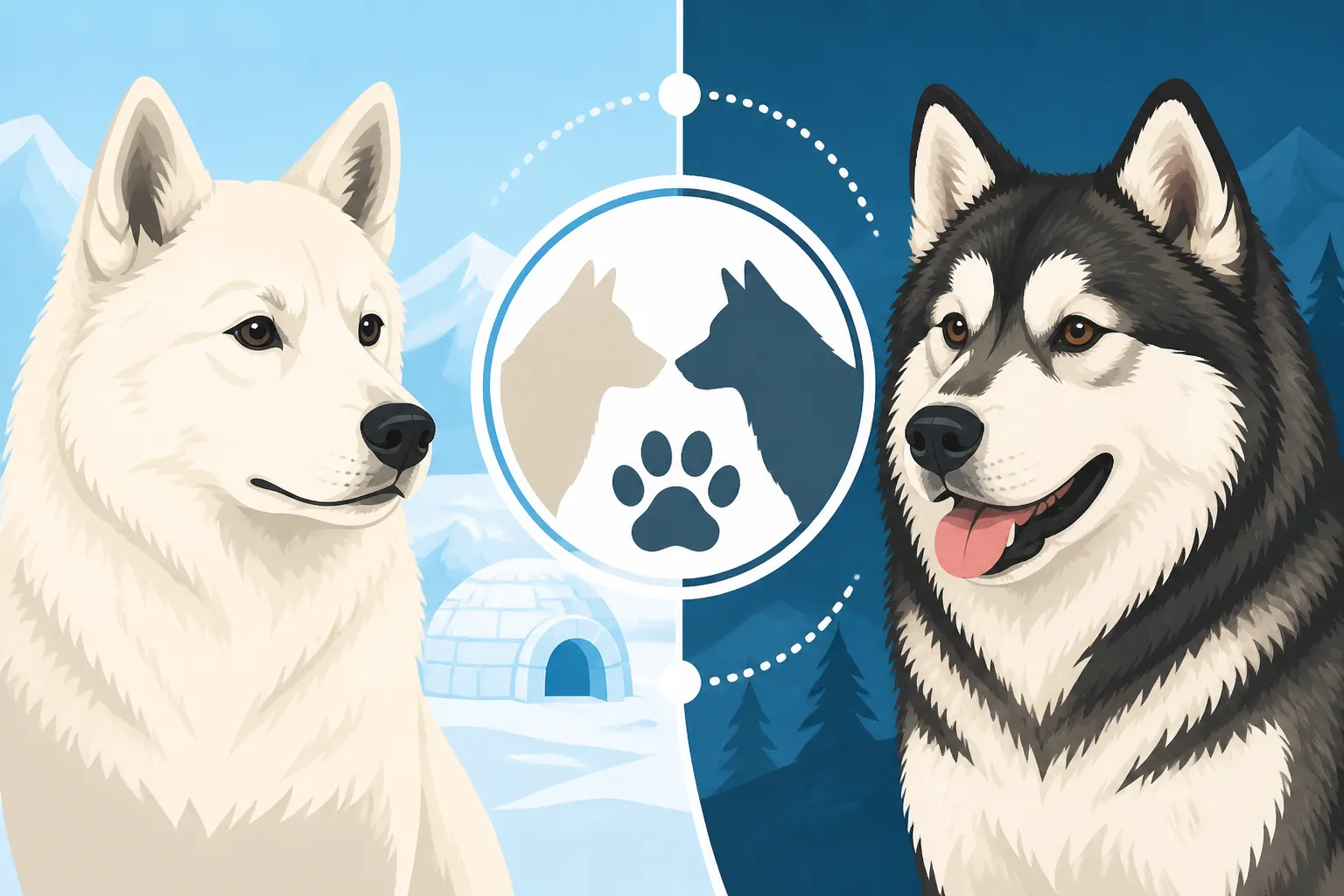
Whether a Canadian Eskimo Dog Is Related to the Malamute
It is easy to see a Canadian Eskimo Dog and an Alaskan Malamute and assume they are versions of the same northern breed: both are powerful, thick-coated dogs with a history of pulling loads in Arctic conditions. They are related in the broad sense of sharing northern working-dog ancestry, but they are distinct breeds with different histories, communities and development.
Are Canadian Eskimo Dogs and Alaskan Malamutes related
They share northern working-dog ancestry
The Canadian Eskimo Dog and Alaskan Malamute belong to the broader family of northern spitz-type dogs. Both have physical traits that helped dogs work in harsh climates: a dense coat, sturdy build, strong feet and the ability to pull. Those shared traits can make the breeds look strikingly alike, especially to someone who has mainly seen them in photographs.
That resemblance does not mean one breed is simply a variety of the other. Across generations, Arctic dogs were shaped by the work expected of them and the communities that raised them. Similar demands—travel, hauling and coping with cold—can favor similar features, even in populations with separate histories.
It is reasonable to describe the breeds as distant relatives within a wider northern-dog ancestry. It is not accurate to treat “related” as proof that the Canadian Eskimo Dog descended directly from the Alaskan Malamute, or that the Malamute is merely a Canadian Eskimo Dog from farther west. The available breed histories identify them as distinct.
Similarity is not proof of direct descent
The most useful distinction is between a shared ancestral background and a direct parent-to-descendant line. Northern dogs and people moved across Arctic regions over long periods, and dog populations could exchange genes or share older ancestors. That broad history makes connections plausible, but it does not establish a simple family tree in which one modern breed came from the other.
A modern breed name also refers to a population shaped over time, not to a single unchanged group of dogs from antiquity. Historical dogs were not always classified or recorded using today’s breed categories. For that reason, claims that one present-day breed is the original source of another should be treated cautiously unless supported by clear historical or genetic evidence.
The Malamute’s history is strongly associated with the Mahlemut people of the Kotzebue Sound region in Alaska. The Canadian Eskimo Dog’s history is associated with Inuit communities in the Canadian Arctic. These communities and their dogs have distinct histories, even though both belong to the larger human and canine story of the North. For background on the Malamute’s origins, see The Mahlemut of Kotzebue Sound Bred the Alaskan Malamute and Where the Malamute's Kotzebue Sound Is.
How their histories developed in different regions
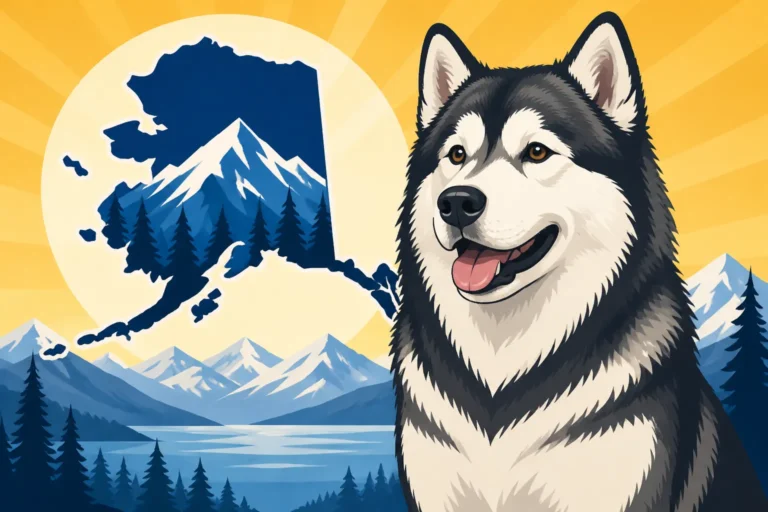
The Alaskan Malamute developed in western Alaska
The Alaskan Malamute is associated with the Mahlemut, an Iñupiat people whose traditional homeland includes the Kotzebue Sound area of northwestern Alaska. The dogs were valued as strong working companions, including for hauling freight. Their development reflected local needs, conditions and the knowledge of the people who depended on them.
That background is not interchangeable with the history of Inuit dog populations in Canada. The names may sound similar because both stories belong to the Arctic, but “Arctic dog” is a broad description, not a single breed identity. The Malamute’s connection to the Mahlemut is one important part of its particular history. Who the Mahlemut Who Bred the Malamute Were explores that connection in more detail.
Malamutes were not developed as sprint racers. Their reputation is tied to strength and freight work rather than speed over short distances. That distinction helps explain why the breed is often described as substantial and powerful, and why its working history is different from that of many racing sled dogs. Freight, Not Speed: What Separates a Malamute From a Racing Dog looks more closely at that role.
The Canadian Eskimo Dog developed in the Canadian Arctic
The Canadian Eskimo Dog—also called the Canadian Inuit Dog—has a separate history rooted in Inuit communities in Canada’s Arctic. It was used as a working dog in demanding northern conditions, including for pulling and travel. Its history is connected to the people and regions where these dogs worked, rather than to the Mahlemut homeland in Alaska.
The word qimmiq is often used in connection with Inuit dogs, but Inuit languages and naming practices vary by region. It is best not to assume that one term describes every community’s dogs in exactly the same way, or that a historical local name is automatically equivalent to a modern breed label.
The breed’s history has also faced serious challenges. Changes in transportation, settlement and working life affected the need for traditional sled dogs, and the Canadian Eskimo Dog became rare. That history is an important reason to discuss the breed as a distinct cultural and working heritage—not simply as a close lookalike of the Malamute.
What the breeds have in common and how they differ
Shared traits reflect similar work
Both breeds can be strong, independent and well insulated against cold. Both have a working-dog background, and both may be most comfortable when their physical and mental needs are taken seriously. A thick coat and a broad, powerful appearance are clues to northern adaptation, but they do not tell the whole story of ancestry.
Their similarities are practical as well as visual. Dogs that pull loads in difficult terrain need sound bodies, stamina and cooperation with people. Different populations can develop comparable features when they face comparable tasks. This is one reason northern breeds can seem closely related even when their histories are distinct.
| Feature | Alaskan Malamute | Canadian Eskimo Dog |
|---|---|---|
| Historical region | Northwestern Alaska, including the Kotzebue Sound area | Canadian Arctic |
| Cultural association | Mahlemut people, an Iñupiat people | Inuit communities in Canada |
| Traditional role | Freight hauling and other demanding work | Sled work and travel in Arctic conditions |
| Breed identity | Distinct recognized breed | Distinct breed, also called the Canadian Inuit Dog |
| What the similarity means | Shared broad northern working-dog heritage is plausible | Similar traits do not prove direct descent from the Malamute |
The table is a broad comparison, not a substitute for an individual dog’s pedigree or a detailed regional history. Working roles and appearances can vary, and a dog’s ancestry cannot be reliably determined from coat or body shape alone.
Their differences are more than a map location
It can be tempting to describe the distinction as “Alaska versus Canada,” but geography is only part of it. Each breed’s history developed through different communities, local environments and working traditions. Those differences matter because dogs were not shaped by climate alone; people selected and valued dogs according to the work and relationships that mattered in their own setting.
The Malamute’s history is commonly discussed through the Kotzebue and M’Loot lines that contributed to the modern breed. That history is specific to the development of the Alaskan Malamute and should not be applied to the Canadian Eskimo Dog. The Kotzebue and M'Loot Lines Behind Every Modern Malamute explains those Malamute lineages.
The breeds also should not be confused with every other northern dog. The Siberian Husky, Greenland Dog and other Arctic working dogs have their own histories and identities. Broad ancestry can overlap without making the breeds interchangeable. For another useful comparison, The Alaskan Malamute Against the Siberian Husky explains why two familiar sled-dog breeds are not the same.
How to interpret claims about their relationship
Be cautious with simple family-tree claims
If you see a statement that the Canadian Eskimo Dog “came from” the Alaskan Malamute, ask what the claim means. Does it refer to shared ancient northern ancestry, possible historical gene flow, or direct descent from a defined Malamute population? Those are very different claims, and a short social-media caption may blur them together.
The same caution applies to claims that the breeds are unrelated. In ordinary conversation, “related” can mean anything from belonging to the same broad type of dog to sharing a fairly recent ancestor. In this case, the most careful answer is that the breeds share a broader northern working-dog context, while remaining distinct breeds with separate regional and cultural histories.
Breed histories are also shaped by how records were kept. Older dogs were not always registered or described using modern standards, so it may be difficult to map every historical population neatly onto today’s breeds. That uncertainty is not a reason to invent a direct connection; it is a reason to state what is known at the right level of detail.
Appearance and DNA need careful interpretation
A Malamute-like face or thick coat cannot establish that a dog is a Canadian Eskimo Dog, a Malamute, or a cross between them. Many northern breeds share features because those features suited cold-weather work. Even an experienced observer should be cautious about identifying ancestry from appearance alone, particularly when the dog’s history is unknown.
DNA testing can offer clues about a dog’s ancestry, but results depend on the reference populations and methods used by the testing service. A test result should not be treated as a complete historical account of a breed or as proof that one modern breed descended directly from another. For a registered purebred dog, documented pedigree and appropriate breed records are more relevant than visual guesses.
If you are considering adopting or buying a dog described as a Canadian Eskimo Dog, ask for its documented background and be prepared for uncertainty, especially with a rescue or mixed-breed dog. For a Malamute, learning how modern breed lines developed can help put a pedigree in context; Whether Every Malamute Traces to Kotzebue or M'Loot addresses that question. Either way, focus on the individual dog’s health, temperament and care needs rather than relying on a label alone.
The clearest answer
A Canadian Eskimo Dog is not an Alaskan Malamute, and the Malamute is not simply another name for the Canadian breed. They are distinct northern working breeds with different regional and cultural histories. Their resemblance and broad Arctic working-dog background support describing them as related in a general sense, but not as direct descendants of one another.
That distinction lets both breeds be understood on their own terms. The Malamute’s story belongs to its Alaskan roots and the Mahlemut people; the Canadian Eskimo Dog’s story belongs to Inuit communities in the Canadian Arctic. Shared northern ancestry is part of the picture, but it does not erase the separate histories that made each breed what it is.
Disclaimer
This article is for general informational purposes only and does not constitute professional advice. Laws, prices and regulations vary by location and change over time. Consult a qualified professional for guidance on your specific situation.