Whether Amundsen Used Malamutes or Greenland Dogs
Amundsen’s South Pole expedition is sometimes linked to Alaskan Malamutes because both dogs are powerful Arctic sled dogs. But the dogs he relied on were Greenland dogs, not Malamutes. That distinction matters when tracing the history of the breed: Amundsen’s journey shows how several different northern dog populations worked in polar travel, not that Malamutes pulled his sleds to the Pole.
Amundsen used Greenland dogs, not Alaskan Malamutes
The dogs on the South Pole expedition
Roald Amundsen’s expedition reached the South Pole on December 14, 1911. Its sled dogs were Greenland dogs, brought south for the journey aboard the Fram. Historical accounts commonly describe the team as numbering about 97 dogs at the start of the Antarctic expedition.
The dogs were not simply companions travelling alongside the explorers. They provided the main power for hauling sledges across difficult terrain and helped make Amundsen’s plan practical. A dog team could move supplies over snow and ice without relying on horses or people to pull every load. That mattered in Antarctica, where weather, distance and the weight of provisions made efficient travel essential.
Amundsen’s strategy depended on the dogs as working animals, and the expedition’s plans included using some dogs as food for the remaining dogs and for the men. This was a harsh feature of the expedition’s logistics, not a sign that the dogs were disposable or unimportant. The team’s survival and progress were closely tied to managing the dogs, their food and their workload.
Why people sometimes call them Malamutes
The confusion is understandable. Greenland dogs and Alaskan Malamutes are both northern sled dogs with thick coats, sturdy builds and a long history of work in cold environments. In a general account, someone may use “Malamute” loosely to mean a large, powerful sled dog, even when the historical animal belonged to another population.
But a broad resemblance is not a reliable breed identification. Arctic working dogs developed across different regions and communities, and they did not all share the same name, ancestry or working history. The Greenland dogs on Amundsen’s expedition came from Greenland; the Alaskan Malamute is associated with the Mahlemut people of Alaska. Those histories should not be collapsed into one simply because both dogs could pull a load.
For a wider look at the role of working dogs in Arctic life, see What the Mahlemut Used Their Malamutes For and How Long Malamute Type Dogs Have Been in Alaska. Those histories provide useful context, but they do not change the answer about Amundsen’s team: his polar dogs were Greenland dogs.
How Greenland dogs and Malamutes differ in the historical record
Place and community are part of the identification
A dog’s appearance alone rarely tells the whole story. “Greenland dog” identifies a northern working-dog population associated with Greenland, while “Alaskan Malamute” refers to a breed with a distinct history in Alaska. When reading expedition accounts, the location where dogs were obtained and the terminology used by the people involved are often more useful than a modern guess based on photographs.
The name Malamute is connected to the Mahlemut, an Inuit people of the Kotzebue Sound region in Alaska. Their dogs were valued for practical work, including hauling freight and supporting life in a demanding environment. Greenland dogs likewise have a history as working sled dogs, but in Greenland and among the communities who developed and used them.
The distinction is similar to recognizing that two breeds can share a job without being the same breed. A freight dog in Alaska and a sled dog from Greenland may both be strong, cold-adapted and capable of hauling supplies. Their shared function does not make them interchangeable in historical records. For more on the Alaskan side of this story, The Mahlemut of Kotzebue Sound Bred the Alaskan Malamute explains the community and place behind the breed’s name.
Similar working traits do not prove shared identity
Both types of dog were suited to demanding work, but “sled dog” describes a role rather than a single breed. Across the Arctic, people relied on dogs that could travel in severe conditions, pull loads, find a steady pace and work with human handlers. Different communities shaped dogs for their own environments and needs.
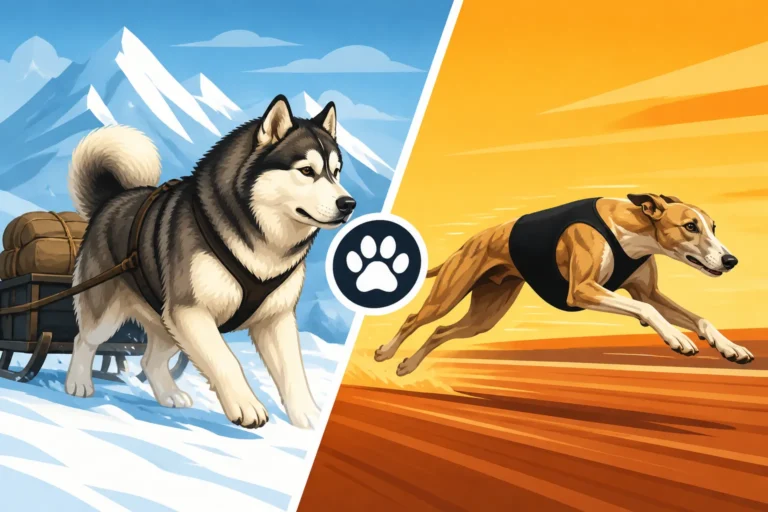
Malamutes are especially associated with freight work: moving substantial loads over distance rather than racing at top speed. Greenland dogs also served as powerful transport dogs in polar conditions. That broad overlap can make the names seem interchangeable in casual retellings, particularly when a writer is describing a dog team without identifying its origin.
A useful distinction is to ask three questions: where did the dogs come from, what name did the expedition use for them, and what work were they trained to do? The first two help identify the animals; the third explains their role. For more context on the breed’s freight heritage, see Freight, Not Speed: What Separates a Malamute From a Racing Dog and Why a Malamute Pulls Slowly Rather Than Fast.
| Question | Amundsen’s South Pole team | Alaskan Malamute |
|---|---|---|
| What were the dogs called? | Greenland dogs | Alaskan Malamutes |
| What is the historical association? | Greenland and polar sled travel | The Mahlemut people and Alaska |
| What work did they do? | Hauled sledges and supported the expedition’s travel plan | Traditionally hauled freight and performed other practical work |
| Were Amundsen’s dogs Malamutes? | No | No; the names refer to different histories |
What the dogs did on Amundsen’s expedition
Sled hauling was central to the plan
The South Pole was far from the expedition’s coastal base, and the team needed to move food, equipment and other supplies across snow and ice. Dogs made it possible to transport loads with a travelling party that could keep moving. The expedition had to think carefully about how much the dogs could pull, how far they could travel and how much food had to be carried for them.
This was not just a matter of attaching dogs to a sledge and setting off. The animals needed to be organized into teams, cared for in punishing conditions and managed as the route unfolded. The people planning the journey had to account for depots, changing conditions and the practical limits of both dogs and humans. The dogs’ contribution was therefore built into the expedition’s logistics from the beginning.
Malamutes have their own freight history, which helps explain why the comparison comes up so often. A heavy, steady dog hauling supplies is an image many people associate with the breed. For more on that work, How Much Weight a Malamute Freight Team Hauled looks at the kind of loads linked to Malamute teams. It is useful background, but it should not be mistaken for a description of Amundsen’s particular dogs.
The expedition’s use of dogs involved difficult choices
Amundsen’s team planned to use dogs not only for pulling but also as a food resource. As the expedition progressed, some dogs were killed, and their meat helped feed the surviving dogs and expedition members. This practice is often startling to modern readers, especially those accustomed to thinking of dogs primarily as household pets.
In the context of the expedition, food was a serious logistical constraint. Every animal that travelled required provisions, and carrying all the food needed for a large team over a long route would have added considerable weight. The expedition’s approach reflected the severe conditions and the strategy its leaders chose. It is possible to recognize the dogs’ essential contribution while also acknowledging the hard reality of how the team managed food and survival.
That history also helps distinguish a working-dog expedition from a modern recreational sled-dog outing. Amundsen’s journey was an attempt to cross an extreme environment and reach a specific geographic goal. The animals were part of a carefully planned transport system, and their care and use were bound up with the expedition’s chances of success.
How to describe Amundsen’s dogs accurately
Use the name supported by the expedition’s history
When writing or talking about the South Pole journey, the clearest wording is: “Amundsen used Greenland dogs.” If you want to make the contrast explicit, say that they were Greenland dogs, not Alaskan Malamutes. This avoids turning a familiar breed name into a catch-all label for every large Arctic working dog.
It is also reasonable to use a broader phrase such as “sled dogs” when the exact type is not central to the sentence. For example, “Amundsen’s sled dogs hauled supplies across Antarctica” describes their function without making a breed claim. The trouble starts when the general term is replaced with “Malamutes” as if the historical identity were settled by the dogs’ size or appearance.
This care with naming is useful beyond the Amundsen story. Historical accounts may use terms that do not map neatly onto modern breed categories, and photographs may not provide enough detail to identify a dog. Where the record names a particular population, retaining that name is usually more accurate than assigning a breed based on resemblance.
Keep the broader sled-dog story in view
Correcting the label does not make the Alaskan Malamute’s history less impressive. It simply gives each dog population its own place in the story. Greenland dogs were part of Amundsen’s polar expedition; Malamutes have their own deep connection to Alaska and freight work. These histories overlap in the broader world of northern transport but are not the same account.
That broader picture also helps readers understand why polar history is often simplified. A familiar breed name is easy to remember, and “Malamute” can become shorthand for a powerful sled dog in popular retellings. But a useful breed history depends on distinguishing dogs by origin and documented use, rather than treating every Arctic working dog as one type.
For related expedition background, see Which Expeditions Used Alaskan Malamutes and Whether the Iditarod Uses Malamutes. These topics help place Malamutes within the larger history of northern travel and sled-dog work. They should be read alongside, not substituted for, the specific account of Amundsen’s Greenland dogs.
Disclaimer
This article is for general informational purposes only and does not constitute professional advice. Laws, prices and regulations vary by location and change over time. Consult a qualified professional for guidance on your specific situation.