What a Malamute’s Bar Marking Looks Like
A Malamute’s bar marking can look like a dark stripe running down the middle of the face, but it is easy to confuse with a blaze, mask, or changing puppy coat. This guide explains where the bar appears, how it relates to other facial markings, what natural variation to expect, and how to tell appearance from a health concern.
What a Malamute’s bar marking looks like
The basic shape and position
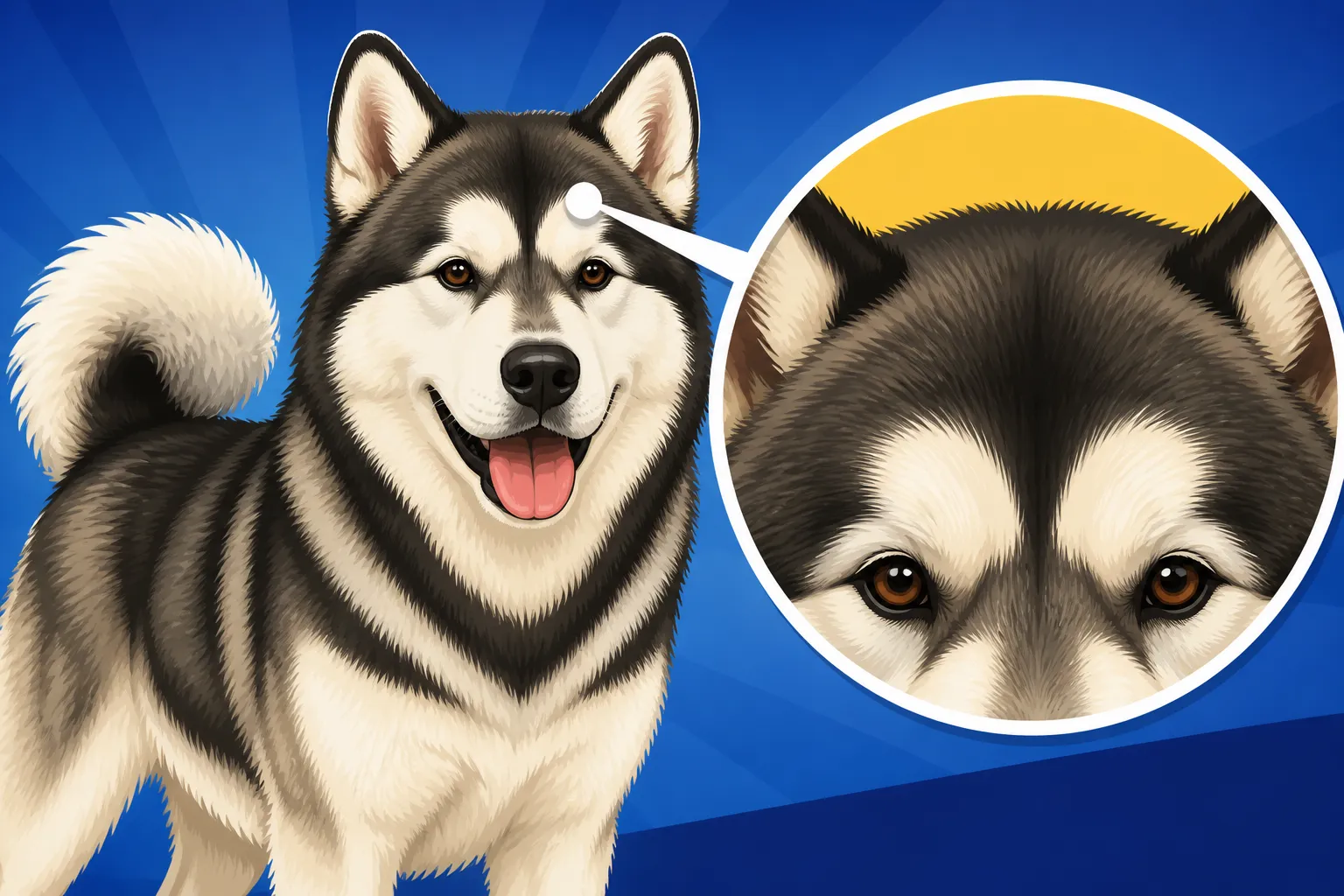
A bar is a dark marking that extends down the center of a Malamute’s face from the darker cap on the head. Depending on the dog, it may look like a narrow stripe between the eyes, a broader band across the forehead, or a marking that continues farther toward the muzzle. The edges do not have to look perfectly straight or symmetrical.
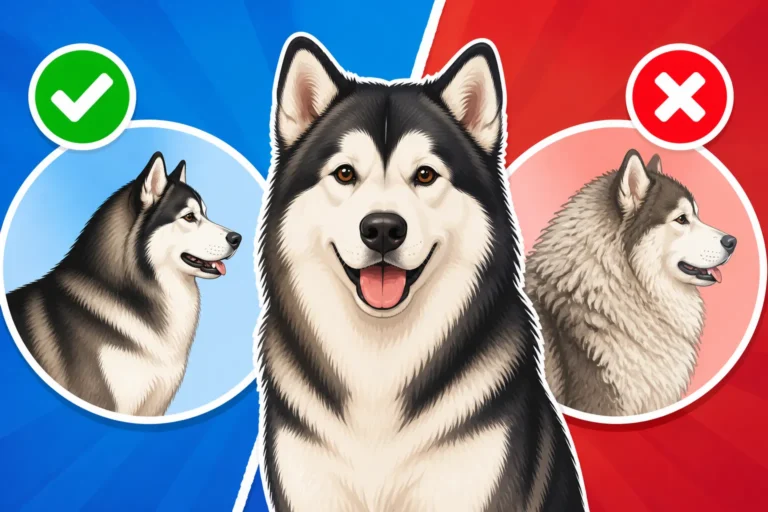
The contrast is often easiest to see when the dog has a light face and a darker cap. On a red-and-white Malamute, for example, the darker marking may blend into warm reddish-brown fur. On a black-and-white dog, the boundary can appear sharper. Coat color and lighting affect how prominent a bar seems, so two dogs with similar markings may look quite different in photographs.
A bar is not a separate coat texture, raised ridge, or stripe of skin. It is simply a pattern of fur color. If you part the coat, you should see normal skin beneath it. That distinction matters: a dark patch of fur is a marking, while crusting, swelling, a sore, or a sudden area of hair loss is a skin change worth discussing with a veterinarian.
Bar, cap, blaze, and mask
Malamute faces can combine several markings, which is why descriptions sometimes sound confusing. The cap is the darker area over the top of the head. A bar is a darker area that extends down from the cap along the face. A blaze is generally a lighter stripe or patch running down the center of the forehead. A mask refers to darker shading around the eyes and across parts of the face.
These patterns can overlap. A dog might have a cap and bar, a cap and blaze, or a face that appears mostly white beneath the cap. A bar may be narrow and crisp on one Malamute but broad or somewhat uneven on another. The word describes the general pattern, not a single exact design that every dog must reproduce.
| Marking | Typical appearance | What to look for |
|---|---|---|
| Cap | Darker fur over the top of the head | The color covers much of the crown |
| Bar | Darker marking extending from the cap down the center of the face | A stripe or band appears between the eyes or farther down the face |
| Blaze | Lighter marking on the forehead, often between darker areas | A pale stripe or patch contrasts with surrounding fur |
| Mask | Darker shading around the eyes or across more of the face | The dark area is broader than a simple central bar |
For a broader look at how these patterns fit into the breed’s coat, see What a Malamute's Cap and Bar Markings Are and The Colors an Alaskan Malamute Comes In. Those descriptions can help when a dog’s pattern seems to sit somewhere between two terms.
Why bars do not all look alike
A bar does not need to be a narrow, perfectly centered line. It can widen near the forehead, fade as it approaches the muzzle, or blend gradually into the cap. Fur length and density also soften its outline. After a coat blow, when loose undercoat has been shed, the face may look subtly different simply because the coat lies in a new way.
Photos can exaggerate or hide the pattern. Bright sunlight may make lighter fur look almost white and deepen the contrast with darker fur. Indoor lighting can make red or gray shades appear muted. A dog looking slightly to one side may also make a centered marking look off-center.
When describing a particular Malamute, it is usually more useful to say what you can see—such as “a dark stripe between the eyes”—than to insist that a marking fits one exact label. Breed-standard terminology gives people a shared vocabulary, but everyday dogs can have subtle or mixed patterns.
How bar markings relate to coat color and breed appearance
Markings are part of a larger coat pattern
The bar is only one small part of a Malamute’s overall appearance. The breed has a dense double coat, and its colors and markings vary. A bar may be easy to pick out on a high-contrast face but almost disappear where the cap and facial fur are similar shades.
It is also normal for the face to have more than one visible feature. A Malamute can have a cap, a bar, lighter areas around the muzzle, and shading around the eyes all at once. To understand the full pattern, look at the dog’s face from several angles and in ordinary daylight rather than judging it from one close-up photograph.
The breed’s accepted appearance includes variation in color and facial markings. A bar’s size or sharpness, by itself, does not tell you whether a dog is healthy, well cared for, or a particular type of Malamute. For more on the range of appearance, Which Colors the Alaskan Malamute Standard Allows is a useful related read.
A bar is not the same as a full mask
A bar is typically a central marking. A full mask is a broader facial pattern, with dark shading covering more area around the eyes and face. Some dogs have features that appear between these descriptions, especially when the dark markings fade gradually into lighter fur.
This distinction is about pattern, not temperament or behavior. A darker face does not mean a dog is more protective, more wolf-like, or more difficult to train. Those assumptions are common when people see a striking mask, but facial pigmentation does not reveal personality.
If you are comparing a Malamute’s face with examples online, remember that photos may be edited, heavily filtered, or taken in different light. The best comparison is the natural coat in consistent lighting. You can also explore Whether a Malamute Can Have a Full Mask to see how a broader mask differs from a central bar.
Face markings and puppy coat changes
A puppy’s face may not look exactly the same as it does after the adult coat comes in. As the coat grows and sheds, dark and light areas can become more or less distinct. The underlying pattern may remain recognizable while its edges soften, its contrast shifts, or the overall face looks fuller.
This can surprise new owners. A puppy with a very clear stripe may appear to have a softer, less defined bar later. Another puppy’s marking may seem more noticeable after a coat change because the surrounding fur has lightened or the coat has settled differently. That does not automatically mean the pattern has truly changed in a dramatic way; often the coat’s development and lighting are doing most of the work.
If you are assessing a puppy, avoid treating one early photograph as a guaranteed preview of its mature face. Whether a Malamute's Face Markings Change With Age and Whether a Malamute Puppy's Color Changes cover those shifts in more detail.
How to identify a bar without mistaking it for a problem
Check the fur, not just the color in a photo
Look at the marking in daylight and from more than one angle. Notice whether the darker area follows the fur pattern from the cap down the face, and whether the skin beneath looks ordinary. A bar should appear as colored hair, not as a change in the skin’s surface.
Parting the fur gently can help you distinguish normal coat color from a scab or irritated patch. Do not repeatedly rub or scrape the area to test it. If the skin seems sore, smells unusual, is swollen, or the dog reacts as though it hurts, focus on the skin issue rather than trying to classify the marking.
A useful routine is to check the muzzle, eye rims, ears, and paws during regular grooming. This is especially helpful in a thick-coated dog, where fur can hide early skin changes. If you need a brush or comb for routine coat care, Chewy is one place owners may look for general grooming supplies; choose tools appropriate for a double coat and use them gently around the face.
Watch for changes that deserve attention
A bar that has been present for a long time and consists of normal-looking fur is usually just a marking. A sudden change in the skin, a new crust, persistent redness, or hair loss is different. Those signs can have many causes, so it is not possible to diagnose the issue by looking at a photograph or assigning a coat-pattern name.
Facial crusting deserves particular care in this breed. Crusts around the muzzle or eyes may be related to skin disease, infection, irritation, or another condition; they should not automatically be dismissed as part of the dog’s coloring. A veterinarian can examine the skin and decide whether testing or treatment is needed. For related reading, see Whether a Malamute's Crusty Skin Means Zinc Deficiency.
If you are gathering details before an appointment, take clear photos in natural light and note when you first saw the change. Avoid applying human creams or supplements unless your veterinarian recommends them. Chewy may carry general pet-care items, but a shopping choice cannot determine whether a changing skin patch needs medical attention. If the dog is uncomfortable or the area is worsening, contact your veterinary clinic.
Keeping the facial coat comfortable
The face usually needs less intensive grooming than the body, but loose fur can still collect around the cheeks and neck. Use a gentle brush, work slowly, and avoid pulling at the whiskers or brushing directly across the eyes. If a dog dislikes face handling, short, calm sessions are more useful than trying to finish a full grooming routine at once.
For owners who order grooming basics from Chewy, the key is not a particular product claim but choosing a tool suited to the coat and introducing it gradually. Keep the bar visible as a natural color pattern; do not trim or dye fur to make the marking look more defined. Shaving or clipping the face is unnecessary for showing the pattern and can cause avoidable irritation.
If loose hair, mats, or discomfort make home grooming difficult, a groomer familiar with double-coated breeds can help. Ask them to avoid shaving the coat and to tell you if they notice skin irritation. Chewy can be convenient for replenishing ordinary grooming supplies, but hands-on advice from a veterinarian or experienced groomer is more appropriate when the concern is skin health rather than appearance.
Common questions about a Malamute’s bar
Does every Alaskan Malamute have a bar?
No. Malamutes can have different facial patterns, and not every dog shows a clearly defined central bar. Some have a cap with a mostly light face, some have more extensive shading, and some have markings that are faint or difficult to separate from the surrounding coat.
That variation does not make a dog less of a Malamute. A bar is one possible facial marking, not a health test or a stand-alone way to confirm a dog’s breed. Pedigree information and appropriate breed documentation are more relevant for that question.
Does a dark bar mean a dog is mixed with another breed?
Not by itself. A central facial marking is a coat pattern, and appearance alone cannot establish ancestry. People sometimes mistake a strong bar or mask for a sign of a wolf-like cross, but many purebred Malamutes have distinctive facial markings. Eye color and other features should not be used as a shortcut to determine ancestry either.
If you are evaluating a dog’s background, ask for reliable records rather than relying on a single visual feature. A facial pattern can be interesting and distinctive without telling you the whole story.
Can a bar fade or look different over time?
It can look different as a puppy’s coat develops, as the adult coat comes in, or as seasonal shedding changes how the fur lies. Lighting, camera settings, and wet or flattened fur can also affect the apparent contrast. A change in how the bar looks in a photograph is not necessarily a change in the dog’s actual pattern.
A sudden alteration in the skin or coat is another matter. If the area becomes bald, crusted, inflamed, or uncomfortable, have it checked rather than assuming the bar is changing. For a separate but sometimes confusing facial color change, Whether a Malamute's Nose Can Be Snow Nose explains why nose pigmentation can vary.
Is a bar marking linked to health or personality?
A bar is a color pattern and does not, on its own, predict health, temperament, intelligence, or working ability. A confident, outgoing Malamute and a quieter one can have similar facial markings. Likewise, the width or darkness of a bar does not indicate whether a dog is a good fit for a household.
When choosing or caring for a Malamute, prioritize health history, responsible breeding or rescue information, the dog’s individual behavior, and a realistic understanding of the breed’s needs. Facial markings can make each dog recognizable, but they are only one small part of the animal in front of you.
Disclaimer
This article is for general informational purposes only and does not constitute professional advice. Laws, prices and regulations vary by location and change over time. Consult a qualified professional for guidance on your specific situation.