How Much a Female Alaskan Malamute Weighs
A female Alaskan Malamute can look much heavier than she is because her thick double coat hides her outline—and a scale cannot tell you whether that weight is healthy. The breed’s usual adult reference is about 75 pounds, but frame, age, muscle, and body condition all matter. This guide explains what to expect and how to assess your dog beyond the number.
How much should a female Alaskan Malamute weigh?
The breed standard’s reference weight
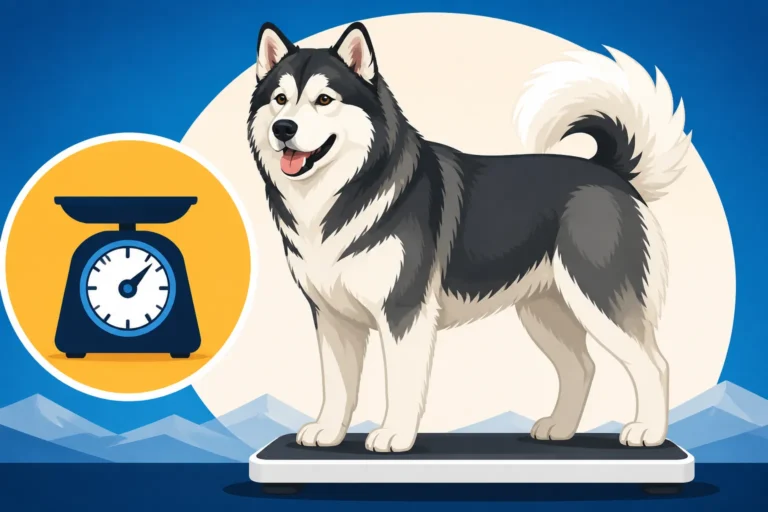
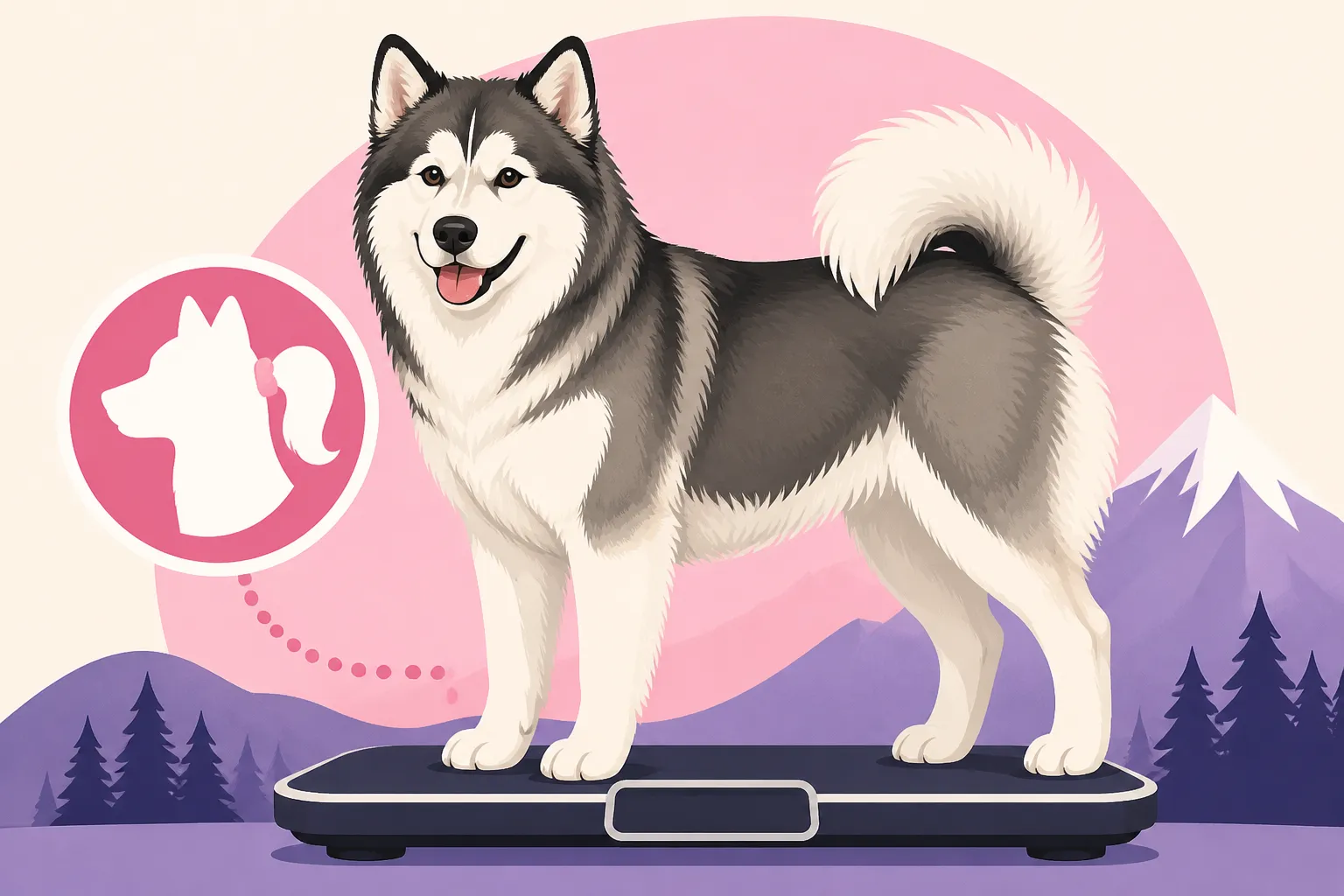
The familiar reference for an adult female Alaskan Malamute is about 75 pounds, with an ideal height of roughly 23 inches at the shoulder. These figures describe a desirable working size, not a strict limit every dog must meet. A healthy female may be somewhat lighter or heavier because individual dogs differ in frame, muscle, and overall build.
That distinction matters. Two females can weigh the same and look quite different: one may be compact and muscular, while another may be taller and more lightly built. Weight alone cannot show whether a dog has too much body fat or simply a larger frame. For background on the breed’s build and the numbers often used as reference points, see What an Alaskan Malamute Actually Weighs.
| What you’re assessing | Useful reference | How to interpret it |
|---|---|---|
| Adult female weight | About 75 pounds is a common breed-standard reference | A guideline, not a mandatory target for every dog |
| Adult female height | Roughly 23 inches at the shoulder | Measure at the shoulder, not to the top of the head |
| Individual healthy weight | Varies with frame, muscle, and body condition | Ask your veterinarian to help establish your dog’s own target |
| Weight trend | More informative when measured consistently over time | Look for a gradual, unexplained change rather than reacting to one reading |
The breed standard is useful for understanding the general type, but it is not a prescription for feeding or a verdict on health. Your veterinarian can assess your dog’s body condition and history and help set a practical target weight. For a closer look at this benchmark, What an Adult Female Alaskan Malamute Weighs addresses the female-specific reference.
Why healthy females may not match the reference exactly
A female with a broad chest, substantial bone, and well-developed working muscle may weigh more than a smaller-framed female without being overweight. Conversely, a dog that weighs close to the reference can still carry excess fat if she has little muscle or a softer body shape. Breed, sex, and scale readings are only part of the picture.
Malamutes’ heavy coats make visual judgment especially tricky. A dog can appear wide and plush even when her body condition is appropriate; another may look neat after shedding while still carrying extra weight. That is why it helps to use your hands as well as your eyes. Whether a Female Malamute Is Much Smaller can also help put differences between male and female size into perspective without treating either sex’s typical weight as a rule.
If you are comparing your dog with an online chart or another Malamute at the park, remember that the comparison may be misleading. The other dog could be younger, taller, more muscular, or carrying excess weight. Focus on your dog’s body condition, comfort, and weight trend rather than trying to make her match someone else’s number.
How to tell whether her weight is healthy
Check body shape and feel for her ribs
A hands-on check is more useful than trying to see a Malamute’s waist through a full coat. With your dog standing comfortably, run your fingers gently along her rib cage. You should generally be able to feel the ribs without pressing hard, though they should not feel sharply prominent. A layer of fat can make ribs difficult to locate, while very visible ribs may be a reason to ask your veterinarian whether she is underweight or unwell.
Look from above and from the side, too. From above, a healthy dog often has some visible narrowing behind the ribs rather than a straight, broad outline from chest to hips. From the side, the belly should usually tuck up somewhat behind the rib cage. A thick coat can blur these features, so use the same gentle touch each time you check. For a more detailed hands-on guide, see Feeling for Ribs Under an Alaskan Malamute's Coat.
Body-condition scoring is often used to describe these observations. It considers how easy it is to feel the ribs, whether there is a waist, and whether the abdomen has a tuck. It is not a substitute for a veterinary exam, but it gives you a consistent way to notice changes. If you are unsure whether you are feeling bone, muscle, or a fat layer, ask your veterinarian to demonstrate during an appointment.
Watch for changes beneath the coat
A Malamute’s coat can hide gradual weight gain, especially around the ribs and waist. You may notice that a harness fits differently, your dog is slower to rise, or a familiar walk seems more tiring. Those signs do not prove that weight is the cause, but they are useful reasons to check her condition and discuss any changes with a veterinarian.
Photographs can help you compare her shape over time. Take them from above and from the side in similar lighting and with her standing naturally. Pair the pictures with a written weight log, rather than relying on memory. If you buy food or care supplies through Chewy, an order history may help you remember when you changed foods or package sizes; it does not replace measuring the amount you actually serve.
If your dog’s outline is hard to assess, or you are not sure whether she is carrying extra weight, How to Spot a Heavy Malamute Under Its Coat offers more pointers. A sudden change in weight, a persistent appetite change, or weight loss without an obvious reason deserves a conversation with your veterinarian rather than a home diet adjustment.
How age, activity, and feeding affect weight
Puppies and adolescents grow on their own schedule
A female Malamute puppy should not be pushed to reach adult weight quickly. Growth happens over many months, and puppies of the same age can differ in size while developing normally. A healthy growth pattern is more important than trying to match a chart or a relative’s puppy.
Keep track of growth at routine veterinary visits, and ask whether her body condition is appropriate for her age. Avoid adding extra food or supplements simply because she looks smaller than another puppy. Feeding instructions on a food package can be a starting point, but the right amount depends on the individual puppy, the food’s calorie content, and her growth and activity. For a focused discussion of this stage, see Whether a Malamute Puppy Should Grow Slowly.
As she matures, her needs may shift. Growth slows, daily activity changes, and later, surgery or a change in routine may affect how much energy she uses. Rather than making a large change based on one weigh-in, measure her food consistently and review her weight and body condition with your veterinarian.
Food and activity should match the dog in front of you
A Malamute that regularly pulls, hikes, or does other sustained work may use more energy than a companion dog with a quieter routine. But even an active dog’s needs vary with workload, weather, age, and recovery time. A few energetic outings do not necessarily mean she needs a dramatic increase in food, just as a less active week does not automatically require a major cut.
Measure meals instead of estimating by eye, and count treats and training rewards as part of what she eats. If you change foods, compare the feeding directions on the specific package rather than assuming the same scoop contains the same calories. Chewy’s product listings may help you review package details when comparing foods, but your veterinarian is the better person to advise whether a particular diet suits your dog’s health needs.
Keep a simple record of food portions, treats, exercise, and weight. If you notice a steady upward trend, review the record before making changes: perhaps portions have crept up, treats have become more frequent, or activity has dropped. If she is losing weight despite eating normally, or gaining weight despite carefully measured portions, ask your veterinarian about possible medical or dietary explanations. Keeping an Alaskan Malamute at a Working Weight offers further context on maintaining condition in a dog whose workload may vary.
Weighing her and deciding what to do next
Get a reliable measurement
For a large dog, a veterinary clinic’s scale is often the simplest way to get a dependable reading. Ask whether you can weigh her during a visit or arrange a brief weight check. If you use a home scale, make the routine as consistent as possible: use the same scale, weigh at a similar time of day, and record the date alongside the result.
Some people weigh themselves, then weigh themselves while holding the dog and subtract the two readings. This may work for a dog small enough to lift safely, but it is awkward and unreliable for many adult Malamutes. Do not strain your back or risk dropping your dog just to get a number. If she is uncomfortable stepping onto a scale, make a plan with your veterinary team to weigh her calmly.
A single reading can be affected by timing, recent meals, or differences between scales. Look at the trend across repeated measurements instead. If a change seems unexpected, confirm it on the same scale before drawing conclusions. A food scale can help measure portions accurately, and Chewy may be one place to look for feeding and measurement supplies, but the key is using a consistent method.
Set a goal with your veterinarian
If your female is above or below the breed-standard reference, that fact alone does not mean she needs to gain or lose weight. Ask your veterinarian to assess her body condition, muscle, age, activity, and medical history. They can help determine whether her current weight is appropriate and, if not, what a safe plan should look like.
If weight loss is recommended, gradual changes are generally more practical than a sudden food restriction. Your veterinarian can advise on portion adjustments and follow-up weighing. If weight gain is needed, the reason matters: increasing calories without understanding why a dog is thin can overlook an underlying problem.
For a healthy adult female, think of 75 pounds as a useful point of reference—not a pass-or-fail number. The best target is the weight at which she maintains a suitable body condition, moves comfortably, and stays well, as assessed with your veterinarian. Her shape and weight trend tell a fuller story than the scale alone.
Disclaimer
This article is for general informational purposes only and does not constitute professional advice. Laws, prices and regulations vary by location and change over time. Consult a qualified professional for guidance on your specific situation.