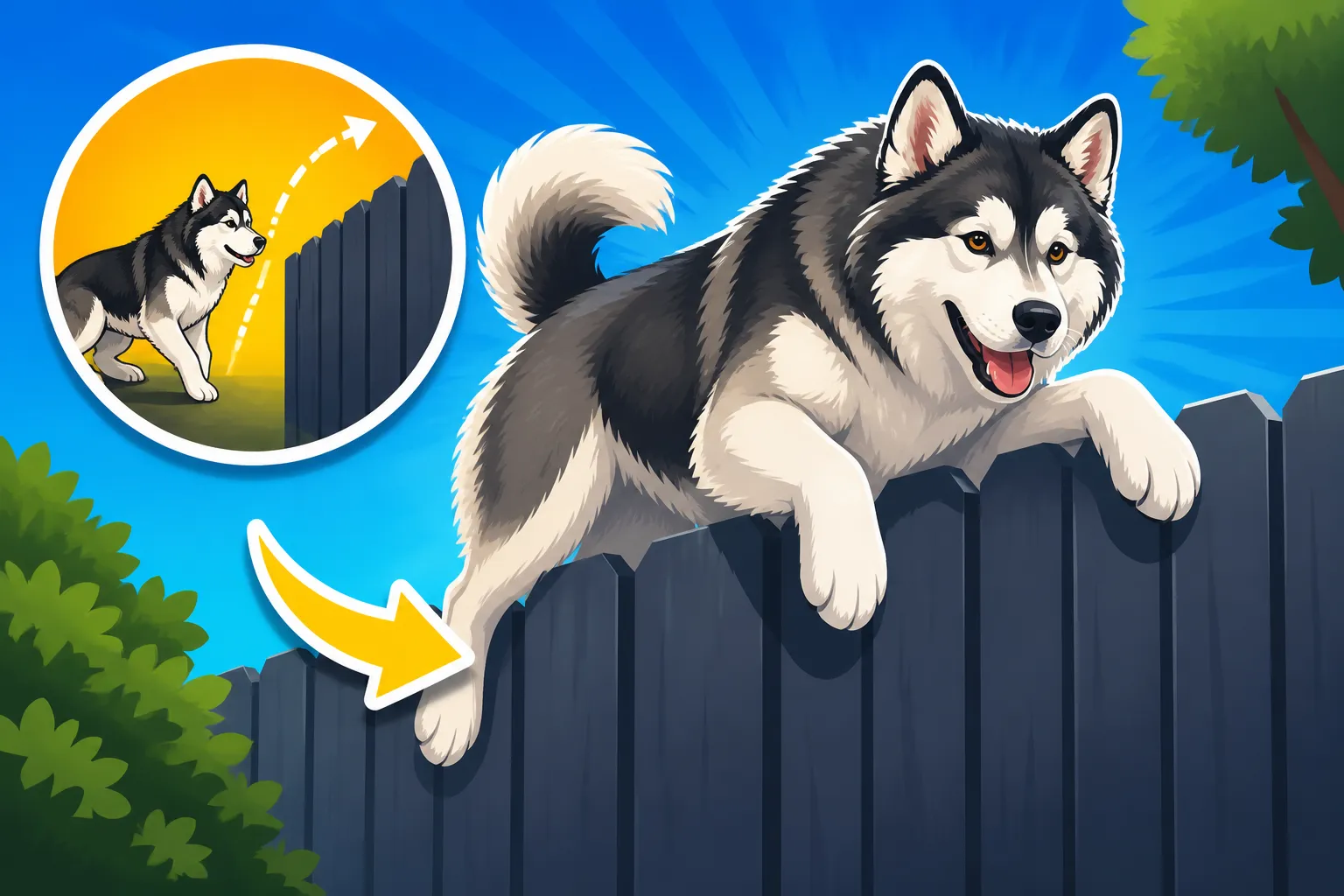
How a Malamute Climbs a Fence
It's incredibly frustrating, isn't it? You invest in what you think is a perfectly secure yard, only to turn around and find your magnificent Alaskan Malamute has suddenly scaled the fence like a furry, four-legged mountaineer. You might stare at the seemingly insurmountable barrier and wonder, "How on earth did they do that?" This guide is for every Malamute owner who has experienced that moment of bewildered panic, diving deep into the psychology and physical prowess that allows these dogs to become escape artists, and crucially, offering realistic strategies to keep your furry escape artist safely contained.
Understanding the Malamute's Drive to Climb
When your Malamute Houdini performs their latest escape act, it’s rarely out of malice. Instead, it’s usually a potent combination of deep-seated breed instincts, an intelligent and curious mind, and often, a touch of boredom. Understanding these motivations is the first step toward thwarting their airborne adventures.
Instinctual Behavior vs. Boredom
Alaskan Malamutes are not lapdogs content with an hour on the couch. They were bred for endurance, strength, and problem-solving in harsh environments. Their ancestors had to navigate complex terrain and find resources, and that drive to explore and overcome obstacles is still very much alive in your pet. So, when they see a fence, they don't always see a boundary; they might see a challenge or just another part of the landscape to traverse.
This innate drive is often amplified by sheer boredom. A Malamute who isn't sufficiently exercised, both physically and mentally, is a creative Malamute looking for a job – and that job might just be "fence inspector" or "perimeter breach specialist." If they're left alone in the yard for hours with nothing to do, the fence becomes the most interesting thing around. They'll start testing it, pushing on it, looking for weaknesses, and before you know it, they've discovered a new route to adventure. It's not personal; it's just what a smart, under-stimulated Malamute does. This is why addressing their mental and physical needs is so paramount, especially during the adolescent phase when they start to really push boundaries. Many owners find their Malamute really starts testing the limits around 14 months, which is often called The Age an Alaskan Malamute Tests Its Owner.
The Lure of the Unknown
Beyond simply being bored, Malamutes are also driven by powerful external stimuli. The world outside the fence often holds far more allure than the familiar confines of the yard. For a breed with such a strong prey drive, a squirrel darting up a tree or a neighborhood cat strolling by can be an irresistible siren call. These are dogs whose ancestors once hunted bears, so a small, scurrying creature is simply too tempting to ignore. What an Alaskan Malamute Was Bred to Hunt.
But it’s not just prey. Malamutes are generally social creatures, and the sight or smell of another dog or person walking by can trigger a desire to "go say hello." If your Malamute isn't spayed or neutered, the instinct to find a mate can be an even more powerful motivator, turning any fence into a mere suggestion of a barrier. The thrill of the chase, the promise of new scents, and the possibility of interaction can override any training or perceived barrier, making them incredibly inventive in their escape attempts. It's like a puzzle for them, and the reward is the vast, interesting world beyond your property line.
The Mechanics of Malamute Fence Climbing
It's one thing to understand why they want to climb, but seeing how they actually do it can be truly astounding. Malamutes possess a unique combination of physical attributes that make them surprisingly agile and powerful climbers, turning ordinary fences into their personal playground.
Leveraging Vertical Surfaces
For many breeds, a chain link fence is an impenetrable wall. For a Malamute, it can be an open invitation to climb. Their strong, well-muscled paws, often equipped with robust dewclaws, are perfect for hooking into the mesh. They essentially treat the chain link like a ladder, methodically placing their paws into the openings and using their incredible upper body strength to hoist themselves up. It's a testament to their strength and coordination.
The size of the mesh plays a significant role here. Fences with wider openings provide more obvious footholds, making the climb even easier. A Malamute can quickly assess the easiest route up, and once their front paws are secure, their powerful hind legs launch them upwards. Flimsy top rails or posts are easily bent or flattened under their weight, providing a precarious but effective bridge to freedom. Even solid fences, if they have horizontal supports on the inside or enough texture, can be scaled by a determined Malamute who knows how to lean their weight and push upwards.
The Role of Agility and Strength
While Malamutes are known for their brute strength in pulling, that same powerful musculature translates directly into impressive jumping and climbing abilities. Their well-developed hindquarters, designed for propelling heavy loads, are equally adept at launching them upwards. They don't just jump; they can often "scramble" up surfaces, using their front paws for grip and their back legs for propulsion.
Their balance and coordination are also remarkable. It’s not uncommon to see a Malamute gracefully perch on top of a narrow fence, weighing their options before deciding whether to drop down on the other side. They're not clumsy giants; they are athletes. Moreover, they are master strategists when it comes to utilizing their environment. A conveniently placed dog house, a pile of firewood, a garbage can, or even a large snowdrift can become a launching pad or a crucial step in their ascent. They see these objects not as part of the landscape, but as tools to aid their escape. This creativity is why a simple 6-foot fence, which might stop many dogs, is often merely a suggestion to a determined Malamute. They are certainly powerful jumpers, capable of clearing quite a bit, so understanding How High a Malamute Can Jump is important for any owner.
Common Fence Types and Malamute Vulnerabilities
Knowing your Malamute’s motivation and physical capabilities is crucial, but it's equally important to understand how different types of fencing present unique challenges and vulnerabilities to these escape artists. What works for one breed might be a mere speed bump for a Malamute.
Chain Link Fences: The Easy Escalator
Chain link fences are perhaps the most notorious accomplice in Malamute escapes. For many dogs, the interwoven wire is a solid barrier, but for a Malamute, it's practically a pre-built ladder. Their strong, often thick, nails and robust paw pads can easily hook into the diamond-shaped openings of the mesh. They will test different sections, find the easiest footholds, and with surprising speed and agility, begin their ascent.
The top rail, if present and not securely capped or reinforced, can be pushed down, creating a ramp. Without a top rail, the sharp ends of the chain link can be bent over. Owners often describe the disheartening sight of their Malamute simply walking up the fence like it’s a set of stairs. Furthermore, the very flexibility of chain link works against containment; a determined Malamute can push and pull at the wire, stretching it, bending it, and eventually creating an opening large enough to slip through, or simply flattening a section to step over. Many owners mistakenly think that height alone will solve the problem with chain link, but without other deterrents, it just means they have a taller ladder to climb.
Wooden Privacy Fences: Not as Private as You Think
Wooden privacy fences, while offering a visual barrier that some owners hope will deter escape, come with their own set of vulnerabilities. The most significant weakness is often the presence of horizontal support beams on the inside of the fence. These crossbeams, which offer structural integrity to the fence, become perfect stepping stones for a Malamute. They can use these as a series of ledges, boosting themselves up step-by-step until they reach the top.
Beyond the internal supports, wooden fences are susceptible to chewing and prying. A Malamute’s powerful jaws, designed for working in harsh conditions, can make short work of wooden pickets. They might find a weak board, a loose knot, or a small gap, and then systematically chew, push, and pry until a board is dislodged or a large enough opening is created. This destructive behavior is often fueled by boredom or the scent of something interesting on the other side. Finding splintered wood at the bottom of your fence is a clear sign that your Malamute is actively working on a breach. While they offer privacy, they don't necessarily offer the security needed for such an intelligent and determined escape artist.
Other Fence Materials: Brick, Vinyl, and Beyond
While less common, other fence materials also have their quirks when it comes to Malamute containment. Solid brick or stone walls are generally too smooth and high to climb directly, but any ledges, decorative elements, or even uneven mortar can provide a paw-hold for a particularly inventive Malamute. Crucially, if there are any objects placed too close to these fences – a planter, a woodpile, even a sturdy bush – they instantly become a boost for a climbing attempt.
Vinyl fences, with their typically smooth surfaces, might seem like a good option, as they offer fewer footholds. However, some vinyl fences have texture or horizontal rails that a Malamute can exploit. Furthermore, thinner vinyl materials can still be susceptible to chewing, particularly at ground level, creating a weak point. Farm fencing, such as woven wire or electric fencing, is almost universally inadequate for Malamutes. They can easily push through, jump over, or simply ignore the mild deterrent of an electric shock if the motivation to escape is strong enough. It's a constant battle of wits and strength when you own a Malamute, and no fence material is completely foolproof without careful planning and reinforcement.
Preventing Malamute Fence Climbing
Now that we’ve explored why and how your Malamute becomes a fence-climbing connoisseur, let’s talk about concrete steps you can take to make your yard genuinely Malamute-proof. It requires a multi-faceted approach, combining physical reinforcements with diligent training and management.
Reinforcing Your Existing Fence
The most direct way to prevent climbing is to modify the fence itself. First, height is critical. A standard 6-foot fence is often not enough for a determined Malamute. Many owners find that an 8-foot fence is the minimum, and some even opt for 10 feet. It might sound extreme, but these dogs have an incredible vertical leap and climbing ability.
Next, consider the top of the fence. If it's a chain link, install "coyote rollers" or a similar outward-angled extension. These are essentially PVC pipes or metal bars that spin freely on a wire along the top of the fence, preventing the dog from getting a purchase with their paws to pull themselves over. For solid fences, an inward-sloping section at the top, or a smooth, unclimbable cap, can also deter them. But remember, Malamutes are often digging as much as they are climbing, so addressing the bottom of the fence with buried L-footings, concrete, or heavy gauge wire laid horizontally under the ground is also crucial. This combination tackles both major escape routes, and it ties into the advice in posts like Fencing a Yard Against a Malamute That Was Bred to Dig and Why a Malamute Cannot Be Stopped From Digging.
Strategic Landscaping and Obstacle Removal
Sometimes, the fence isn't the problem itself, but what's around it. Malamutes are incredibly resourceful, and they will use anything as a boost. Immediately remove any objects that could aid in an escape. This includes dog houses, storage bins, firewood piles, benches, children's play equipment, or even dense bushes with strong branches that could provide a foothold. Even accumulated snowdrifts in winter can create a perfect ramp over a fence that was previously secure.
Consider your landscaping choices near the fence line. Thorny bushes or dense, scratchy shrubs planted tightly along the inside perimeter can act as a natural deterrent, making the climb less appealing due to discomfort. Just be sure to research any plants for toxicity to dogs. For truly persistent climbers, some owners have resorted to a "double fence" system, creating a smaller, inner perimeter a few feet inside the main fence. This creates a buffer zone, meaning even if the Malamute gets over the first fence, they are still contained within your property, buying you time to intervene.
Comprehensive Training and Management
Physical barriers are vital, but they are only one part of the solution. Your Malamute's mind and body need to be engaged to reduce their motivation to escape. Never leave a Malamute unsupervised in a yard, especially if they have a history of climbing or if you're implementing new containment strategies. Even a few minutes alone can be enough for them to find a weakness.
Consistent training is paramount. Work on solid "stay" and "leave it" commands, specifically practicing at the fence line. Reward heavily for staying away from the fence and for checking in with you. Consider enrolling in obedience classes; sometimes a fresh perspective from a professional trainer can work wonders. BAXTER & Bella, for instance, offers online training programs that could provide structured guidance for these challenging behaviors. Crucially, your Malamute needs sufficient mental and physical exercise every single day. Long walks, hiking, carting, weight pull, puzzle toys, and regular training sessions will tire them out and satisfy their innate drive to work. A tired Malamute is a good Malamute, and one less likely to scheme an escape. Invest in durable chew toys or puzzle feeders, perhaps from Amazon, to keep their minds engaged when you can't actively supervise them. How Much Exercise an Alaskan Malamute Needs is a great resource to understand just how much activity these dogs truly need to be content. Remember, a Malamute with nothing to do will find something to do, and often, that means testing boundaries. This proactive approach to their wellbeing significantly reduces the likelihood of them attempting to scale your fence and ties into the overall understanding that these dogs truly need a job every day to thrive. Whether a Malamute Needs a Job Every Day and The Malamute That Bolts Through an Open Door both highlight the importance of proactive management for this intelligent, driven breed.
| Fence Type | Malamute Climbing Vulnerabilities | Recommended Reinforcements |
|---|---|---|
| Chain Link | Easy foot/claw holds, flimsy top rail, can be bent/flattened | Height extension (8-10 ft), top rollers (e.g., coyote rollers), buried L-footings, thicker gauge wire, removal of nearby objects |
| Wooden Privacy | Horizontal supports (inside), gaps, chewable boards, objects near fence | Remove internal horizontal supports, ensure no gaps, add anti-chew strips, move all objects at least 3-4 feet away from fence |
| Vinyl | Can be scaled if textured/supports, chewable at ground level | Smooth top cap, secure base, anti-chew protection at ground level, ensure no internal supports that can be climbed |
| Wire (farm/deer) | Easily pushed through, jumped over, poor visibility | Not recommended as primary Malamute containment, consider double fencing or a secure kennel run |
Disclaimer
This article is for general informational purposes only and does not constitute professional advice. Laws, prices and regulations vary by location and change over time. Consult a qualified professional for guidance on your specific situation.