How Far Under Concrete a Malamute Will Dig
Oh, the sheer frustration of looking out at your yard, thinking you've finally tamed the digging beast, only to find a new crater or, worse, evidence of an escape attempt right where you thought you were safe! Alaskan Malamutes are magnificent, powerful dogs, but their innate drive to dig can feel like an endless battle, especially when you start to wonder if they can tunnel straight through the earth's crust. This guide is here to shed some light on just how deep and far these determined dogs can dig, even under what seems like an impenetrable concrete barrier, and, more importantly, what you can actually do about it.
The Instinctive Drive Behind a Malamute's Excavation Habits
Let's be real, you bought an Alaskan Malamute, not a lap dog. These incredible animals were bred for millennia by the Mahlemut people of the Arctic, not to sit pretty, but to work tirelessly, freighting heavy loads across vast, often frozen, landscapes. Digging is not some mischievous whim; it's hardwired into their very being, a survival trait passed down through generations. Understanding this fundamental truth is the first step in managing, rather than fighting, their natural inclinations.
The Deep Roots of Malamute Digging
Think about their ancestors in the Arctic. Digging served multiple, vital purposes. It wasn't just for fun; it was about survival. A Malamute might dig to create a den for shelter from harsh winds or extreme cold, forming a cozy, insulated hollow. In warmer months, or even in our temperate climates today, digging down to cooler earth is a highly effective way to regulate their body temperature, especially with that dense double coat. It’s their natural air conditioning system. This deep-seated instinct means that merely telling them "no" or punishing them for digging will be about as effective as telling the tide not to come in. You're fighting against millions of years of evolutionary programming.
Then there's the hunting aspect. Malamutes were formidable hunters, capable of tracking and bringing down large game, or finding small prey hidden beneath snow or earth. That powerful nose, combined with their strong paws, makes for an incredibly efficient digging machine. If they catch a scent, even a faint one from a rodent underground, they will pursue it with a relentless single-mindedness that puts most excavators to shame. For them, it’s not just digging; it's problem-solving, exploring, and satisfying an innate drive. This is why A Malamute Was Bred to Hunt Bears and It Has Not Forgotten is such a critical piece of their behavioral puzzle.
The Challenges of Containing a Determined Digger
When we talk about digging under concrete, we're not just discussing a dog idly pawing at some loose dirt. We're talking about a highly motivated, intelligent animal that will methodically work to achieve its goal. If there's a weakness, they will find it. A small gap, a hairline crack, a slight unevenness where concrete meets soil – these are all invitations for a Malamute. They have the strength to dislodge loose rocks, move heavy objects, and create leverage. Their persistence is legendary, and what might take another breed hours to achieve, a Malamute can accomplish in minutes, especially if it means freedom or access to something interesting. It’s not just about their raw power; it’s their mental fortitude. They don't give up easily, which is both a blessing in a working dog and a challenge in a domestic setting.
How Deep and Far a Malamute Will Dig Under Concrete
So, you've poured a nice concrete slab, or maybe you have a house foundation, or a retaining wall. You think, "Aha! No more digging here!" And then, one day, you see the tell-tale mound of dirt beside the concrete, or worse, your Malamute has vanished. It's a stomach-dropping moment, and it teaches you just how resourceful these dogs can be.
Exploiting Weaknesses and the "Leverage Dig"
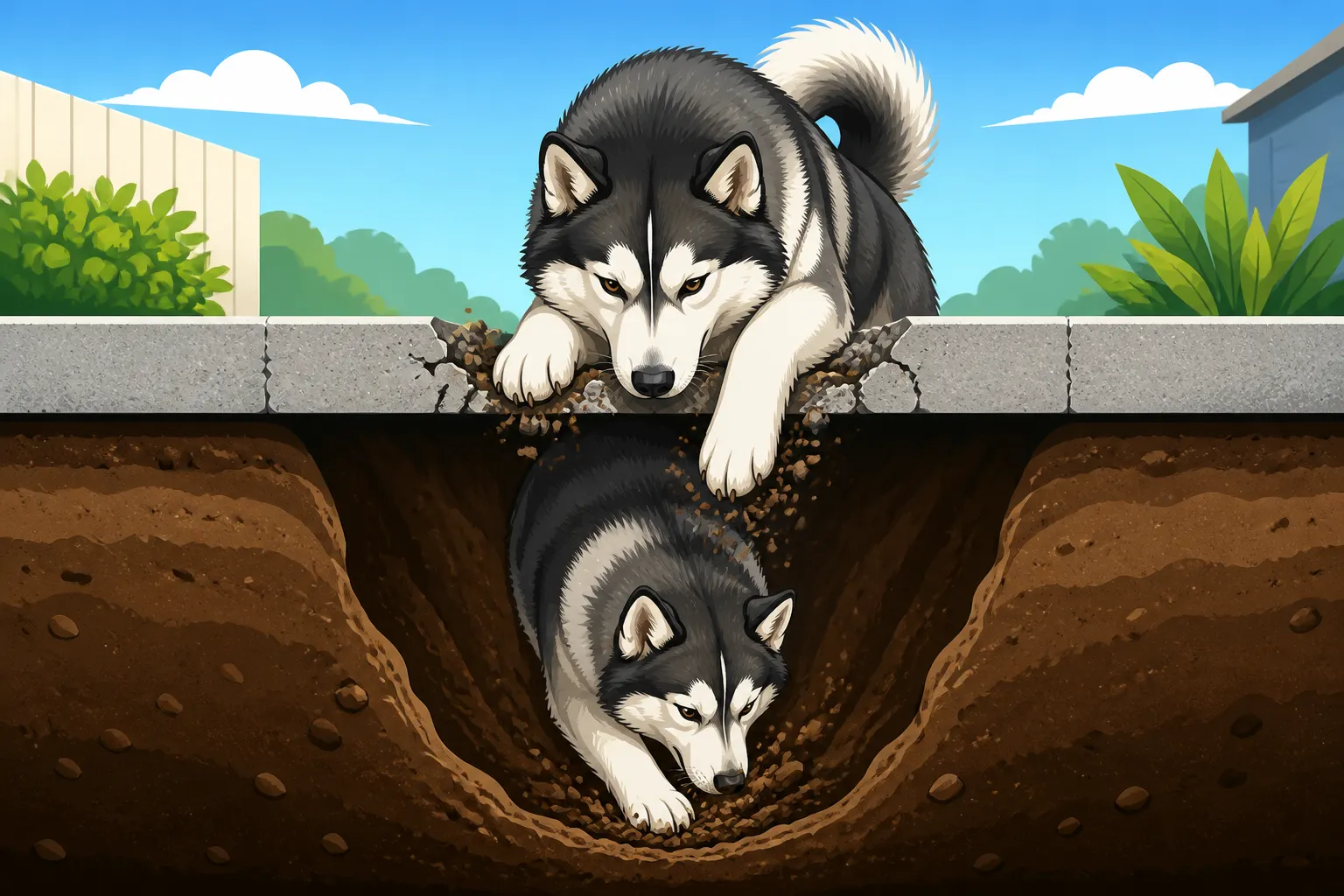
Malamutes rarely dig through concrete, of course. That's a myth. What they do is exploit any interface where concrete meets soil, or any crack or seam. Imagine your concrete patio or fence footing. It doesn't extend infinitely downwards. At some point, it ends, and that's where the Malamute sees an opportunity. They don't need to go through the concrete; they just need to go under it.
They start by digging at the edge, where the soil is softer. Once they create a small void, they use their powerful paws and nose to lever the dirt away. They'll burrow down, then out, creating an inverted "L" shape tunnel. They can easily dig down 2 to 3 feet, sometimes even deeper, to get below the footing of a typical fence or foundation. If the concrete itself is only a few inches thick at the edge, they might only need to go a foot or so down to create enough space to squeeze underneath. They have incredible spatial awareness and will gauge whether their body can fit through the created gap. It's truly impressive, in a terrifying kind of way, how quickly they can excavate a surprising amount of earth.
The Horizontal Tunneling Capabilities
Once they've gone down sufficiently to get under the barrier, their next move is often to tunnel horizontally. This is where the real danger lies. A Malamute might dig down 2 feet, then tunnel outwards for several feet in any direction if motivated. If your fence has concrete footings that only go down a foot, a Malamute can tunnel down past that footing, and then out into your neighbor's yard, or worse, into a busy street. The distance they can tunnel horizontally is only limited by their motivation and the stability of the soil. If the soil is loose and sandy, they can create quite extensive underground networks. If it's clay-heavy and collapses easily, they might only go a few feet before encountering a cave-in, which they’ll then try to dig around.
They don't necessarily need a grand escape plan. Sometimes, they're simply exploring a scent, trying to reach a perceived "treasure" on the other side. This is why you might find a tunnel that doesn't seem to go anywhere but ends abruptly – they simply lost interest or the scent faded. But if the motivation is high enough, like chasing a squirrel or another dog, or if they are in full escape artist mode, there's little that will stop them once they've found their initial weak point. You might find this ties into How Far Down a Malamute Will Dig.
| Type of Barrier Edge | Typical Depth of Concrete/Footing | Malamute Tunneling Depth | Malamute Tunneling Distance (Horizontal) | Risk Level |
|---|---|---|---|---|
| Patio Slab Edge | 4-6 inches | 1-2 feet | 2-5 feet | High |
| Fence Post Footing | 1-2 feet | 2-3 feet | 3-8 feet | Moderate |
| House Foundation | 3-4 feet (below frost line) | Varies by foundation type | Limited by foundation wall and pipe access | Low to Moderate (less likely for escape, more for denning) |
| Retaining Wall Base | 1-3 feet | 2-4 feet | 3-10+ feet | High |
This table illustrates that while concrete itself is a formidable barrier, its edges and depth relative to a Malamute's digging prowess are the critical factors. Don't assume a concrete boundary means they won't try to go under it.
Fortifying Your Defenses Against the Underground Explorer
Now that we've established that concrete isn't a magical, impenetrable shield against a determined Malamute, what can you actually do to protect your yard and keep your furry excavator safely contained? It requires a multi-faceted approach, combining physical barriers with environmental management and training.
Deepening and Reinforcing Physical Barriers
The most effective way to prevent tunneling under concrete, or any fence for that matter, is to extend the barrier vertically below ground level. This means burying a section of your fence or adding an L-footer.
-
L-Footing/Dig Guard: This is probably the gold standard for dig-proof fencing. Instead of just burying the fence straight down, you create an "L" shape. Imagine a section of fence buried 1 to 2 feet deep, with another section bent horizontally into the yard, extending 1 to 2 feet inwards. When your Malamute starts digging at the base of the fence, they quickly hit this horizontal "foot" of the fence. Because they're digging down and then out, this horizontal barrier physically blocks them. They can't tunnel under it without encountering it first. You can achieve this with heavy gauge wire mesh, chain link, or even sections of concrete pavers laid horizontally. For really determined Malamutes, you might need to go even deeper or wider with this "L." If you're building a new fence, consider burying a section of it. You can find durable mesh fencing options on platforms like Amazon that can be effectively integrated into an L-footer design.
-
Concrete Trench: For a truly unyielding barrier, some owners resort to pouring a narrow concrete trench along the fence line, extending 2-3 feet deep. This is a significant undertaking, but it creates a solid, continuous underground wall that a Malamute cannot dig under. It's essentially extending your concrete footing much deeper. However, this is costly and labor-intensive, and many find the L-footer system to be a more practical compromise.
-
Large Rocks/Pavers: As a less extreme measure, burying large, flat rocks or heavy concrete pavers along the fence line, extending a foot or more downwards and outwards, can create a deterrent. While not as foolproof as an L-footer, it provides a hard surface they hit when digging, making them reconsider. The trick is to ensure they are snugly fitted and difficult to dislodge.
Remember, the goal isn't just to make it impossible, but to make it so difficult and unrewarding that your Malamute gives up and moves on to an approved digging spot.
Managing the Environment and Providing Alternatives
Physical barriers are crucial, but they're only one part of the solution. You also need to address why your Malamute is digging in the first place and provide appropriate outlets for that energy.
-
The Digging Pit: This is a lifesaver for many Malamute owners. Dedicate a specific, approved area of your yard as the "digging pit." Fill it with sand, loose soil, or a mix of both. Bury toys, treats, and even their favorite bones in there, especially when they're not looking. Encourage them to dig only in this spot. When you see them start to dig elsewhere, gently redirect them to their pit. Praise them enthusiastically when they dig in the right place and find a buried treasure. Consistency is key here. This provides a legitimate outlet for their instinct, saving your lawn and your sanity. Giving an Alaskan Malamute Its Own Digging Pit offers more insights into this strategy.
-
Exercise and Mental Stimulation: A bored Malamute is a destructive Malamute. These dogs need a lot of exercise and mental engagement. Daily walks (on a leash, always, because Why an Alaskan Malamute Will Never Have a Reliable Recall), running, hiking, or even urban mushing can burn off physical energy. Mental stimulation is just as important. Puzzle toys, training sessions, and interactive games can help satisfy their intelligent minds. If they're tired and mentally satisfied, they're less likely to feel the urge to excavate your yard. Consider activities like Pulling Is the Only Job an Alaskan Malamute Really Wants to tap into their breed-specific drives.
-
Temperature Management: Remember, Malamutes dig to stay cool. If your dog is outside in warm weather, ensure they have ample shade, plenty of fresh water, and access to a cooling mat or a kiddie pool. Sometimes, just providing a cooler spot will significantly reduce their digging driven by heat. Summer Is the Season That Kills Alaskan Malamutes underscores the importance of managing their environment in warmer months.
The Role of Training and Supervision
While you can't train away an instinct, you can certainly train behavior and manage the environment to make digging less problematic.
-
"Leave It" and "Stop Digging" Cues: Teach your Malamute a solid "leave it" command. When you see them begin to dig in an undesirable spot, use your cue. If they stop, reward them heavily. You can also teach a specific "stop digging" cue. This requires consistent, positive reinforcement. Tools like the BAXTER & Bella online puppy school offer resources that can be incredibly helpful for teaching these foundational commands and understanding breed-specific challenges. Their approach focuses on positive reinforcement, which is essential for a sensitive yet stubborn breed like the Malamute.
-
Supervision: The simplest and often most effective method, especially for young or new Malamutes, is direct supervision. Don't leave your Malamute unattended in the yard for extended periods until you are confident in your containment and their understanding of acceptable digging zones. When you're outside with them, you can immediately redirect any unwanted digging. This means being present, not just physically but mentally, observing their behavior and intervening proactively.
-
Damage Control and Reinforcement: If your Malamute has already created a tunnel, don't just fill it with dirt. That's like putting a band-aid on a gaping wound. They will simply dig it out again. You need to reinforce that spot. Fill the hole with large rocks, then dirt, or bury wire mesh in the area. Make it hard for them to re-dig that same spot. This sends a clear message that this specific area is off-limits. Repeatedly finding a reinforced, unyielding spot might just teach them that their efforts there are futile.
Ultimately, containing a Malamute's digging beneath concrete is an ongoing project. It's about combining intelligent physical barriers, providing acceptable outlets for their natural instincts, and consistent, positive reinforcement training. It's a testament to your Malamute's incredible drive and problem-solving skills, and with the right strategies, you can channel that energy safely and constructively.
Disclaimer
This article is for general informational purposes only and does not constitute professional advice. Laws, prices and regulations vary by location and change over time. Consult a qualified professional for guidance on your specific situation.