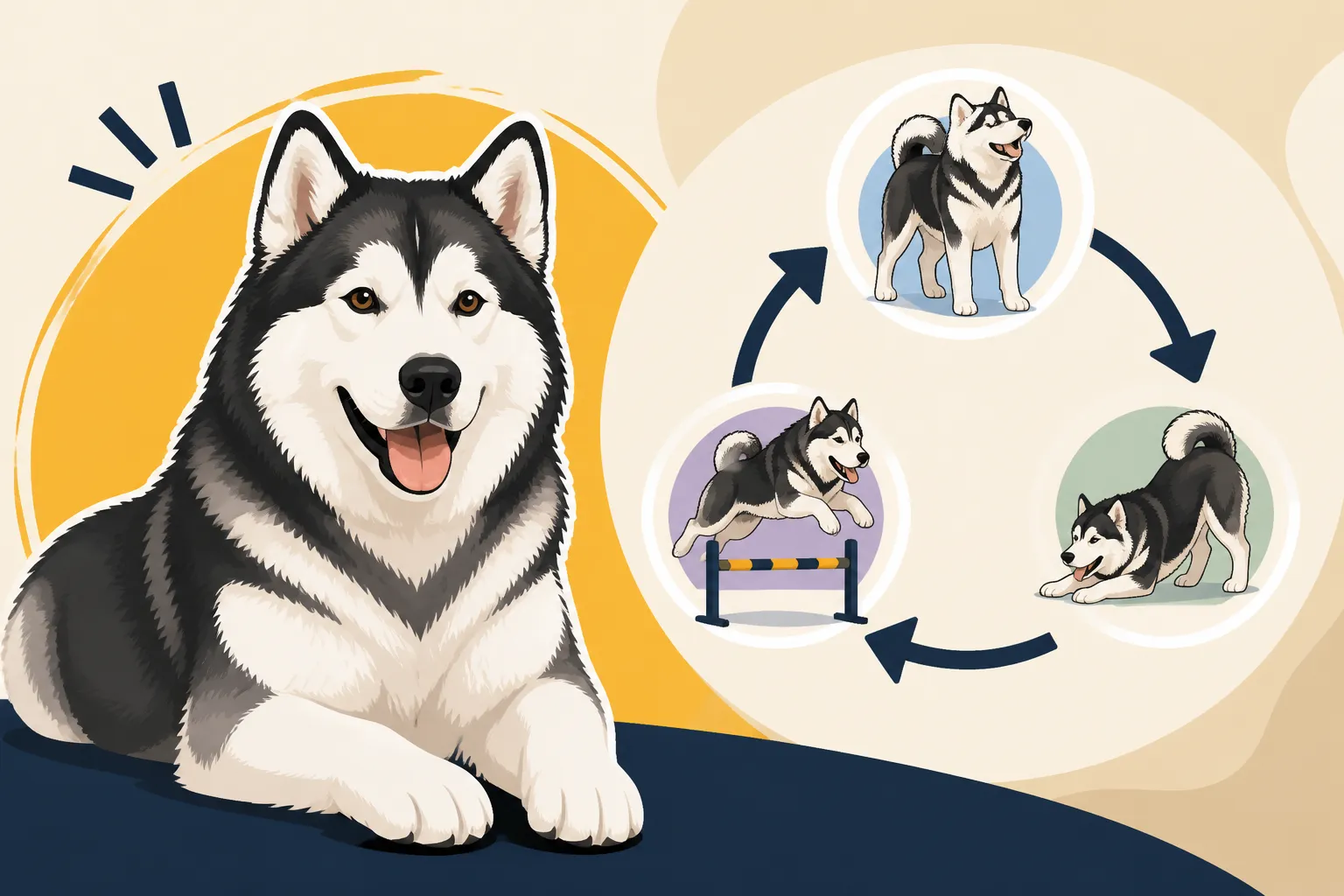
How Many Repetitions a Malamute Needs
Many Malamute owners quickly realize that training isn't always a straightforward path, especially when it comes to how many times you need to repeat a command before it truly sinks in. It’s incredibly frustrating when you feel like you’ve said “sit” a hundred times, and your smart, furry companion is looking at you like it's the first time they’ve ever heard the word. This guide will dive deep into the unique Malamute learning style and offer practical strategies to make those training repetitions count, rather than just becoming background noise.
Understanding the Malamute Learning Style
You've got a Malamute, and that means you've got a dog with a brain wired for independence and problem-solving, not necessarily for endless, unthinking obedience. This isn't a Golden Retriever who lives to please; this is a dog bred to make decisions for itself in harsh environments, often far from human guidance. Understanding this fundamental difference is crucial when you're thinking about "repetitions."
The Independent Nature of the Malamute Brain
Alaskan Malamutes were developed to be freighting dogs, pulling heavy loads for miles, sometimes without direct human instruction for extended periods. This history fostered a strong sense of independence and self-reliance. When you ask your Malamute to do something, their first thought isn't always "How can I make my human happy?" It's often "What's in it for me?" or "Is this a good idea right now?" This isn't stubbornness, not exactly, though it can certainly feel like it. It's an innate drive to evaluate the situation and choose the most beneficial course of action for them.
Because of this, they don't just absorb commands through sheer repetition in the same way some other breeds might. They need to understand the value of the command, the reason for compliance. If the reward isn't compelling enough, or if they perceive another, more interesting option (like sniffing that interesting bush or greeting a passerby), then your repetitions fall on deaf ears. You might find that Why Force Fails on an Alaskan Malamute is a concept that resonates deeply with your experience.
Boredom and the Malamute
Another significant factor in a Malamute's learning curve is their intelligence, coupled with a remarkably low tolerance for boredom. Repeating the same command, in the same way, in the same environment, over and over again will very quickly lead to a checked-out Malamute. You'll see it in their eyes – that glazed-over look, a yawn, a sudden intense interest in a dust bunny on the floor. They learn quickly, yes, but they also get bored quickly.
If a training session becomes monotonous, your Malamute will simply decide it's not worth their mental effort. They might offer a half-hearted attempt, or they might just wander off. This isn't malicious; it's just how their intelligent minds work. They thrive on novelty and challenge. If you're consistently running into this wall, you're not alone. Many Malamute owners wonder Whether Repetition Bores an Alaskan Malamute, and the answer is usually a resounding yes if it's not varied.
Motivation Is Key
Given their independent nature and propensity for boredom, the number of repetitions your Malamute "needs" is less about a fixed count and more about the quality of your motivation and engagement. What truly drives your Malamute? Is it a specific high-value treat, a favorite squeaky toy, or a burst of excited praise? For many, it's a combination, and it often requires a higher caliber of reward than you might use for other breeds.
A tiny piece of dry kibble might work for a quick "sit" when nothing else is happening, but if you're trying to teach a complex new behavior or proof a known command in a distracting environment, you'll need to pull out the big guns: freeze-dried liver, cheese, cooked chicken, or something equally irresistible. What an Alaskan Malamute Will Work For often surprises new owners; it's a far cry from a generic "good boy." Tapping into that strong motivation allows you to get more effective repetitions in a shorter amount of time, because your Malamute is actively choosing to engage.
The "Right" Number of Repetitions Isn't a Fixed Number
Forget the idea that there's a magic number of repetitions, like "20 times a day for a week." For an Alaskan Malamute, the process is far more nuanced and dynamic. It's about building a strong foundation, generalizing commands, and understanding that learning isn't a linear path.
Quality Over Quantity
When it comes to Malamutes, ten focused, enthusiastic repetitions are worth a hundred half-hearted, boring ones. It's not about how many times you say the word, but how many times your Malamute actively chooses to perform the behavior correctly and is rewarded for it. If you're repeating "stay" while your Malamute is constantly looking away, inching forward, or breaking position, those aren't quality repetitions. In fact, they might be reinforcing the wrong behavior – that staying is optional or that you'll just keep asking.
Instead, aim for short bursts of highly engaged training. Capture their attention, give the command, reward immediately and generously for success, and then take a brief mental break before the next repetition. This keeps their brain active and prevents the dreaded boredom. Think about building a solid muscle memory not just of the action, but of the choice to comply being highly rewarding. If you notice your Malamute starting to check out, it's time to end the session or switch to a different, more exciting activity.
Varying the Environment
This is perhaps the biggest misconception about repetitions. A Malamute might learn to sit perfectly in your quiet living room after just a handful of repetitions. You might think, "Great! They've got it!" But take them to a busy park, and suddenly "sit" might as well be a foreign language. This isn't because they've forgotten; it's because they haven't generalized the command across different environments. The command "sit" in the living room is a completely different stimulus than "sit" with squirrels, children, other dogs, and interesting smells all vying for their attention.
To truly "proof" a command, you need hundreds of repetitions across a vast array of locations, with varying levels of distraction. Start in low-distraction environments, then gradually introduce more challenges. This process itself requires many, many repetitions. A good online training platform, like the one offered by BAXTER & Bella, might suggest structured approaches to gradually introduce distractions, helping you move from the living room to the backyard, then to a quiet street, and eventually to more bustling locations. The point is not just repeating the command, but repeating it successfully in increasingly challenging contexts.
Generalization and Proofing
Proofing a command means your Malamute will respond reliably, no matter the distraction, distance, or duration. This takes immense effort and, yes, a lot of repetitions, but they must be purposeful repetitions.
Consider the following table to illustrate how repetitions for a single command, like "stay," can vary depending on the level of proofing:
| Proofing Level | Environment | Repetitions Focus | Estimated Reps to Initial Reliability |
|---|---|---|---|
| Basic | Quiet living room, no distractions | Reinforcing the immediate action | 5-10 solid, rewarded reps |
| Intermediate | Backyard, slight household noise | Adding mild distractions (e.g., family walking by) | 20-30 successful reps across different sessions |
| Advanced | Quiet park, leashed, distant dogs | Introducing controlled, low-level external distractions (e.g., distant dog walker) | 50-75 successful reps |
| Expert | Busy park, off-leash, high distractions | Sustained focus amidst significant movement & noise | 100+ highly rewarded, successful reps |
Keep in mind these numbers are for successful repetitions. If your Malamute isn't getting it, you need to go back a step, reduce distractions, or increase the reward, not just keep repeating it incorrectly. This is especially true for an intelligent breed like the Malamute, who might quickly decide that ignoring you is the more interesting option if you're not capturing their focus effectively. This table highlights why Whether an Alaskan Malamute Ignores a Cue It Knows is often about proofing, not forgetfulness.
Strategies for Effective Training Sessions
Since sheer brute-force repetition doesn't work for our clever, independent Malamutes, we need to be strategic. The goal is to maximize the impact of each repetition, ensuring your Malamute is engaged, motivated, and truly learning.
Short, Frequent Sessions
Instead of one long, tedious training session, break it up into many short, high-impact bursts throughout the day. Five minutes, three to four times a day, is far more effective than one twenty-minute session where your Malamute loses interest halfway through. Whether Short Sessions Suit an Alaskan Malamute is a question that experienced Malamute owners will answer with a resounding yes. These brief sessions prevent boredom, keep your Malamute's mind fresh, and allow you to end on a positive note before they get tired or distracted.
Think about incorporating training into your daily routine. Ask for a "sit" before opening the door for a walk, a "down" before they get their meal, or a "stay" while you prepare their favorite chew. These real-life applications are incredibly powerful repetitions because they are relevant and immediately rewarding. This approach keeps training fun and prevents it from feeling like a chore for either of you.
High-Value Rewards
As mentioned before, your Malamute needs a compelling reason to engage. For most Malamutes, this means using high-value food rewards. While praise and toys are great, food often cuts through distractions more effectively. Experiment to find out what your Malamute considers top-tier. Is it tiny pieces of hot dog? Cooked chicken? Cheese? Freeze-dried treats available on platforms like Amazon can be excellent for this, as they are often irresistible and easy to break into small, quickly consumed pieces.
The reward should be immediate – within 1-3 seconds of the correct behavior. This helps your Malamute connect the action directly with the positive outcome. If you delay, they might not understand what they're being rewarded for. Vary your rewards too; sometimes a treat, sometimes a quick game of tug, sometimes just enthusiastic praise. This keeps them guessing and engaged, rather than just expecting the same old thing. Whether Food Motivates an Alaskan Malamute is a key factor in how effective your repetitions will be.
Making Training a Game
Turn training into a series of fun games rather than strict drills. Malamutes love to work, but they love it even more when it's framed as an exciting challenge. Hide-and-seek with commands, obstacle courses in the living room, or "find it" games where they have to perform a command to earn a treat all count as valuable repetitions. This approach taps into their natural intelligence and prey drive in a constructive way.
For example, when teaching "come," don't just stand there and call them. Make it a joyful, exciting event. Run away from them, crouch down, make happy noises, and when they reach you, throw a party with treats and praise. This makes coming to you a highly rewarding experience, building positive associations with the command. The more fun it is, the more repetitions you'll get willingly, and the faster the concept will stick. This kind of playful engagement is a cornerstone of The First Year With an Alaskan Malamute Puppy and beyond.
When to Seek Professional Help
Even with the best intentions and strategies, there might be times when you hit a wall or encounter specific behavioral challenges that feel insurmountable. Recognizing these moments and knowing when to reach out for professional guidance is not a failure; it's a responsible and proactive step in your Malamute's training journey.
Identifying Training Plateaus
It's common to reach a point where your Malamute seems to stop progressing. Maybe they've mastered "sit" and "down" in the house, but simply cannot generalize these commands to more stimulating environments. Or perhaps a new behavior, no matter how many times you try, just isn't clicking. This is a training plateau, and it's a sign that your current approach might need an adjustment.
A plateau can also manifest as increased "selective hearing" or a regression in previously learned behaviors, especially during the adolescent phase. The Adolescent Malamute That Rewrites the Rules at Fourteen Months is a very real challenge, and what worked when they were a puppy might suddenly seem ineffective. If you find yourself consistently frustrated, angry, or dreading training sessions, it's definitely time to consider outside help. Your relationship with your Malamute is paramount, and preserving its positive nature is worth the investment.
The Benefit of a Fresh Perspective
A certified professional dog trainer, particularly one with experience with independent working breeds like Alaskan Malamutes, can provide invaluable insight. They can observe your interactions and training techniques, identify subtle cues you might be missing, and suggest alternative methods or higher-value motivators. Sometimes, a slight tweak in your timing, body language, or reward delivery can make a world of difference.
They can also help you break down complex behaviors into smaller, more manageable steps, making the learning process less overwhelming for both you and your Malamute. A good trainer doesn't just train your dog; they train you to be a more effective communicator and leader. They can help you understand the nuances of Malamute behavior, offering strategies tailored to your specific dog and household. Exploring Whether a Malamute Needs a Professional Trainer is a valid consideration for any dedicated Malamute owner. They can help turn those endless, frustrating repetitions into meaningful, productive learning experiences.
Disclaimer
This article is for general informational purposes only and does not constitute professional advice. Laws, prices and regulations vary by location and change over time. Consult a qualified professional for guidance on your specific situation.