Whether Every Malamute Traces to Kotzebue or M’Loot
A pedigree may say “Kotzebue” or “M’Loot,” while a breeder describes a dog as a mix of both. That can make it sound as if every Alaskan Malamute has a simple, traceable connection to two neat family trees. The real story is more layered: those strains shaped the modern breed, but historic records, other early dogs, and generations of interbreeding make an absolute claim difficult.
The short answer about Kotzebue and M’Loot ancestry
The two names refer to early strains, not separate breeds
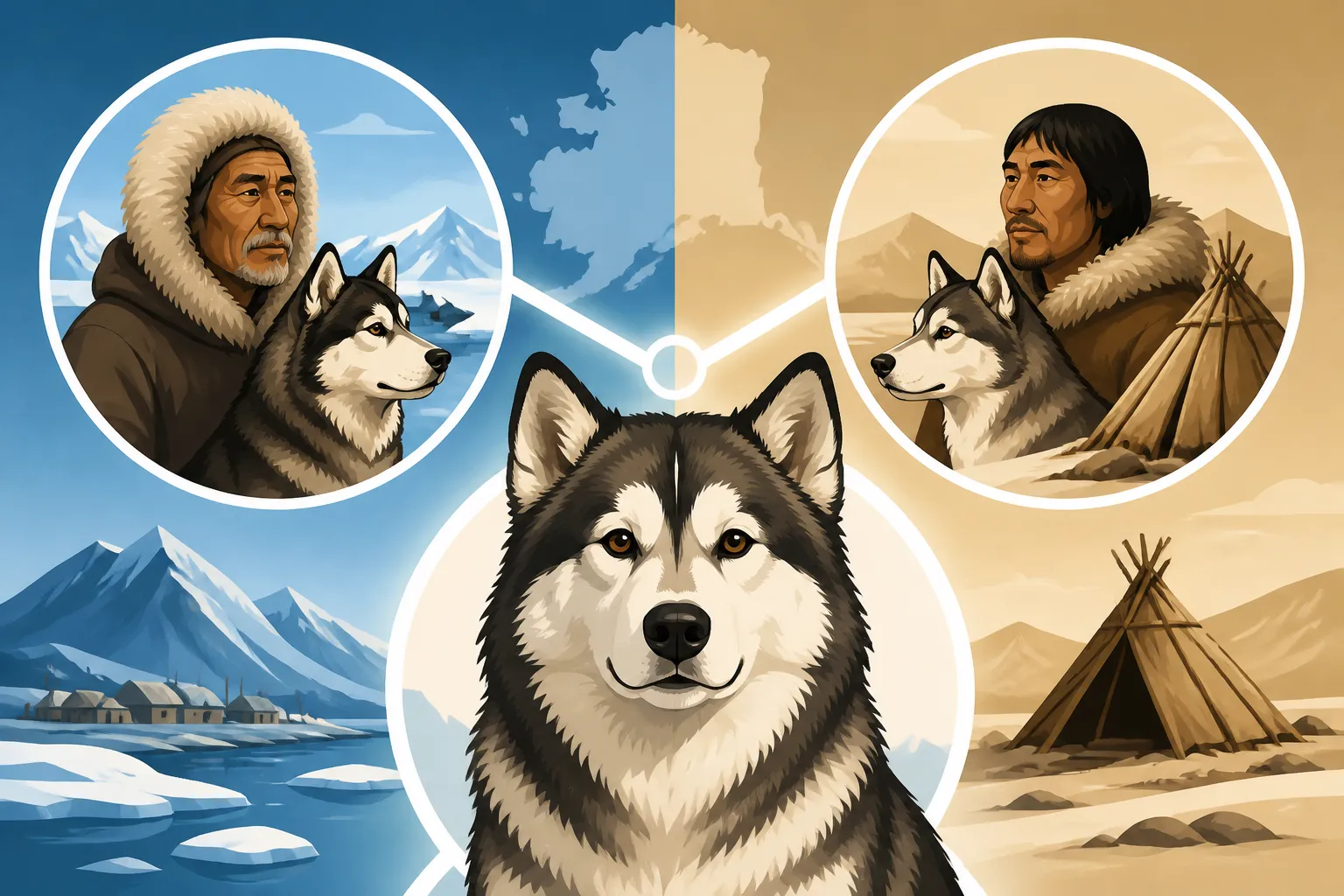
Kotzebue and M’Loot are names associated with influential early Alaskan Malamute breeding strains. They were not separate breeds with permanently sealed pedigrees, and a dog described as “Kotzebue” or “M’Loot” was not automatically a distinct kind of Malamute. The labels are shorthand for groups of dogs connected with particular breeders and breeding programs.
The Kotzebue strain is associated with Eva B. Seeley, while the M’Loot strain is associated with Paul Voelker. The dogs in these groups helped shape the breed as it became formally recognized and bred in the lower 48 states. For more background on the people and history behind the breed, see The Mahlemut of Kotzebue Sound Bred the Alaskan Malamute and The Kotzebue and M'Loot Lines Behind Every Modern Malamute.
That history is easy to oversimplify into “all Malamutes come from two lines.” A more careful statement is that Kotzebue and M’Loot stock contributed significantly to the modern breed, and many accounts describe the present-day population as drawing on both. That does not mean every individual dog can be confidently assigned to one or both strains at every point in its ancestry.
Why “every Malamute” is too absolute
A claim about every dog requires complete, reliable records for every generation. Early breeding records were not always as comprehensive as a modern pedigree database, and the breed’s population was small enough that rebuilding and combining dogs mattered. Historical accounts also refer to other early stock, including the Hinman-Irwin strain. That makes a simple two-branch family tree an incomplete way to describe the breed’s development.
There is a difference between saying that a strain contributed to a breed and proving that every living individual descends from it in a documented, uninterrupted line. A pedigree can support ancestry claims back through the generations it records. It cannot fill in missing records or turn broad historical understanding into certainty about every dog.
So, if someone asks whether every Malamute traces to Kotzebue or M’Loot, the most responsible answer is: the two strains were foundational to the modern breed, but “every Malamute” is stronger than the historical record can comfortably establish. The names explain important parts of the breed’s history; they should not be treated as a complete ancestry test.
What the Kotzebue and M’Loot labels actually tell you
The Kotzebue strain
The Kotzebue strain is often described as more uniform in appearance than some other early stock. That reputation reflects the breeding history and the dogs associated with the strain; it does not mean every dog labeled Kotzebue looked identical or shared a guaranteed set of traits. A lineage label gives historical context, not a promise about a particular dog’s height, coat, temperament, or working ability.
When reading about this group, keep in mind that a historical strain is not the same thing as a modern, genetically isolated population. Dogs can be related through several routes, and the name attached to a line is most useful when supported by pedigree documentation. For a closer look at the strain’s history, see What the Kotzebue Malamute Line Is.
The label also should not be used as a shortcut for judging quality. A dog’s health, structure, behavior, and suitability for a home depend on far more than a historic family name. If you are considering a puppy, ask about the parents and their health testing, and ask the breeder to explain the pedigree rather than relying on a broad claim like “pure Kotzebue.”
The M’Loot strain
M’Loot refers to stock associated with Paul Voelker’s breeding program. In broad descriptions of Malamute history, M’Loot dogs are often contrasted with Kotzebue dogs, sometimes with claims about differences in size or appearance. Those comparisons can be useful as historical shorthand, but they are not dependable rules for identifying an individual dog today.
A dog’s modern pedigree may include ancestors from more than one early strain. After generations of breeding between related populations, visible traits do not neatly reveal a dog’s full ancestry. A larger frame, a particular head shape, or a certain coat color cannot establish that a dog belongs to one historic group.
The M’Loot name is still useful when discussing how the breed developed, especially alongside the Kotzebue story. But it should not be taken to mean there is a standardized “M’Loot Malamute” with separate official status. See What the M'Loot Malamute Line Is for more on the strain and its place in breed history.
| Question | What the label can tell you | What it cannot prove by itself |
|---|---|---|
| Is this dog connected to an early strain? | A documented pedigree may show recorded ancestors associated with it. | That the dog has only that strain in its ancestry. |
| Does the strain guarantee a certain size or look? | Historical accounts may describe tendencies in particular breeding groups. | The exact adult appearance or measurements of an individual dog. |
| Is one strain healthier? | The label can prompt questions about a breeder’s history and records. | That a dog is free of inherited or other health problems. |
| Are Kotzebue and M’Loot separate modern breeds? | They are meaningful terms in Malamute history. | That they are distinct, officially separate breeds today. |
How the strains came together in the modern breed
Recognition and a small foundation population
The modern breed took shape through a relatively small number of influential dogs and breeders. When a breed population is small, a few breeding programs can leave a lasting mark. That is one reason Kotzebue and M’Loot appear so often in discussions of Malamute ancestry: they are central to the recorded story of the breed’s development and expansion.
The breed was recognized by the American Kennel Club in the 1930s. The history did not stop there. The Malamute population faced serious losses during the Second World War, and rebuilding afterward required careful use of the dogs that remained. The circumstances of that rebuilding are part of why today’s ancestry is better understood as a shared, evolving population than as two pristine branches. See How the Malamute Was Rebuilt After the Gold Rush for an account of an earlier period of strain on the breed, and Whether the Two Malamute Lines Were Ever Merged for more on how the historical groups relate.
A small foundation population also makes ancestry less tidy than family-tree diagrams suggest. Dogs may have been bred across groups, pedigrees may differ in how far back they document relationships, and a later generation can carry influences from multiple early sources. The history is real, but it is not always reducible to a clean label for each present-day dog.
Why breeders may still talk about the lines
Breeders and enthusiasts may use Kotzebue and M’Loot when discussing pedigrees, traditional type, or the history of particular dogs. In that context, the names can be useful shorthand. They may signal that someone is talking about a documented set of ancestors or a historical breeding tradition, rather than claiming that all modern dogs fall into two fixed categories.
The catch is that people do not always use the terms with the same precision. One person may mean a recorded ancestral connection; another may be describing a general look; a third may be repeating a breeder’s claim. If the distinction matters to you, ask what the person means and request the pedigree information that supports the claim. Whether Breeders Still Distinguish the Two Malamute Lines explores why the labels continue to appear.
It is also worth separating pedigree history from genetic testing. A DNA test may estimate breed composition or identify particular genetic markers, depending on the test, but that is not the same as a definitive reconstruction of a dog’s Kotzebue or M’Loot ancestry. Questions about ancient Arctic ancestry are related but distinct; see Whether Malamute DNA Shows Ancient Arctic Ancestry.
What the lineages mean for Malamute owners and puppy buyers
Do not choose a dog based on a line name alone
If you are looking for a puppy, a historic strain label should be one small part of the conversation, not the deciding factor. Ask the breeder about the parents’ health, temperament, daily life, and working or show background. Ask what health screening has been completed and whether you can see the results. A confident answer about lineage does not replace those practical details.
It can help to ask a breeder to walk you through a pedigree in plain language: Which ancestors are documented? How far back do the records go? Are there dogs from more than one early strain? A thoughtful breeder should be able to explain what they know and acknowledge what the records cannot establish. Be cautious if a label is presented as proof that a puppy will be unusually large, unusually healthy, or automatically suited to a specific job.
A dog’s present-day needs are much more immediate than its distant strain history. Coat care, exercise, training, nutrition, and veterinary attention apply regardless of whether the pedigree emphasizes Kotzebue, M’Loot, or a blend. For breed context beyond ancestry, The Household an Alaskan Malamute Was Built For looks at the kind of home and lifestyle that can suit this powerful working breed.
Treat day-to-day care as individual, not lineage-based
The historical line names do not tell you exactly what food a particular Malamute needs, how much exercise it can handle, or whether it will be comfortable with another dog. Those decisions depend on the individual dog’s age, health, condition, environment, and behavior. If you are comparing foods, focus on nutritional adequacy and your veterinarian’s guidance rather than assuming one strain calls for a special formula. For routine shopping, Chewy’s product information can help you compare ingredients and formats, but it does not replace veterinary advice.
The same goes for grooming. A thick double coat needs regular attention, but the right brush and grooming routine depend on the dog’s coat condition and tolerance. Chewy can be one place to compare basic grooming tools, while a professional groomer can advise on coat-specific issues. The strain label itself does not tell you which tool will work best.
If a breeder or seller uses ancestry language to make a health claim, slow down and ask for specifics. The question “Which line is healthier?” has no useful answer without considering the actual dogs, their records, and the health concerns relevant to the breed. Which Malamute Line Is Healthier is a useful next read, but the practical point is simple: evaluate documented health information about the parents and puppy, not a reputation attached to a historic name. For ordinary supplies once you bring a dog home, Chewy may be a convenient place to compare options, but buying from a retailer cannot resolve questions about pedigree or inherited health.
A simple way to evaluate a lineage claim
When a breeder, seller, or online post makes a claim about Kotzebue or M’Loot ancestry, use these steps:
- Ask what the label means. Is the person referring to documented ancestors, a general appearance, or a breeder’s own line name?
- Request the pedigree. Look at the recorded dogs and how far the documentation extends.
- Check whether the claim is being used to imply a guarantee. Lineage does not guarantee size, temperament, working talent, or health.
- Ask about the parents as individuals. Their health testing, behavior, and living conditions are more directly useful than a broad historical label.
- Keep uncertainty in perspective. Incomplete records do not make the breed’s history meaningless; they simply limit what can be proven about a particular dog.
This approach lets you appreciate the breed’s history without being pushed into false certainty. Kotzebue and M’Loot are important names, and the modern Alaskan Malamute was shaped by the dogs and breeders associated with them. But the safest wording is that these strains are major contributors to the breed’s foundation—not that every present-day Malamute has a perfectly documented, exclusive path back to one or both.
Disclaimer
This article is for general informational purposes only and does not constitute professional advice. Laws, prices and regulations vary by location and change over time. Consult a qualified professional for guidance on your specific situation.