Whether a Blue Eyed Malamute Is a Husky Cross
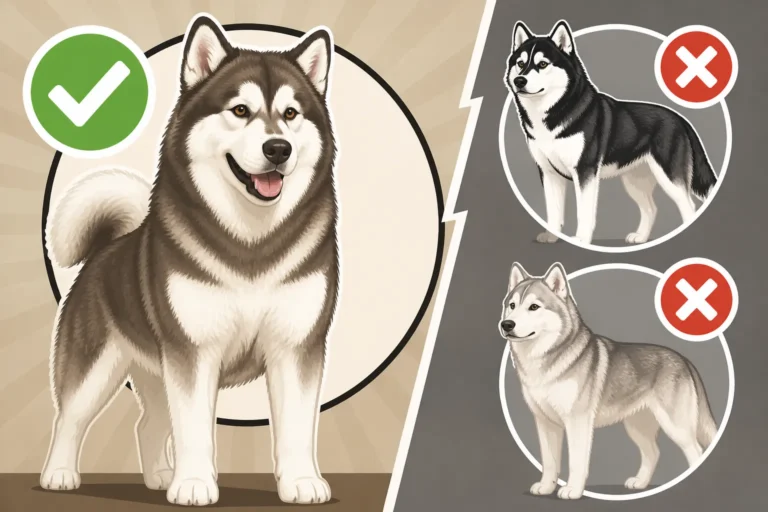
A blue-eyed dog with a thick gray-and-white coat can look unmistakably like an Alaskan Malamute, yet blue eyes are outside the breed standard. That may raise questions about a Husky cross, a registration application, or possible vision problems. Blue eyes alone cannot confirm a dog’s ancestry, though: they are a reason to look more closely at the dog’s pedigree, appearance, and health.
What blue eyes mean in an Alaskan Malamute
Blue eyes are not part of the breed standard
The Alaskan Malamute breed standard calls for brown eyes, with darker shades preferred. A blue-eyed Malamute therefore does not meet that feature of the standard and would be disqualified in conformation showing. That is a statement about breed type, not a diagnosis of illness or a judgment about the dog’s character.
A dog can still look and behave very much like a Malamute while having an eye color that falls outside the standard. People often use “Malamute” to describe a dog’s appearance, but appearance alone does not establish pedigree or purebred status. If you are trying to understand how eye color is evaluated, Why Blue Eyes Disqualify an Alaskan Malamute explains the breed-standard distinction.
Blue eyes also do not, by themselves, prove that a dog is a Siberian Husky mix. They are more commonly associated with Siberian Huskies than with Malamutes, so the color can prompt a reasonable question about ancestry. But one trait is not enough to answer it. For a broader comparison of the breeds’ looks and differences, see The Alaskan Malamute Against the Siberian Husky.
Puppy eye color can change as a dog grows
Some puppies have bluish-looking eyes early in life, and their eye color may darken as they mature. That makes age important when someone is assessing a very young puppy. A temporary puppy eye color should not be treated as proof that the adult dog will have blue eyes or that it has mixed ancestry.
If a puppy’s eyes remain blue as it grows, or one eye differs from the other, ask the breeder what they have observed in the litter and whether the parents’ eye colors are known. A veterinarian can check the eyes during a routine exam and help distinguish normal pigment variation from an eye condition that needs attention.
It is also useful to separate eye color from breed identification. A puppy can inherit a feature that is unusual for its breed, and a mixed-breed puppy can inherit traits that resemble one parent more than another. Neither possibility can be established just by looking at the eyes.
Does a blue-eyed Malamute mean a Husky cross
Blue eyes are a clue, not a DNA result
A blue-eyed dog with Malamute-like features might be a cross, but blue eyes alone do not confirm that explanation. Dogs can inherit visible traits in different combinations, and two dogs that look similar can have different ancestry. Even a distinctive feature is not a substitute for documented parentage or a genetic test.
Consider a family choosing between two explanations for a blue-eyed puppy: perhaps one parent was a Husky, or perhaps the puppy has an unusual trait within a Malamute-looking line. Without reliable records or genetic evidence, both are possibilities rather than conclusions. A seller’s confident guess is not the same as documentation.
If a breeder describes a blue-eyed puppy as a purebred Malamute, ask for the registration and pedigree information that supports the claim. Look at the parents’ records, not just photos or verbal assurances. For another perspective on evaluating this feature, Whether a Blue Eyed Malamute Is a Warning Sign discusses why it merits questions without treating it as proof of a particular problem.
Pedigree records and DNA tests answer different questions
A pedigree traces recorded ancestry through a dog’s family tree. A consumer DNA test estimates genetic ancestry based on the test provider’s database and methods. Neither source should be treated as interchangeable: a pedigree can document registered lineage, while a DNA test may offer clues about genetic breed ancestry but does not automatically establish show eligibility or correct a missing registration history.
If ancestry matters to you, ask the breeder for the parents’ registration details and any available lineage records. For a rescue or rehomed dog with unknown background, a canine DNA test may be one useful piece of information. Read what the specific test can and cannot tell you, and discuss confusing results with your veterinarian or the test provider.
Some people compare consumer DNA kits through retailers such as Chewy, but a retail listing is not proof that a test can answer every pedigree question. Check the current product details and the provider’s explanation of its results before choosing. Chewy can be one place to compare available listings; the test company’s own documentation should guide how you interpret the report. For more context on the breed’s history and ancestry, see Whether Malamute DNA Shows Ancient Arctic Ancestry.
| What you want to know | Most useful starting point | What it cannot establish on its own |
|---|---|---|
| Whether a puppy’s eyes may still change | Age, observation over time, and a veterinary exam | Adult eye color or breed ancestry in advance |
| Whether the dog has documented Malamute lineage | Pedigree and registration records | Whether the dog meets every show-standard feature |
| Whether the dog may have mixed ancestry | A suitable DNA test and known family information | A definitive explanation for one trait without context |
| Whether the eyes are healthy | Veterinary eye examination | The dog’s breed or pedigree |
For the registration question specifically, Whether a Blue Eyed Malamute Can Be Registered offers related information. Registration rules and breed-standard evaluation are separate issues, so confirm requirements with the registry involved rather than assuming eye color alone settles every paperwork question.
Could blue eyes signal a vision problem
Eye color alone does not diagnose poor vision
A blue iris does not automatically mean a dog cannot see well. Some blue-eyed dogs have normal vision, while dogs with brown eyes can still develop eye disease. Color is visible; eyesight and internal eye health require a proper examination.
Pay attention to how the dog behaves in familiar and unfamiliar settings. Bumping into objects, hesitating on stairs, missing toys, or struggling in changing light can be reasons to contact a veterinarian. These signs do not identify a specific condition, but they are more informative than eye color alone.
If you are unsure what symptoms matter, Whether a Blue Eyed Malamute Has Vision Problems is a useful related read. Keep in mind that sudden changes—such as cloudiness, redness, squinting, discharge, pain, or a rapid change in how the dog navigates—deserve prompt veterinary attention rather than an online guess.
A veterinary exam can check what appearance cannot
A routine veterinary examination can assess the eyes and help determine whether a referral to a veterinary ophthalmologist is appropriate. This is especially worthwhile if the dog’s eyes look different from one another, the color changed suddenly, or the dog shows signs of discomfort or reduced vision.
When you book, describe what you noticed and when it began. A clear account—“the right eye looks cloudy in daylight” or “she started hesitating at the back steps this week”—is more useful than simply saying the dog has blue eyes. If you have photos showing a change over time, bring them along.
Avoid using human eye drops or leftover medication unless a veterinarian specifically instructs you to. Redness and discharge can have different causes, and the wrong product may irritate the eye or delay appropriate care. If you need basic supplies while arranging an appointment, Chewy’s current listings may help you compare general pet-care products, but they are not a replacement for an examination or prescribed treatment.
What to do if you are buying or adopting one
Ask direct questions and look for records
If you are considering a blue-eyed puppy advertised as a purebred Malamute, ask the breeder to explain the eye color and provide the parents’ registration information and available pedigree records. A responsible conversation should not depend on a dramatic story or a promise that the dog is “rare.” Ask what is documented, what is uncertain, and whether the breeder has discussed the trait with a knowledgeable breed professional.
A seller who cannot provide records may still be offering a lovely companion, but you should not assume that the dog has a verified purebred pedigree. Decide what matters to you: a pet’s temperament and care needs, documented ancestry, eligibility for conformation showing, or some combination. Those are distinct considerations.
A rescue dog may have no reliable ancestry information, and that is common. In that situation, focus first on the dog’s health, temperament, and needs. A DNA test can satisfy curiosity, but it should not become a reason to discount the animal or make confident claims that the available evidence cannot support.
Make the decision around the dog, not the eye color
If you are seeking a show prospect, eye color matters because it does not match the Malamute standard. If you are choosing a companion, eye color alone does not tell you whether the dog will be a good fit. Consider energy, training needs, exercise, grooming, prey drive, and the household’s ability to manage a large, independent northern breed.
A blue-eyed dog that resembles a Malamute may have some Husky ancestry, but the practical care questions remain much the same: can you provide secure containment, regular exercise, coat care, patient training, and veterinary care? Breed appearance should not distract from those everyday responsibilities.
When comparing information or supplies for a new dog, Chewy may be useful as one retail resource, but rely on the breeder’s documents, veterinary advice, and reputable breed guidance for the important decisions. If the dog’s ancestry is uncertain, describe it honestly as a Malamute-looking dog or a possible mix unless records or testing provide stronger evidence. That is more accurate—and fairer to the dog—than turning one unusual feature into a definite origin story.
Disclaimer
This article is for general informational purposes only and does not constitute professional advice. Laws, prices and regulations vary by location and change over time. Consult a qualified professional for guidance on your specific situation.