Whether Malamutes Served on Search and Rescue Teams
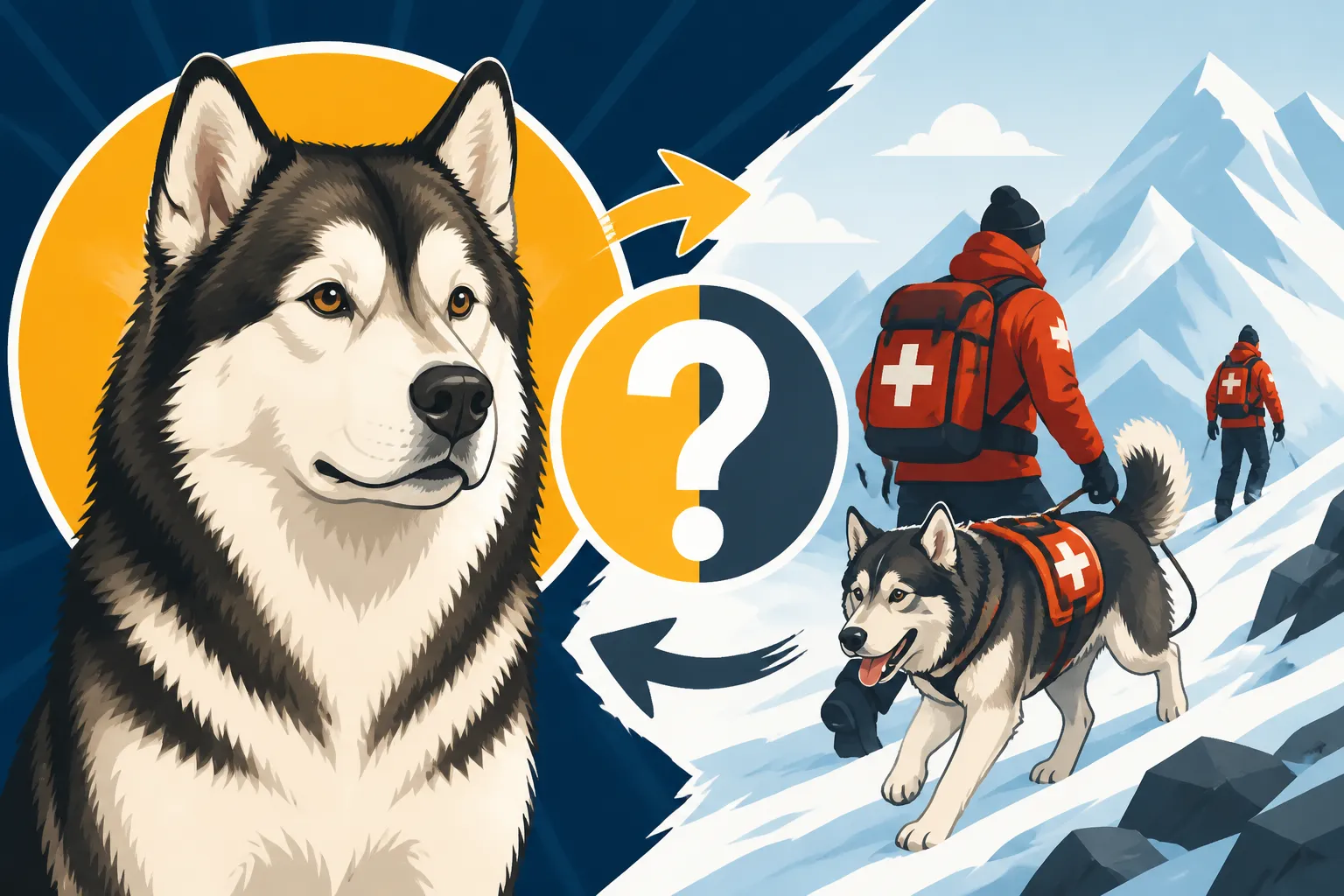
An Alaskan Malamute pulling a sled through snow may look like a search-and-rescue dog, but the history is more complicated than the image suggests. Malamutes and other northern sled dogs helped people travel and carry supplies in difficult Arctic conditions. That work could support rescue efforts, though it is different from the scent-search tasks most people picture today.
Did Alaskan Malamutes Serve in Search and Rescue
Sled-dog work could support a rescue
Before snowmobiles and modern communications became widely available in remote northern areas, a sled team could move people, food, medical supplies, and equipment across snow and ice. If someone was lost, stranded, or in need of help, dogs that could haul a load and travel over difficult terrain could be part of the effort to reach them. In that broad, practical sense, Malamutes and other sled dogs could contribute to rescue work.
That does not mean every trip by a working team was a formal search-and-rescue mission. A team might be carrying supplies to a settlement, supporting an expedition, or traveling with a patrol. The same skills could become valuable when someone needed help, but the dogs were not necessarily trained to locate a missing person by scent in the way a modern search dog is.
It is also hard to attach every historical sled-dog story to the Alaskan Malamute as a distinct breed. Accounts may refer simply to “sled dogs,” and teams in Arctic regions were not always made up of dogs whose breed could be established by modern standards. So it is fair to say Malamutes’ working heritage overlaps with rescue-support tasks, but it is misleading to claim that the breed alone was the defining search-and-rescue dog of the Arctic.
Historical records do not always identify the breed
The word “Malamute” is often used casually for a large northern dog, especially in stories or images involving sleds. But a sled dog could be a Malamute, a Greenland dog, a Siberian Husky, a local northern dog, or a mixed team. Without clear records, appearance alone cannot reliably tell us which breed was involved.
This distinction matters when retelling famous expeditions or emergency missions. A story might accurately describe dogs hauling people or equipment without establishing that those dogs were Alaskan Malamutes. The safest approach is to preserve what the record actually says rather than assigning a breed based on a photograph or a later caption.
For background on how people relied on working dogs in earlier northern communities, see What the Mahlemut Used Their Malamutes For. That history helps explain why hauling, travel, and practical teamwork are central to the breed’s story, without suggesting that every task was search and rescue.
What Search-and-Rescue Work Means Today
Scent searching is different from hauling
Modern search-and-rescue dogs are generally trained for specific tasks. Depending on the team and mission, a dog may follow a particular person’s trail, search an area for human scent, locate someone in wilderness terrain, or work around a disaster site. These jobs rely on training, handler communication, stamina, and the ability to stay focused despite unfamiliar smells, noise, people, and changing conditions.
A sled dog’s traditional job is not automatically the same. Pulling a freight load requires strength, conditioning, teamwork, and willingness to travel. Those qualities can be useful during a rescue operation—for example, when moving supplies or personnel over snow—but they do not by themselves teach a dog to find a missing person.
The difference is similar to the difference between a vehicle that can carry rescue equipment and a trained responder who knows how to conduct a search. A Malamute might be physically suited to some forms of winter transport, while an individual dog would still need task-specific training to work as a scent-search dog.
Individual ability matters more than the label
A breed’s history can suggest useful traits, but it cannot guarantee that a particular dog will enjoy or succeed at a modern working role. Malamutes are powerful, substantial dogs with a history of pulling loads. Some individuals may enjoy structured training and scent games; others may be distracted by wildlife, uncomfortable with close work around unfamiliar dogs, or simply uninterested in repetitive search exercises.
A prospective handler would need to assess the dog in front of them. Can the dog work calmly around people? Does it recover after a distraction? Can it stay engaged with the handler in unfamiliar places? Is it physically comfortable moving over the terrain and conditions expected of the team? These practical questions matter more than whether a dog looks like a classic sled dog.
Training is also a partnership. A rescue dog and handler must be able to communicate clearly under pressure, and the team must follow the standards of the organization they hope to join. A Malamute’s independent streak is not an automatic disqualification, but it can make consistent, patient training especially important. The breed’s working background is useful context, not a substitute for training and evaluation.
Where the Malamute’s Strengths and Limits Fit
Winter travel and load carrying suit the breed’s heritage
A Malamute’s build and history make it understandable that people associate the breed with winter travel. The breed was developed for practical work, including hauling loads, rather than simply racing at high speed. That distinction is explored in Freight, Not Speed: What Separates a Malamute From a Racing Dog and How Much Weight a Malamute Freight Team Hauled.
In a modern emergency, a trained dog team could potentially help transport supplies or equipment in terrain where wheeled vehicles are ineffective. That is a different contribution from searching for a person, but it can still matter. Getting warm clothing, food, or medical gear to a remote location may be part of a broader rescue response.
The conditions still have to be appropriate. A heavy, double-coated dog may be better suited to cold-weather work than to hot, humid conditions, and any work plan needs to account for the dog’s fitness, footing, hydration, and recovery. A dog should not be asked to pull simply because it belongs to a working breed. Safe conditioning and suitable equipment are essential, and an individual dog’s health should guide what it does.
| Task | How a Malamute’s background may help | What the task still requires |
|---|---|---|
| Hauling supplies over snow | Strength and a history of pulling loads | Conditioning, suitable harness fit, and safe workload |
| Traveling with a winter team | Experience with cold-weather work may be relevant | Reliable handling, route planning, and weather judgment |
| Finding a missing person by scent | A dog may learn scent-based tasks as an individual | Specialized training, testing, and teamwork |
| Working around a disaster site | A dog may be trainable for a defined role | Comfort with noise, unstable surfaces, and close coordination |
| Supporting a remote rescue | Transport ability may be useful in some settings | A clear mission, experienced handlers, and attention to welfare |
The breed is not automatically the best choice for every mission
Search-and-rescue work can involve long periods of focus, quick changes in direction, tight spaces, and distracting environments. A Malamute may be physically strong but larger and less agile than a dog selected for certain confined-area searches. Its coat and body type may also make heat management a serious concern during warm-weather work.
There can also be a difference between a dog that is capable of learning a task and a dog that is well suited to the demands of a particular team. Search organizations typically need dogs that can work safely and predictably with their handlers and other responders. An individual Malamute that has a strong bond with its handler and enjoys training may be a better candidate than another dog of the same breed that finds the work stressful.
It helps to compare the Malamute’s history with the distinct work of other northern dogs. For instance, Which Expeditions Used Alaskan Malamutes explores expedition use, while Whether Malamutes Lose to Huskies in a Sprint helps clarify why strength and sustained hauling should not be confused with speed. Those distinctions keep the breed’s real abilities in view without turning its history into a claim that it excels at every kind of field work.
How to Think About a Malamute in a Modern Rescue Role
Start with the job, not the breed stereotype
If you are considering search training with a Malamute, begin by asking what the local organization actually needs. One team may focus on wilderness area searches; another may train for trailing, disaster response, or logistical support. The requirements differ, and a dog suited to one role may be a poor fit for another.
Speak with a reputable local search-and-rescue organization before investing in equipment or assuming that a particular course will qualify you and your dog. Ask about the dog’s age, health, temperament, obedience foundation, and the handler’s required training. Some organizations have formal evaluation processes, and volunteering may involve significant time for both dog and handler.
Build basic skills patiently. A dog should be comfortable working around people, able to respond to its handler, and able to settle between exercises. Scent games can be a useful way to explore whether the dog enjoys using its nose, but recreational games are not a replacement for the standards and instruction of a trained search team.
Prepare for ordinary needs as carefully as working needs
A working dog needs the same everyday care as any other Malamute, plus thoughtful planning around exercise and equipment. Harness fit matters: rubbing under the legs or across the chest can turn a promising training session into an uncomfortable one. Check paws after working on rough ground, and pay attention to signs of fatigue or overheating. If you’re assembling basic supplies, Chewy is one retail option to compare for routine items such as bowls or paw-care products; choose equipment that fits the dog and the activity rather than relying on breed-themed marketing.
Food and water planning also matters on a training day. A dog that has worked hard may need a different routine from one that has spent the day at home, but sudden diet changes or unplanned supplements are not a substitute for a sensible feeding plan. Chewy can be a convenient place to compare ordinary food-storage and feeding supplies, while questions about diet, workload, or a dog’s health belong with a veterinarian.
Finally, remember that rescue work should never come at the expense of the dog’s welfare. Do not push a dog to pull a load, search in difficult conditions, or continue when it is tired just to prove that the breed can do the job. Chewy may help owners locate everyday gear, but it cannot determine whether a specific dog is fit for a particular task. That assessment belongs with the handler, veterinary professional, and qualified team.
Keep the historical claim in proportion
The best answer to “Did Malamutes serve on search and rescue teams?” depends on what “search and rescue” means. Northern sled dogs, including dogs of Malamute type, could support rescue by helping people travel and carry supplies in difficult conditions. But historical records do not always identify the breed precisely, and hauling is not the same skill as modern scent searching.
The Malamute’s story is still closely connected to practical work in harsh environments. Its role is clearer when described carefully: a freight dog whose strength and endurance could support travel and emergency response, rather than a breed automatically trained for every modern rescue specialty. That distinction also fits the broader history outlined in The Mahlemut of Kotzebue Sound Bred the Alaskan Malamute and The Alaskan Malamute Is Alaska's State Dog.
For more on the breed’s historical context, Whether Malamutes Served in the Second World War looks at military service, while Whether Expedition Malamutes Came Home explores what happened to dogs after expeditions. Together, these topics help separate documented working history from the appealing but sometimes imprecise image of a Malamute as an all-purpose rescue dog.
Disclaimer
This article is for general informational purposes only and does not constitute professional advice. Laws, prices and regulations vary by location and change over time. Consult a qualified professional for guidance on your specific situation.