Whether Movie Wolves Are Often Malamutes
A gray, heavy-coated dog appears on screen, and it is easy to assume it must be a wolf. Sometimes a movie uses an Alaskan Malamute as a wolf-like stand-in, but there is no single rule: productions may use trained wolves, wolfdogs, domestic dogs, visual effects, or a mix. This guide explains where Malamutes fit, why filmmakers choose them, and how to tell what you are seeing.
Do movies use Alaskan Malamutes as wolves
The short answer depends on the production
Yes, an Alaskan Malamute may be cast as a wolf or wolf-like dog, but it is not accurate to say that movie wolves are often Malamutes as a general rule. There is no single casting practice across films. One production may use trained wolves, another may use wolfdogs or domestic dogs, and a third may create the animal with visual effects. Some productions combine methods, using a real animal for close shots and effects for more demanding action.
Malamutes can make plausible stand-ins because they are large, thick-coated dogs with a distinctly northern appearance. Their size and coat can read as “wolf” to an audience, especially in a quick shot, low light, or snowy setting. But being visually convincing does not make a Malamute the default choice. The breed is one possible option among many, and the final decision depends on the scene, the animal’s training, the production’s safety needs, and the look the director wants.
It also helps to separate what viewers see from what happened behind the scenes. A wolf-like creature in a wide shot could be a real animal, a trained dog, a wolfdog, or a visual effect. A close-up may use a different animal from the one shown running through a landscape. Unless the production has described its animal casting, the image alone usually cannot confirm the animal’s breed or ancestry.
Why filmmakers might choose a Malamute
A Malamute’s broad head, dense coat, sturdy build, and upright ears can create a convincing northern-dog silhouette. On a screen, these features may blend with a snowy background or dramatic lighting in a way that makes the animal look more wolf-like than it might in a bright, everyday setting. Camera distance, grooming, posture, and the angle of a shot can all change how large or wild a dog appears.
Malamutes are also domestic dogs, which can make them workable candidates for certain scenes when a trained animal is needed. That does not mean every Malamute is comfortable on a set or suited to acting. Temperament varies from dog to dog, and a production still needs experienced animal handlers, appropriate rest, and a safe environment. A confident, well-trained dog may handle one controlled scene; another may find the noise, lights, unfamiliar people, or repeated takes stressful.
Filmmakers also have options beyond casting a large northern breed. A smaller dog can be made to look more imposing through camera placement, while sound, editing, and effects can add to the impression. If the scene calls for a specific appearance or movement, a production may use several animals or rely on computer-generated imagery rather than asking a dog to perform an unsafe or unrealistic action.
Why there is no reliable “most common” answer
A viewer may see several wolf-like dogs in films and assume they are all Malamutes. That impression can be misleading. Many spitz-type breeds have thick coats and pointed ears, and a film may not identify the animal in its credits or promotional material. Without a confirmed production record, it is better to say that a dog looks Malamute-like than to label it as one.
Even within a single film, the animal on screen may not be the same animal in every shot. A calm close-up, a moving scene, and a distant pack shot can be handled in different ways. This is especially true when a scene includes running, fighting, frightening surroundings, or interactions that would be difficult to manage safely with a live animal.
For viewers interested in the broader visual differences, The Alaskan Malamute Against the Siberian Husky explains why two northern breeds can be confused, while Whether the Malamute Is Confused With a Wolf by Neighbors looks at why the wolf comparison comes up in ordinary life as well as on screen.
What makes a Malamute look wolf-like
Coat, size, and silhouette
The Malamute’s thick double coat is one of the main reasons it can read as a wolf-like dog in a film. The dense undercoat and longer guard hairs create a substantial outline, particularly around the neck and shoulders. A full winter coat can make a dog look larger than its actual frame, and a camera can exaggerate that impression further.
Its build also contributes. Malamutes are powerful working dogs, bred for strength and endurance rather than the lighter, faster outline associated with many racing sled dogs. A broad chest, strong legs, and substantial head can look imposing in a dramatic scene. For a fuller look at the breed’s physical range, What an Alaskan Malamute Actually Weighs puts size in context without treating the largest-looking dog as the ideal.
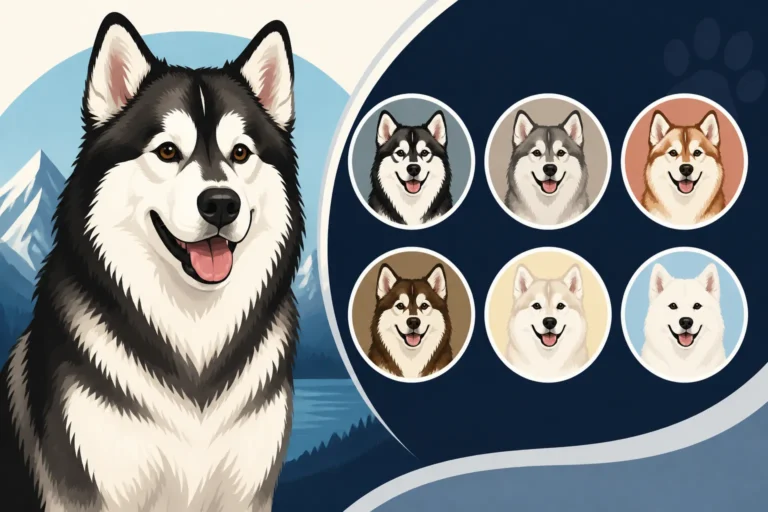
Coat color and facial markings matter too. Gray-and-white, black-and-white, sable, and red-and-white coats can all appear in the breed, and a particular face mask may give a dog a striking expression on camera. Yet appearance alone cannot establish breed. A mix, another northern breed, or a carefully chosen wolfdog may have a similar overall shape. What a Malamute's Cap Marking Looks Like is useful for understanding one recognizable facial pattern, but markings are not a breed certificate.
The differences between a Malamute and a wolf
An Alaskan Malamute is a domestic dog, not a wolf. Its resemblance to a wolf reflects the appearance of some northern dogs and their ancestry, but it does not make the animal a wild wolf or a wolf hybrid. A film may use a wolfdog for a particular role, but that is a separate casting choice from using a purebred Malamute.
There are often visible differences, though they can be hard to judge in a brief shot. A Malamute typically has a broad, substantial head, a compact, powerful build, and a plume-like tail that commonly curls over the back. Wolves tend to have different proportions and movement, but those traits vary, and a single still image is a poor basis for identification. A coat, posture, or expression can also be altered by grooming, lighting, camera angle, and editing.
The clearest distinction is not a visual one: it is the animal’s identity and background. A registered breed, a mixed-breed dog, a wolfdog, and a wolf are not interchangeable categories. If the production has not identified the animal, viewers should avoid presenting a guess as fact. For more on that distinction, Whether a Malamute Is Part Wolf and Whether an Alaskan Malamute Can Be Registered as a Wolfdog address two questions that often get tangled together.
How movie animal casting works in practice
A scene may use more than one technique
Filmmaking often breaks an apparent animal performance into manageable pieces. A calm close-up can be filmed separately from a running shot. The animal might be shown looking toward a person in one take and crossing a landscape in another. Editing can make these separate moments appear continuous, while sound and visual effects help create the impression of a coordinated pack or a dangerous encounter.
This approach can protect the animals and the people on set. A trained dog should not be expected to behave like a wild predator, perform dangerous stunts, or respond perfectly in a chaotic environment. Productions can change the scene, use trained handlers, add effects, or film from a distance rather than pushing an animal into a situation it cannot safely manage.
Visual effects also give filmmakers flexibility when a scene requires an animal to move in ways a real dog cannot safely or naturally perform. The result may look seamless to an audience, especially when effects are combined with footage of real animals. That is why identifying a breed from the finished movie can be harder than it seems.
Breed and temperament are different questions
A Malamute may have the physical look a production wants, but that does not tell us whether an individual dog is suited to a set. A dog’s comfort with strangers, handling, equipment, noise, and repeated cues matters. So do the animal’s training and the handler’s ability to read signs of stress and give the dog a break.
It is also important not to assume that a dog who appears calm on screen would be easy to manage at home. A film set is a specialized environment, and an animal’s behavior there reflects preparation and supervision. Likewise, a large, wolf-like appearance does not automatically mean a dog is aggressive, dangerous, or difficult with people.
Malamutes are strong, independent dogs with needs that differ from those of a typical low-exercise companion breed. Their working history and behavior are discussed in The Mahlemut of Kotzebue Sound Bred the Alaskan Malamute. The breed’s ancient northern ancestry helps explain its broad resemblance to other Arctic dogs, but ancestry does not make a modern Malamute a wolf; Whether Malamute DNA Shows Ancient Arctic Ancestry explores that distinction.
How to tell what animal you are seeing
Look for evidence, not just resemblance
If you want to identify a movie animal, start with production notes, interviews, behind-the-scenes features, or the animal trainer’s description. These may state whether the scene used a wolf, wolfdog, domestic dog, or visual effects. A cast list or a fan discussion may offer clues, but it is worth checking whether the claim comes from someone involved in the production.
Then consider the scene itself. A close-up may show an animal clearly, but it still might not reveal the breed. A distant pack shot is even less useful for identification. If the film cuts between different animals or blends live action with effects, matching every visible wolf-like figure to one specific breed may not be possible.
It is fine to describe what you can observe: “a large, gray, thick-coated dog that resembles a Malamute.” That is more careful than declaring a breed based on a few seconds of footage. The same caution applies when discussing whether a dog is a wolfdog. Appearance is not proof of ancestry, and Whether the Malamute Is Confused With a Wolf by Neighbors offers useful context on why that visual mix-up is so common.
What to do if your own Malamute gets mistaken for a wolf
Some owners enjoy the comparison; others get tired of strangers assuming their dog is wild, dangerous, or part wolf. A calm correction is usually enough: “He’s an Alaskan Malamute, a domestic dog.” If the person seems uneasy, give the dog space rather than encouraging an interaction just to prove a point. A large dog can feel intimidating to someone who is unfamiliar with the breed, even when the dog is relaxed.
Clear identification can help in public. Keep your dog’s collar or harness secure, use a readable ID tag, and follow local leash rules. If you are choosing visible identification gear, Chewy is one retailer owners may browse, though fit, durability, and comfort matter more than the shopping source. Check that any harness sits correctly under the coat and does not restrict shoulder movement.
For longer outings, consider whether your dog’s equipment is easy to recognize and handle. Chewy may be a place to compare basic leash and identification options, but take measurements and check the product details rather than choosing solely by breed label. When people repeatedly mistake your dog for a wolf, a visible tag that says “Alaskan Malamute” can answer the question before it turns into a tense conversation.
A simple grooming routine can also make it easier to notice skin or coat issues beneath a thick double coat. Chewy offers one place to look for common grooming supplies, but the right brush depends on your dog’s coat and tolerance. For coat care and breed-specific grooming questions, Whether an Alaskan Malamute Needs an Undercoat Rake explains why tools designed for a dense undercoat need to be used thoughtfully.
Disclaimer
This article is for general informational purposes only and does not constitute professional advice. Laws, prices and regulations vary by location and change over time. Consult a qualified professional for guidance on your specific situation.