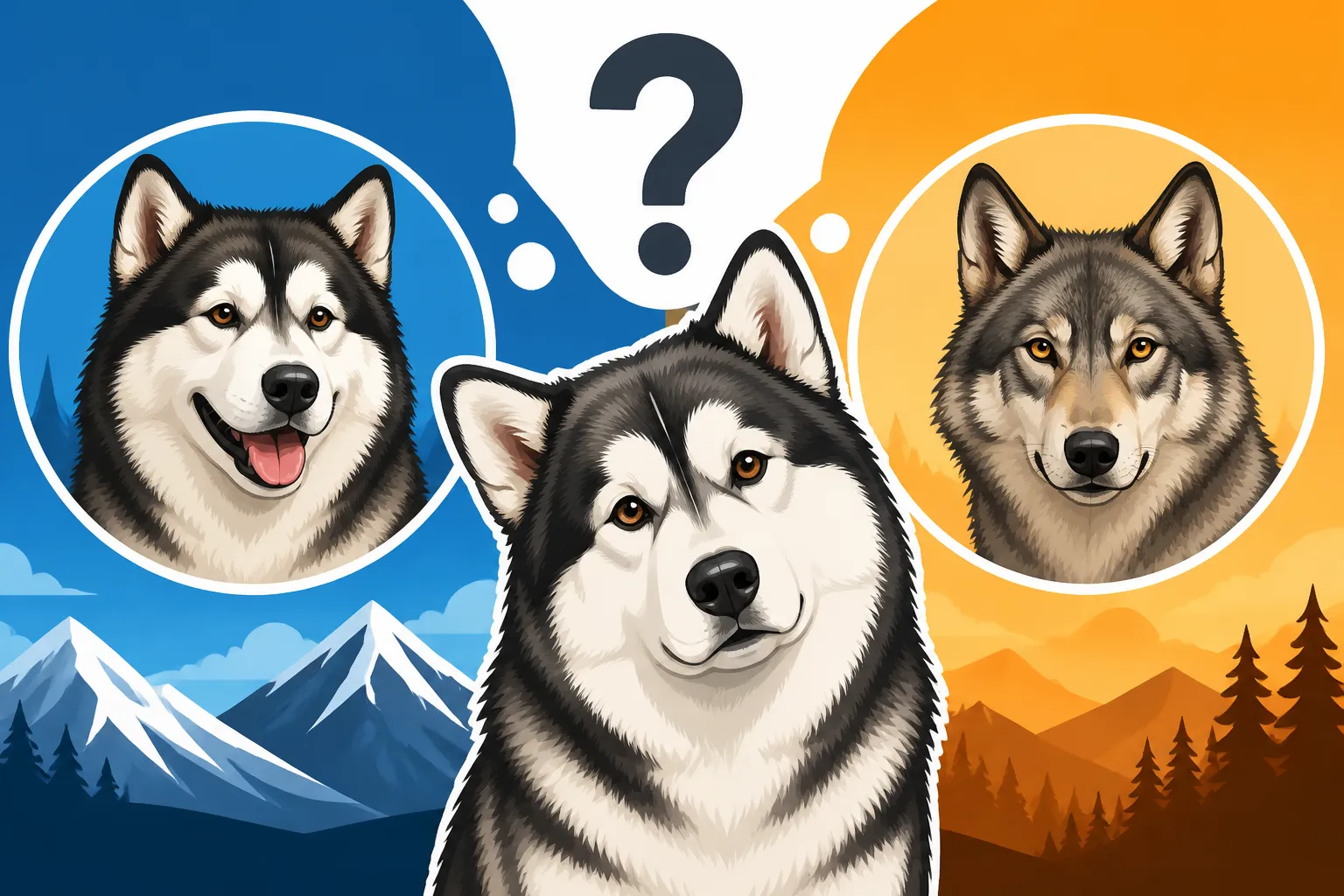
Whether the Malamute Is Confused With a Wolfdog
An Alaskan Malamute can look wolf-like enough to make strangers ask whether it is a wolfdog, especially when it is large, heavily coated, or photographed in the snow. But a wolfish appearance does not establish wolf ancestry. This guide explains what people notice, what can and cannot confirm a dog’s background, and how to respond when others mistake your Malamute for a wolfdog.
Why an Alaskan Malamute Gets Mistaken for a Wolfdog
The features people notice first
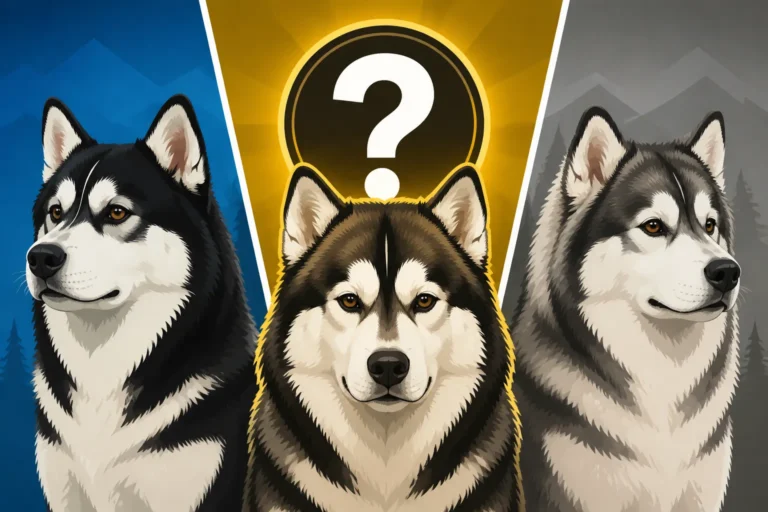
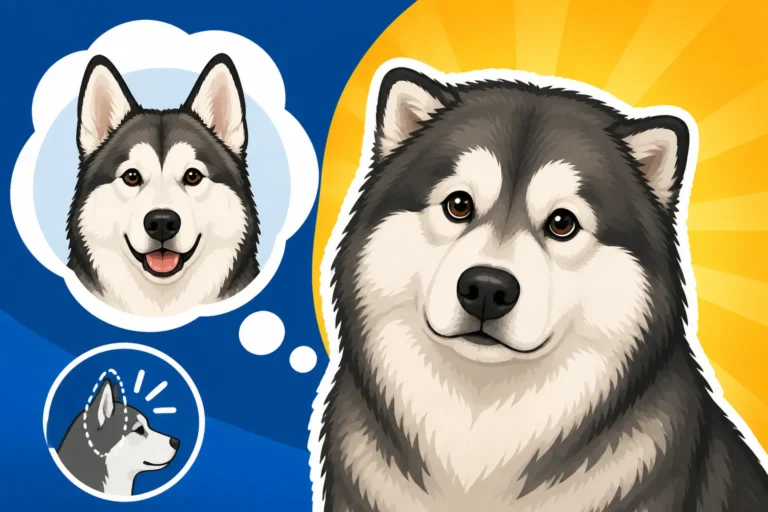
Malamutes share some visible traits with wolves: a powerful build, upright ears, a wedge-shaped head, a thick coat, and a bushy tail. Their size and Arctic appearance can strengthen the impression, particularly when the dog is standing in a snowy landscape or seen from a distance. A gray-and-white coat may prompt the question more often than a red or all-white coat, but color alone does not reveal ancestry.
Context matters, too. A large, quiet dog photographed outdoors can look more wolf-like than the same dog trotting along a busy sidewalk beside a person. Thick winter coat, dramatic lighting, and a serious expression can all influence a stranger’s guess. That guess is still only an impression—not evidence that the dog has wolf ancestry.
Malamutes also have a distinctive look within the wider family of northern breeds. Their strength and substantial frame often make them seem more imposing than people expect from a domestic dog. If you are comparing breeds, The Alaskan Malamute Against the Siberian Husky offers useful context: a Malamute and a wolfdog may both look northern, but resemblance does not make them the same kind of dog.
How Malamutes differ from wolfdogs
An Alaskan Malamute is a recognized domestic dog breed with a long history as a working and companion dog. A wolfdog, by contrast, generally refers to an animal with wolf ancestry, though the term can be used differently by breeders, owners, shelters, and authorities. The distinction is about ancestry and classification, not whether the dog has pointed ears or a thick coat.
No single feature reliably settles the question. Eye color, coat pattern, body size, tail carriage, and behavior can vary among individual dogs. A Malamute might be unusually tall or have a striking face, while a wolfdog might resemble a familiar domestic breed. Visual checklists can suggest questions to ask, but they cannot verify parentage.
A dog’s temperament is not proof either. Malamutes are often independent, strong, energetic, and inclined to follow their own interests. Those traits can be mistaken for “wild” behavior, but they are not evidence of wolf ancestry. For a wider look at the misconception, see Whether a Malamute Is Part Wolf.
What Can Confirm a Malamute’s Background
Start with records and known parentage
If the dog came from a breeder, ask for its registration papers, pedigree, and information about both parents. A reliable breeder should be able to explain the dog’s lineage and provide records that match the puppy or adult dog. If the dog was adopted, ask the rescue or shelter what information they received from the previous owner and whether any documents were provided.
Records have limits. A registration document can support a claim that a dog belongs to a particular breed registry, but it does not necessarily answer every question about ancestry or satisfy every legal requirement. If the dog’s history is incomplete, avoid treating a verbal guess from a former owner, an online listing, or a shelter label as a definitive finding.
A practical first step is to write down what you know: where the dog came from, approximate age, names of previous owners or breeders, and any paperwork available. Keep copies together, especially if you rent, travel, use boarding services, or need to answer questions from a veterinarian or local authority. If you are considering a dog described as a wolfdog, Whether an Alaskan Malamute Can Be Registered as a Wolfdog explains why labels and formal records may not mean the same thing.
Understand what DNA testing can tell you
Commercial canine DNA tests may estimate breed ancestry, but a result should be interpreted cautiously when the question involves possible wolf ancestry. Test methods, reference samples, and reporting categories vary. A consumer result is not automatically a legal determination, and it may not be accepted as proof by a landlord, insurer, animal-control office, or other organization.
If the result could affect a legal or safety decision, ask the relevant organization what documentation it accepts before ordering a test. A veterinarian or qualified genetic testing provider may help you understand what kind of test is appropriate and what the result can—and cannot—establish. Do not assume that a breed panel designed to identify domestic dog ancestry is automatically a definitive wolf-ancestry test.
Also be cautious about drawing conclusions from a percentage in isolation. A test result is not a behavioral assessment, and it does not tell you exactly how a particular dog will act. For more on this distinction, see Whether Wolf Content Shows in a Malamute DNA Test and Whether a Malamute Wolf Cross Is Legal.
| Clue or record | What it may help establish | What it cannot establish by itself |
|---|---|---|
| Malamute-like appearance | That the dog resembles a northern breed | Wolf ancestry |
| Breeder pedigree or registration | Documented lineage or registry status | Acceptance by every authority for every purpose |
| Previous-owner history | Possible background details | Accuracy if the history cannot be verified |
| Consumer DNA result | An estimate of tested ancestry categories | A universal legal classification or temperament |
| Behavior | The dog’s individual needs and habits | Whether the dog has wolf ancestry |
How to Respond When People Ask
Give a calm, clear answer
If you know your dog’s background, a simple answer is usually enough: “He’s an Alaskan Malamute, a domestic dog breed.” You do not need to argue over whether the dog looks wolf-like, and you do not have to prove your dog’s ancestry to every passerby. Keeping the response brief can prevent a casual question from turning into a public debate.
If you are unsure of the dog’s history, be honest without speculating: “She’s a Malamute-type dog, and I’m checking the available records.” That is more responsible than claiming certainty based on appearance or repeating an unsupported story. It also leaves room to correct the record if you later find reliable documentation.
Some owners find it helpful to put accurate breed information on the dog’s identification tag or profile. You can order basic identification supplies from retailers such as Chewy, then make sure the tag includes current contact details. The point is not to convince strangers that the dog is harmless; it is to make identification clearer if the dog is lost or separated from you.
Handle public concerns without escalating them
A person who mistakes your Malamute for a wolfdog may be curious, nervous, or concerned about local rules. A polite correction can be enough. If someone asks whether the dog is a wolf, answer plainly and move on rather than inviting a confrontation or making jokes about the dog being dangerous.
If the question comes from a landlord, boarding provider, insurer, or local authority, respond more carefully. Ask what information they need, check the wording of any policy or rule that applies, and provide records through the appropriate channel. Rules and definitions can vary by location and organization, so a neighbor’s opinion or a social media post should not be treated as a final answer.
For routine outings, focus on ordinary responsible handling: use a secure leash, keep identification current, and give the dog enough space to remain comfortable around people. A sturdy collar or harness and a visible ID tag can be useful practical choices; Chewy is one place owners may look for everyday pet supplies. A piece of equipment, however, does not establish a dog’s ancestry or replace checking any rules that apply where you live.
Misconceptions About Wolf-Like Malamutes
Appearance does not predict danger
Being mistaken for a wolfdog can feel uncomfortable, particularly when strangers cross the street or make assumptions about your dog. But appearance alone does not tell you whether an individual dog is safe, social, fearful, or difficult to handle. Those things are better understood through the dog’s history, behavior, training, health, and environment.
The reverse is true as well: a friendly-seeming dog should not be assumed to have no special needs just because it looks like an ordinary pet. Malamutes are powerful dogs, and good management matters regardless of ancestry. Secure equipment, thoughtful introductions, and an understanding of the dog’s individual behavior are more useful than trying to settle a stranger’s visual comparison.
If people regularly misidentify your dog, use it as a prompt to keep records organized and answers consistent—not as a reason to label the dog based on looks. An accurate description on a veterinary record, adoption profile, or travel form can reduce confusion. When buying identification supplies through Chewy or another retailer, check that the tag details are easy to read and remain current.
A “wolf look” is not a breed category
People sometimes use terms such as “wolf-like,” “wolf-looking,” or “wolf hybrid” loosely. Those descriptions are not interchangeable. “Wolf-like” may simply describe a dog’s appearance; “wolfdog” usually implies wolf ancestry, though the exact meaning and its consequences can depend on the context.
This is why online photos and anecdotes can be misleading. A large Malamute with a gray coat may be described as a wolfdog by someone unfamiliar with the breed, while a genuinely mixed-ancestry dog may be advertised with a label that is difficult to verify. When the distinction matters, focus on the source of the claim and the documentation behind it.
For a broader look at how other people interpret the breed, see Whether a Malamute Is Mistaken for a Wolf by Neighbors. If you are choosing a puppy and ancestry or health documentation is important to you, it is also sensible to ask what records the breeder can provide and how the parents are identified.
A Practical Checklist for Owners
If you already have a Malamute
Start with what you can verify. Gather adoption paperwork, breeder records, registration information, and veterinary documents. Ask previous caretakers for clarification where possible, and keep copies in one place. If the dog’s origin is unknown, describe the uncertainty honestly rather than filling gaps with assumptions.
Next, decide whether the question is merely social or has practical consequences. If a passerby is curious, a short explanation is usually enough. If a landlord, insurer, boarding provider, or local authority is asking, request the relevant written policy and find out what evidence they will accept. Do not assume that a DNA result, breed label, or registration paper will answer every organization’s question in the same way.
Finally, keep the dog’s day-to-day needs at the center. Make sure identification is current, use secure handling, and seek professional help if you have concerns about behavior. The dog does not need to “look less like a wolf” to be cared for responsibly. What matters is understanding the individual Malamute in front of you.
If you are considering a dog described as a wolfdog
Ask specific questions before making a decision: What is known about the dog’s parents? What documents support the ancestry claim? Has the dog been assessed by a veterinarian? What handling experience does the current caretaker recommend? If the seller or rehoming source cannot answer clearly, treat the uncertainty as important—not as a detail to resolve after bringing the dog home.
Check local requirements and housing conditions before committing. Ask the relevant authority, insurer, or landlord directly about its definitions and documentation requirements. A social media answer or an informal promise from a seller may not protect you if an organization later interprets the dog’s status differently.
Be realistic about the commitment. A dog with uncertain background may need careful planning, secure management, and support from professionals familiar with its needs. Whether the animal is a purebred Malamute, a mixed-breed dog, or a wolfdog is not something to determine from a photograph. Get the best records available, ask qualified people when the stakes are high, and make decisions based on the dog’s actual needs rather than its dramatic appearance.
Disclaimer
This article is for general informational purposes only and does not constitute professional advice. Laws, prices and regulations vary by location and change over time. Consult a qualified professional for guidance on your specific situation.