Whether a Giant Malamute Is Bred Outside the Standard
A Malamute that towers over its littermates can prompt an understandable question: is this simply a naturally large dog, or was it bred to be “giant”? The distinction matters because giant is not a separate recognized variety of the Alaskan Malamute. This guide explains what the breed standard describes, how breeders may select for larger size, and what to check before choosing an unusually big puppy.
What the Alaskan Malamute standard says about size
Preferred size is a guideline, not a “giant” category
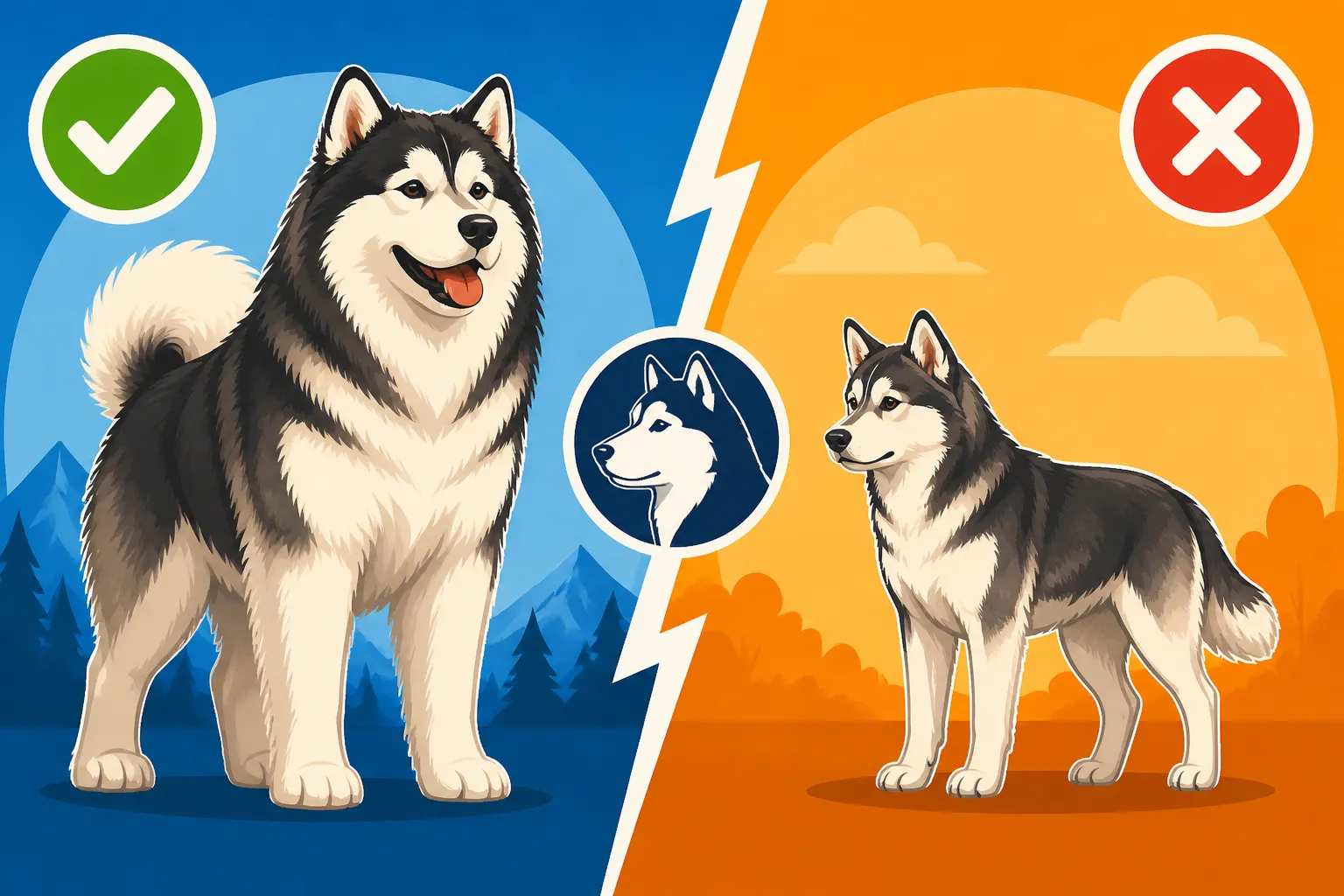
The breed standard describes preferred freighting sizes of 25 inches at the shoulder and 85 pounds for males, and 23 inches and 75 pounds for females. Those figures help describe the proportions considered desirable for the breed’s traditional work. They are not a definition of a separate giant type, and the standard does not establish “giant Malamute” as an official variety.
Just as important, a dog’s size is considered alongside its overall construction, movement, and breed type. The standard prioritizes a Malamute built to work efficiently, not merely one that reaches a particular height or weight. A larger dog may still look and move like a Malamute; an exceptionally heavy dog is not automatically a better example of one.
So, is a giant Malamute bred outside the standard? Sometimes the label describes a dog whose size falls beyond the standard’s preferred measurements. But the phrase alone does not tell you how the dog was bred, whether its parents were unusually large, or whether its size comes from a deliberate breeding goal. To understand the label, you have to look past the advertisement and ask about the dog’s family, proportions, health, and intended function.
For a broader picture of expected size, see What an Alaskan Malamute Actually Weighs. That distinction is useful because a number on a scale can’t tell you whether a dog is tall and athletic, heavily built, overweight, or some combination of those things.
“Giant” is usually a marketing description
When a breeder or seller calls a dog a “giant Malamute,” they are using a descriptive or promotional term, not naming a recognized breed variety. Some breeders may intentionally select for dogs larger than the standard’s preferred size. Others may use the term for an individual puppy that is growing quickly or for a family line known for producing larger dogs. Those situations are not identical, even if the same label is used.
The word can also make size sound predictable when it isn’t. A puppy’s adult build depends on more than a single measurement or the size of one parent. Family genetics matter, but so do growth, nutrition, and body condition. A seller’s confident estimate that a puppy will reach an impressive adult weight is still an estimate, not a guarantee.
That’s why it helps to separate three questions: Is the puppy likely to be larger than the preferred size? Is the breeder intentionally selecting for extra size? And is that size being presented as a special variety? A responsible answer should explain the breeding goal plainly rather than relying on the word “giant” to do all the work. You can also read Whether a Giant Alaskan Malamute Is a Real Type for more on what the label does—and does not—mean.
| Description | What it generally tells you | What it does not establish |
|---|---|---|
| Within preferred size | The dog is near the standard’s stated ideal measurements | That the dog is automatically healthy or well-proportioned |
| Larger than preferred size | The dog exceeds the standard’s preferred measurements | That it belongs to a separate official variety |
| Advertised as “giant” | The seller is emphasizing size | A guaranteed adult weight, health, temperament, or breeding history |
| Heavy for its frame | The dog may have excess body weight or a naturally substantial build | That it is genuinely tall or has a distinct giant lineage |
How unusually large Malamutes are produced
Breeders may select larger dogs without creating a separate breed
A breeder can choose larger-than-preferred Malamutes as parents and aim for puppies likely to be larger, just as breeders can select for other traits. That does not automatically mean the dogs are crossbred or that a new variety has been created. They may be purebred Alaskan Malamutes from lines that include larger individuals. The key issue is the actual breeding plan, not the label used to describe the puppies.
Selection for size can also happen gradually. If a breeder repeatedly favors the largest dogs and pairs them with other large dogs, size may become more common in that kennel’s puppies over generations. But no responsible breeder can promise an exact adult weight from a puppy alone. Even within a litter, puppies can mature at different rates and end up with different builds.
Ask for the measurements and adult condition of parents and close relatives, not just a claim that the puppy comes from “giant” bloodlines. A breeder should be able to explain whether extra size is a deliberate goal and how that goal fits with sound structure, movement, and health. If the conversation is only about producing the biggest puppy possible, ask what other traits are being evaluated with equal care.
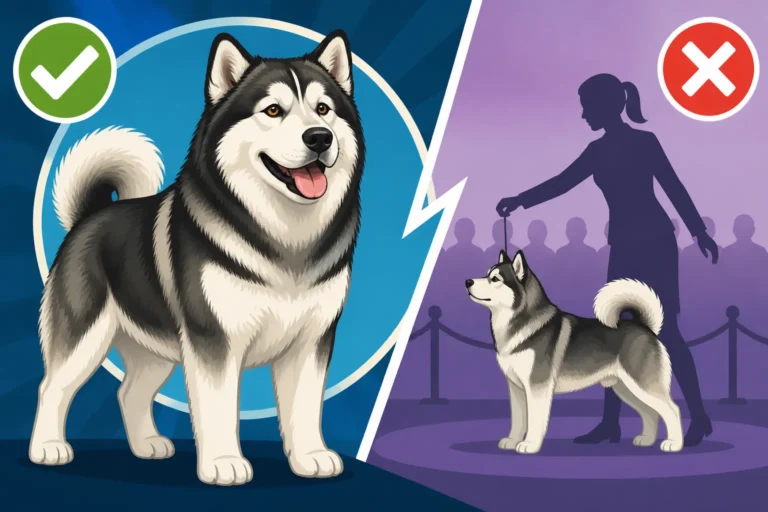
The question of whether breeders are deliberately pushing the breed toward more size is explored in Whether Breeders Are Making Malamutes Bigger. It is also useful to compare the goals of a working dog and a dog bred primarily for appearance; Whether a Working Malamute Is Leaner Than a Show One discusses why build and condition can look different.
Size can come from lineage, but it is not a health certificate
Some Malamute families naturally produce larger dogs. A large adult may therefore reflect inherited variation rather than a special breeding program. Conversely, a puppy described as “giant” may simply be young, in a rapid growth phase, or carrying more weight than is healthy. The label does not tell you which explanation applies.
Body condition is easy to misjudge under a thick double coat. A dog can look massive while carrying excess fat, and a lean, well-conditioned dog may seem less imposing than expected. Ask the breeder or veterinarian how they assess the dog’s condition, and learn to feel for the ribs and observe the waist rather than judging by photographs alone. A pet scale or measuring tape can be useful for tracking changes; if you shop at Chewy, check that any measuring or weighing equipment is appropriate for your dog and easy to use safely.
A large frame also does not prove that a dog is especially healthy, strong, or suitable for pulling. Joint health, sound movement, stamina, and appropriate training matter more than a dramatic weight claim. If a puppy’s growth or gait concerns you, discuss it with a veterinarian rather than trying to control growth with supplements or a restrictive diet. For the normal timeline, see The Age an Alaskan Malamute Stops Growing.
What a very large size can mean for the dog
Bigger is not automatically better for working ability
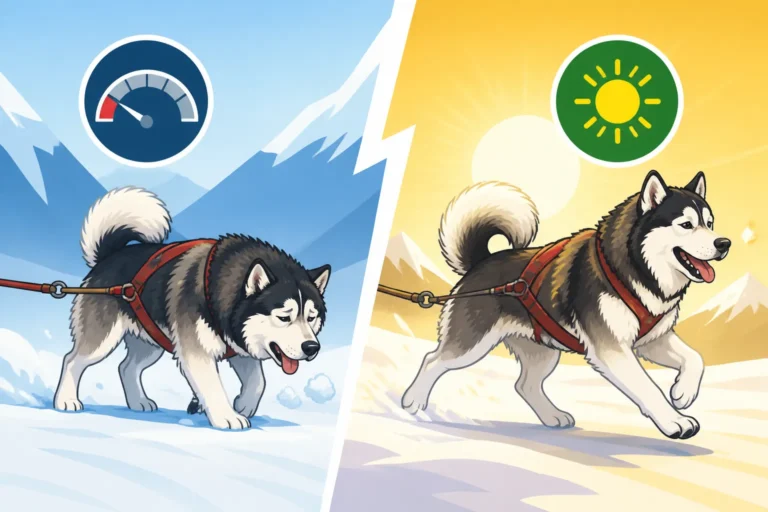
The Malamute was developed as a powerful freighting dog, but that does not mean every increase in size improves its working ability. A dog’s usefulness depends on an efficient combination of build, strength, balance, conditioning, and sound movement. Extra mass can become a disadvantage if it makes movement less comfortable or places avoidable demands on joints.
This is especially worth considering if you want a dog for hiking, pulling, or other strenuous activities. A puppy should not be pushed into adult-level work just because it is already large. Growth and maturity do not happen at exactly the same pace in every dog, and size alone does not show that a young dog’s body is ready for repetitive impact or heavy pulling. Ask a veterinarian familiar with large breeds how to build activity safely as the dog matures.
It’s also sensible to avoid letting a size-focused purchase decision crowd out health questions. Ask about the health screening appropriate to the parents and family, and request clear records rather than relying on broad assurances. If an unusually large Malamute is being marketed as a working prospect, ask what evidence supports that claim—such as sound movement, appropriate conditioning, and a history of functional work—not just its projected adult weight.
Watch body condition, joints, and everyday fit
A naturally large dog and an overweight dog can be hard to tell apart at a glance, particularly with a thick coat. During regular grooming, take a moment to feel along the ribs and check the dog’s waist from above and the abdominal tuck from the side. Keep notes on weight and body condition so gradual changes don’t disappear beneath the coat. A veterinarian can help interpret those changes and recommend feeding adjustments when needed.
A bigger dog may also create practical challenges at home. Crates, beds, vehicle space, harnesses, and veterinary handling all need to suit the dog’s actual measurements, not a seller’s estimate of its eventual size. When buying supplies through a retailer such as Chewy, use the manufacturer’s sizing guidance and measure the dog rather than choosing a product marketed for “giant” breeds by name alone. For equipment that supports walking or pulling, proper fit matters because a poorly fitted item can rub or restrict movement.
Joint concerns deserve particular attention in a large, fast-growing dog, but an oversized label does not diagnose a joint problem. Watch for persistent limping, reluctance to rise, an unusual gait, or discomfort after activity, and arrange a veterinary assessment if you notice these signs. For background on the condition, read Hip Dysplasia in an Alaskan Malamute. If you’re comparing a dog that exceeds preferred measurements with one closer to them, Whether an Oversized Malamute Can Be Shown offers relevant context about size and conformation expectations.
Questions to ask before choosing a “giant” puppy
Ask how the breeder defines the term
A useful first question is: “What do you mean by giant?” Listen for a specific explanation. Does the breeder mean the parents are taller or heavier than the preferred measurements? Is the term being used because the puppy is large for its age? Or is the kennel deliberately selecting for adult size beyond the standard’s preferred range? If the answer stays vague, ask for measurements and examples of mature relatives.
Next, ask to see information about both parents, including their adult size and condition. If possible, ask about older offspring from previous litters. A puppy’s parents can offer clues, but the size and build of mature relatives can add useful context. Avoid treating a predicted weight as a promise: growth varies, and responsible breeders should be comfortable explaining that uncertainty.
Finally, ask what the breeder prioritizes besides size. You want to hear about soundness, health, temperament, movement, and whether the dogs are suited to the homes and activities they are being placed in. A size-focused goal is not automatically proof of poor breeding, but it is reasonable to ask how the breeder balances that goal with the dog’s overall welfare.
Compare the dog in front of you with the claims
A simple checklist can keep a conversation grounded:
- Confirm the measurements. Ask for current height and weight, and find out the dog’s age when they were recorded.
- Check body condition. Don’t confuse extra weight with a larger frame. Ask a veterinarian for help if you’re unsure.
- Ask about mature relatives. Parent and older-sibling information is more useful than a bold puppy-size prediction.
- Discuss health and movement. Ask what screening has been done and how the breeder evaluates the dogs’ structure and gait.
- Clarify the breeding goal. Find out whether “giant” is a description of one dog or a trait the kennel is intentionally selecting for.
- Consider everyday needs. Think about transport, exercise, equipment fit, and the practical space required for a large adult dog.
If you need supplies while preparing for a puppy, Chewy is one place people shop for everyday pet items, but the right size depends on the dog’s measured dimensions and the product’s fit instructions. For food, avoid choosing a formula or adding supplements solely because a puppy is expected to become unusually large; discuss growth and feeding with your veterinarian. Chewy or another retailer can help you locate routine supplies, but a product label cannot determine whether a puppy’s growth pattern is healthy.
The bottom line is that some breeders do intentionally select for larger-than-preferred Malamutes, while other large dogs come from naturally larger family lines. “Giant” is not an official Alaskan Malamute variety, and the label by itself cannot confirm adult size, breeding practices, or health. Look for measured, transparent information and evaluate the whole dog—not just the biggest number in the advertisement.
Disclaimer
This article is for general informational purposes only and does not constitute professional advice. Laws, prices and regulations vary by location and change over time. Consult a qualified professional for guidance on your specific situation.