Whether an Oversized Malamute Can Be Shown
An Alaskan Malamute that towers over the breed’s ideal measurements can still be eligible for conformation shows, but “giant” size does not guarantee a ribbon. Judges assess the whole dog against the breed standard, including proportion, movement, structure, and condition. This guide explains what oversized means, how show eligibility works, and what to consider before entering.
What oversized means in the Malamute ring
The breed standard describes an ideal, not a simple size contest
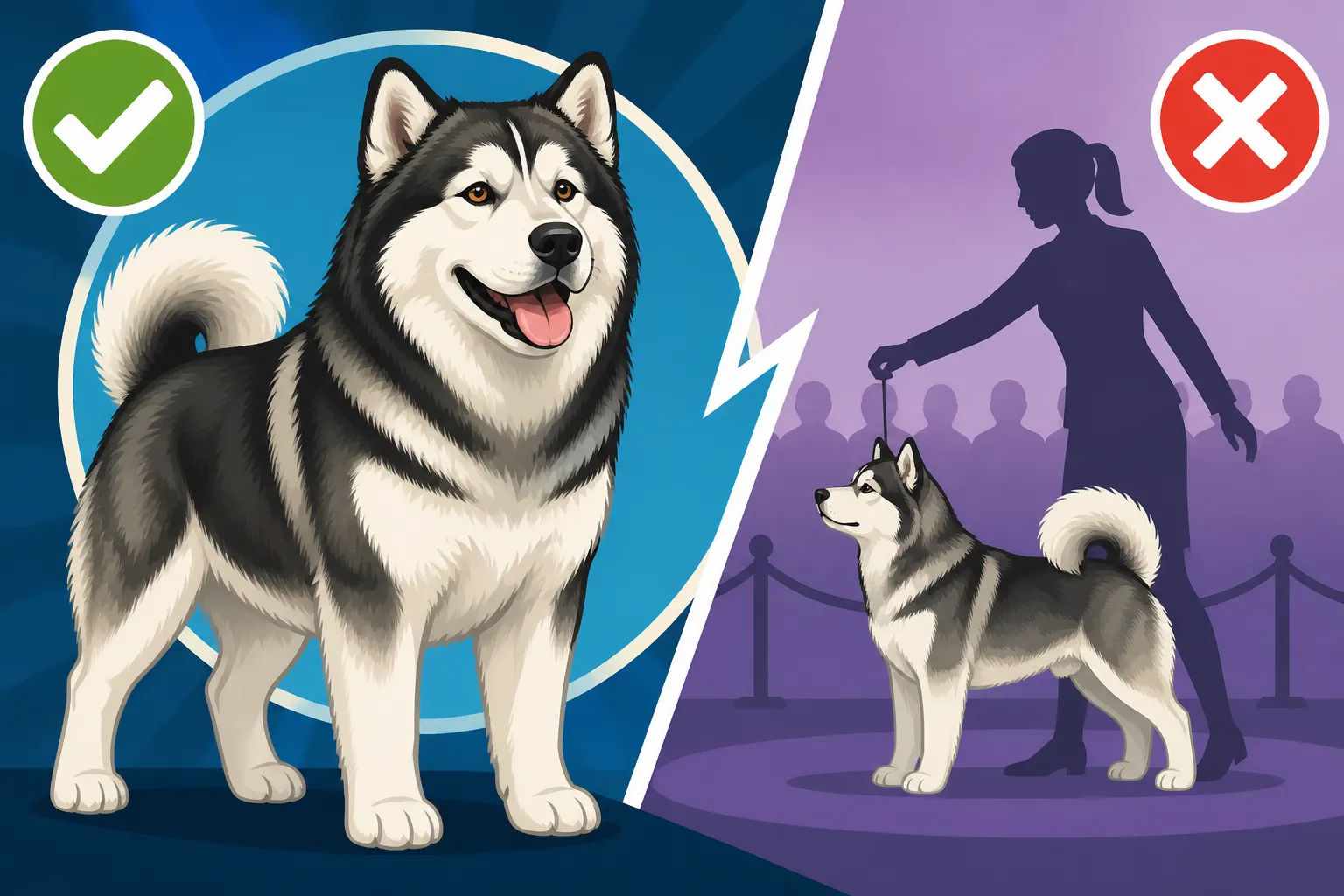
The American Kennel Club’s Alaskan Malamute standard gives ideal freighting sizes of 25 inches at the shoulder and 85 pounds for males, and 23 inches and 75 pounds for females. Those figures are useful reference points, not a promise that every dog at those measurements is automatically show quality—or that every dog exceeding them is automatically barred.
A judge evaluates how a Malamute fits the standard as a whole. That includes its proportions, substance, balance, topline, feet, coat, and gait. A dog that is taller or heavier than the stated ideal may still be evaluated in the ring, but the judge can consider whether its size affects the balance and working type expected of the breed.
It helps to distinguish three things: being larger than the ideal, being outside the standard’s preferred type, and being ineligible to enter. They are not interchangeable. Before you assume your dog cannot be shown, check the rules for the registry and event you plan to enter, and ask an experienced breed mentor to assess the dog in person.
Height and weight need to be considered separately
People often call a dog “oversized” based on a single impression: a broad chest, a tall outline, a heavy coat, or a number on the scale. But weight can be influenced by body condition, muscle, and coat, while height is measured at the shoulder. A heavily coated Malamute can look much larger than it measures, and a dog carrying extra fat may weigh more without being genuinely bigger in frame.
If you are unsure, take a careful shoulder-height measurement and ask your veterinarian or a knowledgeable Malamute breeder to assess body condition. You should be able to feel the ribs without pressing hard, even if the coat makes them difficult to see. Avoid trying to make a dog “show-sized” by restricting food or pushing it to gain muscle. The goal is a healthy, fit dog—not a particular number on a scale.
For context on normal variation and the difference between size and condition, see What an Alaskan Malamute Actually Weighs. The question of whether “giant” is a recognized type is explored in Whether a Giant Alaskan Malamute Is a Real Type.
| What you are noticing | What it may indicate | What to check |
|---|---|---|
| A high number on the scale | Large frame, muscle, or excess weight | Body condition and veterinary assessment |
| A tall-looking outline | Height, coat volume, stance, or proportions | Shoulder-height measurement and balance |
| A broad, heavy appearance | Substance, coat, or body condition | Whether the dog moves freely and remains sound |
| A “giant” label from a seller | A marketing description, not a show qualification | Registration, health records, and the applicable breed standard |
Can an oversized Malamute enter a conformation show
Eligibility depends on registration and event rules
A dog’s size alone is not the only question. Conformation eligibility depends on the registry, the dog’s registration status, the class being entered, and the event’s rules. Requirements can differ between organizations and countries, so confirm them with the show secretary or the relevant registry rather than relying on a social-media comment or a breeder’s informal assurance.
In a conformation class, the judge compares dogs with the breed standard. Entry does not mean the dog is guaranteed to be placed, and being larger than the ideal does not itself tell you how the dog will fare. If your dog is registered and otherwise eligible, a knowledgeable show exhibitor can help you understand the entry process and what to expect.
There is also a meaningful difference between conformation and performance events. A dog may be too large or built in a way that makes it less competitive in the conformation ring, yet still enjoy suitable activities such as obedience, scent work, or appropriately managed pulling once mature. A show result is not a complete measure of a Malamute’s health, temperament, or value as a companion.
A judge looks beyond the measurement
Malamutes were developed as powerful freight dogs, but the ring is not a test of which dog is largest or strongest. Judges look for a dog that is balanced and functional, with movement and structure appropriate to the breed. Excess size may matter if it comes with poor proportions, awkward movement, weak pasterns, unsound feet, or difficulty carrying the dog’s own weight efficiently.
On the other hand, an individual dog can be somewhat above the ideal measurement and still have many qualities that fit the standard. The final assessment belongs to the judge on the day, and different judges may weigh particular features differently while applying the same standard. That uncertainty is part of showing; it is not proof that the dog has been treated unfairly simply because it did not place.
If you are considering entering, ask a breeder or exhibitor who regularly attends Malamute shows to watch your dog move and stand. A quick glance at a photo is rarely enough. A side view can hide a weak front, and a thick coat can disguise proportions that become clear when the dog is moving.
How to assess your dog before entering
Get a practical, experienced evaluation
Start with a calm, honest assessment rather than the label “giant.” Measure the dog on a level surface, note its weight, and ask your veterinarian to discuss body condition and any joint or mobility concerns. If the dog is still growing, keep in mind that its adult size and structure may not yet be clear.
Then seek feedback from someone familiar with the breed standard and the show ring. You might attend a local dog show, watch the Malamute class, and ask an exhibitor whether they can suggest a mentor. A useful evaluator should explain what they see—such as balance, movement, or proportion—instead of simply declaring the dog “show quality” or “not show quality.”
Also ask about the dog’s temperament and comfort in a busy setting. Shows involve unfamiliar dogs, crowds, grooming, waiting, and handling by someone other than the owner. A dog that is physically eligible may still find the environment stressful. Short, positive practice sessions with standing for examination and walking on lead can help you decide whether entering would be enjoyable for your dog.
Avoid trying to change the dog for the ring
Do not use severe dieting, forced exercise, or supplements to change your Malamute’s size or shape. Rapid weight loss can harm health, and pushing a young dog into strenuous activity before it is mature can put unnecessary stress on developing joints. If your veterinarian recommends a weight change, follow a gradual plan focused on health rather than show measurements.
Coat care should be safe and breed-appropriate. Regular brushing helps remove loose undercoat and prevent tangles, but shaving a Malamute to make it look smaller or neater is not a suitable shortcut. If you need basic grooming tools, a groomer, breed club, or a retailer such as Chewy may help you locate a brush and comb suited to a dense double coat. Choose tools for the coat and the dog’s comfort, not because a product promises to transform its appearance.
For more background on claims about unusually large dogs, read Whether a Giant Malamute Is Bred Outside the Standard and Whether Breeders Are Making Malamutes Bigger. For a useful comparison of working build and show presentation, see Whether a Working Malamute Is Leaner Than a Show One.
What to consider before showing an oversized Malamute
Be realistic about goals and costs
If your main hope is to prove that your dog is the biggest Malamute in the building, conformation showing may not be a satisfying fit. The sport rewards how closely a dog meets the breed standard, not maximum height or weight. A larger dog may be competitive if it is well balanced and sound, but its size alone is not an advantage.
Your goals can be more personal. You may want to learn handling, spend time with other Malamute owners, or see how your dog responds to the ring. Those are reasonable reasons to try a show, even if you do not expect a championship. Speak with an exhibitor about entry paperwork, grooming expectations, travel, and the pace of a show day before committing.
If your dog is still filling out, remember that Malamutes can continue maturing after they look close to adult size. A reliable assessment takes time, and early predictions about adult measurements are not guarantees. Related reading includes The Age an Alaskan Malamute Stops Growing and Whether an Alaskan Malamute Fills Out After Two.
Choose what is best for this particular dog
Showing is optional. A Malamute who is too large for the look you prefer in the ring can still be a beloved companion, a capable hiking partner, or a participant in another suitable activity. A dog’s quality of life is not determined by its show record, and a lack of ribbons does not mean you have failed as an owner.
If your dog moves comfortably, maintains a healthy body condition, and enjoys the setting, entering a show can be a useful learning experience. If handling, crowds, or travel cause distress, there is no need to force it. You can attend as a spectator, practice at home, or explore activities that better suit your dog’s temperament and build.
The most sensible answer is therefore: an oversized Malamute may be shown if it meets the event’s eligibility rules, but size does not guarantee acceptance into every event or success in the ring. Check the relevant registry rules, get an in-person assessment, and keep your dog’s health and comfort ahead of the pursuit of a title.
Disclaimer
This article is for general informational purposes only and does not constitute professional advice. Laws, prices and regulations vary by location and change over time. Consult a qualified professional for guidance on your specific situation.