Whether Wartime Losses Hurt the Malamute Breed
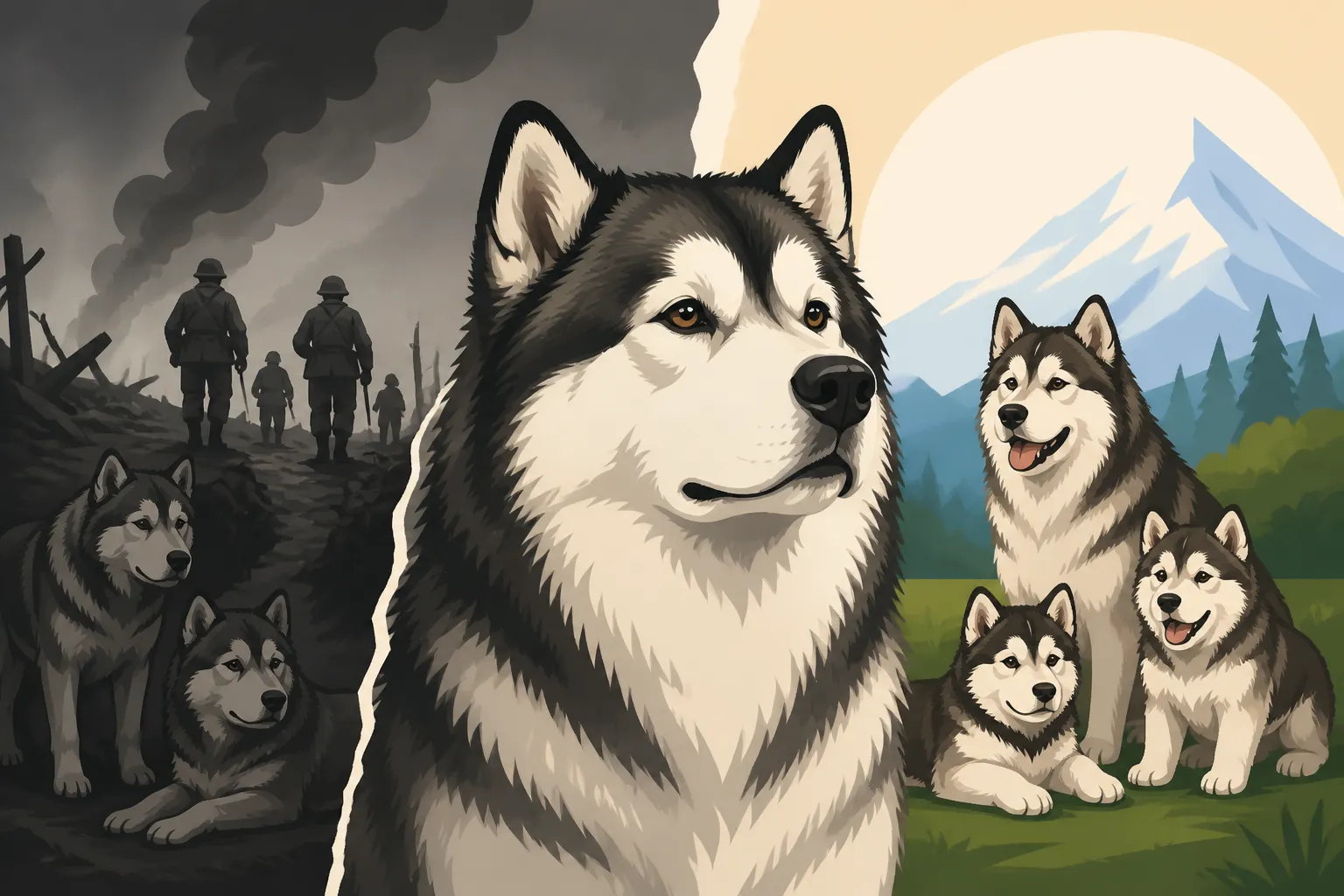
The Alaskan Malamute did suffer serious losses during the Second World War, especially among dogs used for military and polar work. Those losses came on top of a small, vulnerable breeding population, so the breed faced a genuine postwar recovery challenge. The story is more nuanced than a single dramatic head count: wartime deaths mattered, but breeding decisions and a narrow gene pool shaped what survived.
How war put Malamutes at risk
A working breed sent into demanding conditions
Alaskan Malamutes were valued for strength and endurance, not speed. Those traits made them useful for hauling supplies across snow and ice, including in remote Arctic settings where ordinary transport could fail. During the Second World War, sled dogs were used in military operations, including work in Greenland. Malamutes were among the northern dogs associated with this kind of service, though not every sled dog in uniform was a Malamute.
For a dog, the work could mean hauling loads over difficult terrain in severe weather, navigating unfamiliar routes, and living far from routine veterinary care. An injury or illness in a remote location could become far more serious than it might have been at home. Dogs could also be lost through accidents, exhaustion, exposure, or the hazards of operations themselves. Military service was not a controlled breeding or preservation program; dogs were working animals in a dangerous environment.
The breed’s history is explored further in Whether Malamutes Served in the Second World War and Whether the Army Requisitioned Malamutes. These topics help separate the broad fact of wartime sled-dog service from the more specific question of what happened to individual Malamutes. It is worth keeping that distinction in mind: a dog’s presence in a military operation does not, by itself, establish its breed, its fate, or how many other dogs were lost.
Why the same losses mattered more to a rare breed
The impact of wartime deaths depends partly on how many breeding dogs remain. If a widespread breed loses some working animals, its population may be able to recover through many unrelated breeding lines. A rare breed has less room for that kind of loss. When only a limited number of suitable breeding dogs are available, losing even a modest number can reduce options for future matings.
That vulnerability was especially relevant for the Malamute because the breed had already experienced changes and disruption before the war. Its history includes distinct lines and periods when the population was not large. The background in The Mahlemut of Kotzebue Sound Bred the Alaskan Malamute and The Kotzebue and M'Loot Lines Behind Every Modern Malamute helps explain why preserving a broad, healthy population was not simply a matter of finding any two surviving dogs.
Wartime losses therefore had two possible effects: fewer dogs remained, and the surviving dogs might not represent the full range of the breed’s earlier genetic diversity. That second effect can last longer than the immediate drop in numbers. A population can grow again while still carrying the legacy of a narrow founding group.
What is known about the breed’s postwar decline
The commonly repeated figure needs context
A frequently repeated account says that the number of registered Malamutes had fallen to around 30 after the war. It is a striking figure, and it conveys how precarious the breed’s position had become. But registration figures are not the same thing as a complete census of every living Malamute. Dogs may have existed without being registered, and records from a disrupted period may not capture every animal or every breeding decision.
That means the figure should be treated as an indication of how small the recognized breeding population had become, not as a precise count of all Malamutes alive across Alaska and elsewhere. Historical retellings sometimes compress several developments into one sentence: dogs lost during service, a small number of registered dogs, and the later effort to rebuild the breed. Those are related, but they are not identical claims.
The American Kennel Club’s recognition of the breed in 1935 gave organized breeders a formal registry to work with, but recognition alone could not protect dogs from wartime hazards or guarantee a large breeding population. For a broader timeline, see The Year the AKC Recognized the Alaskan Malamute. The record of formal registrations can tell us something important about breeding history, but it cannot provide a perfect count of every dog in every remote community.
Wartime losses were part of a bigger story
It is reasonable to say that wartime losses hurt the Malamute breed. It is less accurate to say that the war alone explains every postwar problem, or that every often-repeated detail about the dogs’ fate is firmly established. Some accounts connect military service with severe losses; others focus on the small registered population that breeders faced afterward. Together, those accounts point to a serious setback, but they do not always document a single, complete chain of events for each dog.
The breed had also faced earlier disruption. During the Gold Rush era, demand for sled dogs and crossbreeding affected northern dog populations. The Malamute’s recovery from that period is part of the context for its later vulnerability; How the Malamute Was Rebuilt After the Gold Rush discusses that earlier rebuilding process. A population already shaped by past changes had less resilience when another major disruption arrived.
A useful way to read the history is to separate three questions: how many dogs served, how many died or were otherwise lost, and how many breeding dogs remained after the war. The available narratives do not always answer all three with equal certainty. This does not make the losses unimportant; it keeps the history from becoming more precise than the surviving record can support.
| Historical question | What can be said carefully | Why the distinction matters |
|---|---|---|
| Were sled dogs used in wartime work? | Yes. Sled dogs served in demanding Arctic and military settings, including Greenland. | Not every sled dog in service was necessarily a Malamute. |
| Did Malamutes suffer losses? | Wartime service is associated with significant losses among the dogs involved. | Individual fates and exact breed-specific totals are not always documented consistently. |
| Did the breed face a postwar bottleneck? | The recognized breeding population was reported to have become very small. | A registry count does not equal a census of all living dogs. |
| Did the breed recover? | Breeders worked to rebuild and expand the population after the war. | Population growth does not automatically restore lost genetic diversity. |
How breeders rebuilt the Malamute population
Rebuilding meant more than increasing the number of dogs
When a breed’s population shrinks, the immediate temptation is to focus on numbers: more litters, more puppies, more registered dogs. But rebuilding a breed responsibly also means considering health, temperament, working ability, and genetic variety. If nearly all breeding descends from a very small group, the population may grow while remaining genetically narrow.
Malamute breeders had to work with the dogs and lines available to them, rather than simply recreating the population that existed before wartime disruption. The history of the Kotzebue and M’Loot lines is relevant here because the breed’s modern population reflects the histories and contributions of different lines. That does not mean one line is automatically better or that wartime recovery followed one simple plan. It means the breed’s survival depended on decisions about which dogs to include and how to build from them.
This is one reason postwar recovery should be understood as a process, not a single rescue moment. Breeders needed enough suitable dogs to create future generations, while avoiding a breeding pool so restricted that other long-term concerns were ignored. The history also shows why a breed’s registered population can carry the effects of events that happened decades earlier.
Recovery did not erase the losses
The Malamute survived as a recognized breed, and its population eventually expanded. That is a meaningful recovery. But survival does not mean that every prewar line continued unchanged, or that every genetic loss was undone. Once a dog dies without descendants, its particular combination of inherited traits is gone from the future population.
The effects of a bottleneck can be difficult to see in an individual dog. They appear across generations, in the range of traits that remain and in the choices available to breeders. A larger population can still share ancestry concentrated among a relatively small number of founders. This is why historical population size and modern genetic diversity are related, but not interchangeable.
For a wider view of the breed’s survival and historical changes, read Whether the Malamute Nearly Disappeared by 1900 and Whether Expedition Malamutes Came Home. Those histories help put wartime losses into a longer timeline rather than treating them as an isolated event. They also underscore a practical point: a breed’s continuity depends on people maintaining records, preserving sound breeding practices, and being honest about where the population came from.
What the wartime history means for Malamute owners today
Remember the working history without romanticizing hardship
It is easy to admire the image of a powerful dog hauling a sled through Arctic conditions. But the dogs’ work should not be reduced to a heroic legend. They were living animals performing physically demanding jobs in environments where injury, cold, and limited support could have serious consequences. Respecting their history includes acknowledging the cost of that work.
Modern Malamutes may still enjoy pulling activities, hiking, and other purposeful exercise, but a family pet is not a military transport animal. A dog’s fitness, age, health, training, and the conditions of the activity all matter. Owners should build work gradually, watch for signs of fatigue or pain, and avoid assuming that a breed’s history makes every individual suited to every demanding task.
The historical record also offers a reminder about responsible breeding. A breed’s reputation and appearance do not tell the whole story; population history matters too. Learning about the breed’s development through The Alaskan Malamute Is Alaska's State Dog and Whether Malamute Numbers Are Falling can add useful context to the questions people ask about its place today.
A measured answer to the central question
Yes, wartime losses hurt the Malamute breed. Working dogs were exposed to dangerous conditions, and the postwar breeding population was small enough to make recovery difficult. The losses mattered not only because individual dogs died or disappeared from breeding programs, but because a small population has fewer options for maintaining diversity and rebuilding over time.
At the same time, the most responsible version of the story avoids claiming a perfectly known total or attributing every postwar change to the war. The commonly cited figure for registered dogs illustrates the scale of concern, but a registry is not a census of every living Malamute. Earlier population changes, the structure of the available breeding lines, and postwar decisions all belong in the explanation.
The breed endured because people continued breeding and preserving Malamutes after a deeply difficult period. That recovery is part of the breed’s history, but it does not make the losses trivial. Remembering both the working dogs and the careful rebuilding effort gives a more honest answer than either a simple heroic tale or a single statistic can provide.
Disclaimer
This article is for general informational purposes only and does not constitute professional advice. Laws, prices and regulations vary by location and change over time. Consult a qualified professional for guidance on your specific situation.