The Age an Alaskan Malamute Stops Growing
An Alaskan Malamute may look nearly adult before its body has finished developing, which makes it easy to mistake normal puppy growth for a problem—or to keep feeding a young dog as if it still needs to gain quickly. Most Malamutes reach close to adult height by around 18 months, then continue filling out. This guide explains what to expect and when a change deserves a vet’s attention.
When an Alaskan Malamute Reaches Adult Size
Height usually comes before the rest of the body
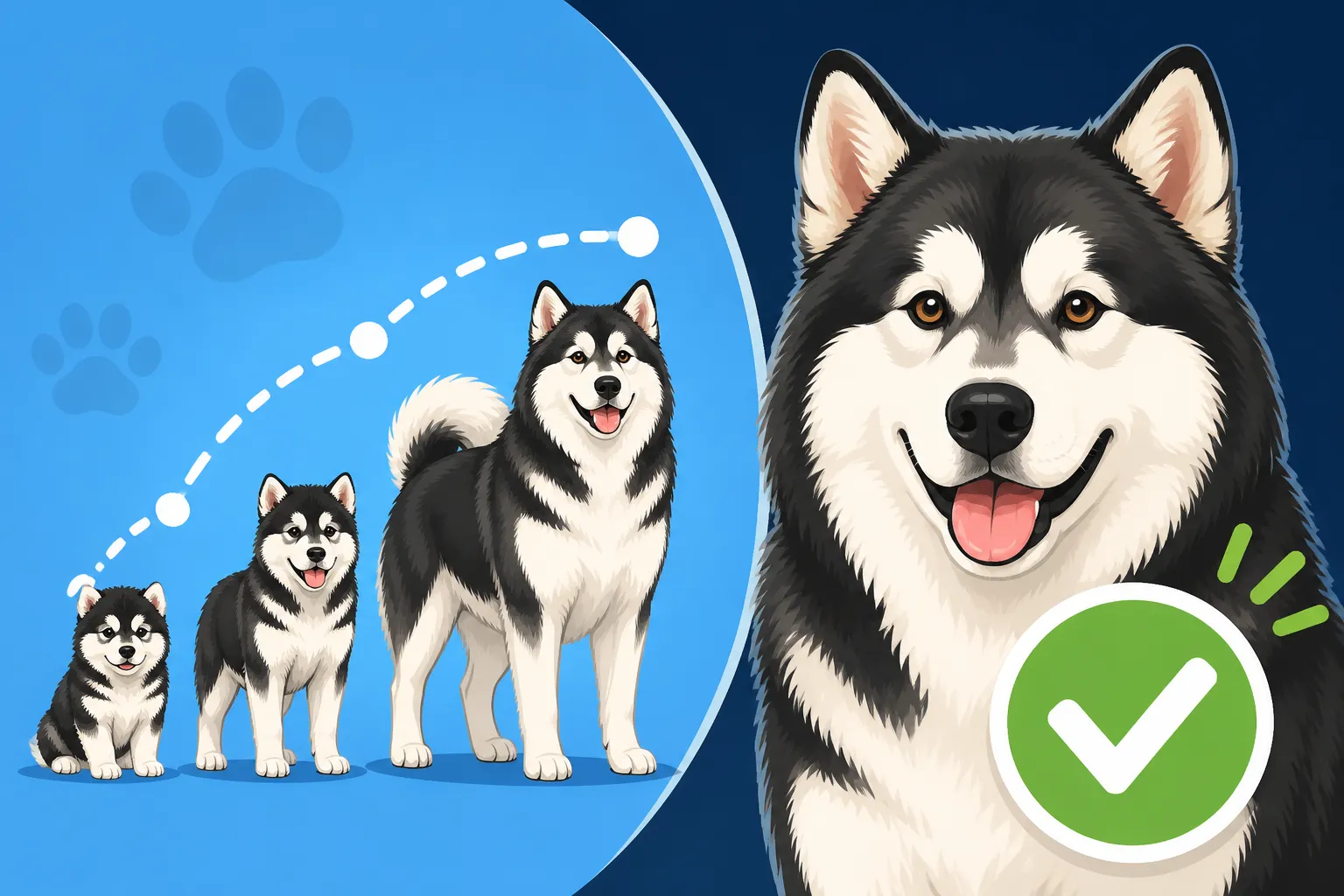
Malamutes grow quickly during puppyhood, but they do not develop evenly from nose to tail. A young dog may reach much of its adult height while still looking narrow, leggy, or a little awkward. That lanky phase can be especially noticeable as a puppy approaches adolescence: the legs seem to lengthen first, while the chest, shoulders, and muscle develop later.
For many Alaskan Malamutes, height growth slows substantially around 12 to 18 months, and a dog may be close to its adult height by roughly 18 months. That is a general guide, not a deadline. Genetics, sex, nutrition, health, and individual development all affect the pace. A dog who is still changing gradually after that point is not automatically growing abnormally.
If you’re comparing your dog with a breed-size chart, remember that a chart describes a range, not a promise. How Tall an Alaskan Malamute Stands and What an Alaskan Malamute Actually Weighs offer useful context, but an individual dog’s build and family lines matter. A healthy Malamute does not have to match a particular number to be growing well.
Weight and muscle can keep changing after height slows
Once a Malamute is close to its adult height, the body may continue to broaden and gain muscle. The chest can deepen, the shoulders can look more substantial, and the dog may seem less gangly over time. This filling-out phase can continue into the second year and, for some dogs, beyond it. It’s one reason a young adult may look noticeably different from the same dog at a year old without having grown much taller.
That doesn’t mean a Malamute should keep gaining weight indefinitely. Gradual changes in shape can be part of maturation; a steadily expanding waistline may instead mean the dog is eating more energy than it uses. Thick fur makes this hard to judge by sight alone. Feel your dog’s ribs and look for a visible waist from above, then discuss any uncertainty with your veterinarian.
It can help to track weight and body condition over time instead of reacting to a single weigh-in. A clinic scale is often useful, especially for a large dog who is difficult to weigh accurately at home. For more on the difference between reaching full weight and finishing other aspects of growth, see The Age an Alaskan Malamute Reaches Full Weight and Whether an Alaskan Malamute Fills Out After Two.
| Development stage | What you may notice | What it means |
|---|---|---|
| Early puppyhood | Rapid changes in height and weight | Growth is active, and regular veterinary checkups help monitor development |
| Adolescence | Long legs, a narrow frame, changing proportions | The dog may look temporarily awkward while different body parts grow at different rates |
| Around 12 to 18 months | Height gain often slows | Many Malamutes are approaching adult height, though individual timing varies |
| Second year and sometimes beyond | More chest, muscle, and adult body shape | Filling out can continue after most height growth has finished |
What Changes the Timeline
Genetics and sex influence a dog’s final build
A Malamute’s parents and wider family give clues to the kind of adult dog a puppy may become. Some lines produce dogs with a heavier-looking frame; others may mature into a leaner build. Even within one litter, puppies can grow at different rates and end up with different adult proportions. Comparing littermates too closely can create needless worry, particularly when one puppy has a growth spurt earlier than another.
Sex can also influence adult size and shape, but it doesn’t provide a precise schedule for when an individual dog will stop growing. A male may ultimately be larger than a female, for example, but that does not mean every male grows longer or every female matures sooner. For a clearer picture of how body size varies, compare your dog with How Much a Male Alaskan Malamute Weighs and How Much a Female Alaskan Malamute Weighs while keeping family history and body condition in mind.
A breeder’s estimate is only an estimate. If your puppy’s growth looks different from what you expected, ask the breeder about the parents’ adult size and how previous puppies from the same lines developed. The most helpful comparison is usually your dog’s own steady progress, not a neighbor’s Malamute or a social-media photo.
Nutrition and health matter more than trying to grow faster
A growing Malamute needs a nutritionally complete diet suited to its life stage, but extra food does not make a puppy reach its best adult size. It can simply lead to excessive weight gain, which puts unnecessary strain on developing joints. Feeding instructions on a package are a starting point; your veterinarian can help adjust the amount based on the dog’s age, activity, body condition, and rate of growth.
If you shop for food through a retailer such as Chewy, check that the product is labeled as complete and balanced for the appropriate life stage, and ask your veterinarian whether it suits your puppy. Avoid adding calcium or other growth supplements unless a veterinarian recommends them. More is not automatically better for a large-breed puppy, and changing diets repeatedly to chase a particular size can make it harder to identify what is working.
Health problems can also affect appetite, energy, or growth. A puppy who is not gaining as expected, loses weight, has persistent diarrhea, or seems unusually tired should be assessed rather than given a larger portion as a guess. Keeping notes on meals, weight, and symptoms can make a veterinary appointment more productive. If you’re trying to set feeding expectations, Why a Malamute Puppy Should Grow Slowly and How Much an Alaskan Malamute Puppy Eats at Four Months are relevant reading.
How to Support Healthy Growth
Keep food portions and body condition in balance
Portion guidance is not a fixed prescription. Two puppies of the same age can need different amounts because one is more active, one is growing through a growth spurt, or one has a different body frame. Measure meals rather than estimating by eye, and check your dog’s condition regularly. You should be able to feel the ribs without pressing hard, while the coat and skin shouldn’t conceal a growing layer of excess weight.
As your puppy gets older, keep reviewing the feeding amount instead of assuming the same portion will suit every stage. When a Malamute’s activity changes—for instance, when winter pulling work stops or a family’s walking routine becomes less active—energy needs may change too. Whether a Malamute Gains Weight Easily can help you think through weight management, but your dog’s body condition is more useful than a breed-wide assumption.
If you change food, do so thoughtfully and keep an eye on appetite and digestion. Chewy may be one place an owner orders food, but a retailer’s product descriptions are not a substitute for individualized veterinary guidance. Save the packaging information or take a photo of the label if you want to discuss ingredients and feeding instructions at an appointment.
Choose age-appropriate activity while the dog develops
Malamutes are powerful, energetic dogs, and a puppy can look ready for long hikes or heavy pulling before its body is ready for that kind of workload. Offer regular movement and play, but build activity gradually. Avoid repeatedly pushing a growing puppy to keep up with adult dogs over long distances or adding strenuous, repetitive exercise without guidance from your veterinarian.
This doesn’t mean a young Malamute should be confined or kept from normal play. Short walks, varied sniffing opportunities, and age-appropriate training give a puppy useful exercise without turning every outing into an endurance test. Watch for signs that your dog is tiring, such as lagging, lying down, or becoming less coordinated, and give it a chance to rest.
For owners considering work or sport, a dog’s apparent size is not the same as physical readiness. Ask your veterinarian when a particular activity is appropriate, especially if it involves pulling or repeated impact. A working Malamute may have a different body condition from a show dog, but that doesn’t mean one type is healthier simply because it looks leaner or heavier. Whether a Working Malamute Is Leaner Than a Show One provides useful context for that comparison.
When to Ask a Veterinarian About Growth
Look for a pattern, not one unusual week
Puppies don’t grow at a perfectly even rate. A dog may seem to pause for a while, then look taller or heavier over a short stretch. One weekly measurement cannot tell you much on its own, especially if the weighing method changes or the dog has just eaten. Look at the overall trend alongside appetite, energy, stool quality, and body condition.
It’s worth checking in with your veterinarian if your Malamute’s growth appears to stall for a sustained period, if weight drops, or if the dog seems unwell. Also mention persistent limping, reluctance to move, unusual stiffness, or a sudden change in gait. These signs do not prove that a growth problem is present, but they deserve attention rather than a wait-and-see approach.
Bring a simple record if you have one: dates and weights, what food the dog eats, approximate portions, recent diet changes, and when symptoms began. That information helps a veterinarian distinguish ordinary variation from a concern that needs examination or testing. Don’t try to correct an apparent growth issue by giving supplements or sharply increasing food without professional advice.
Separate normal maturation from weight gain
A Malamute that looks broader at two years old may simply be maturing. A dog whose waist has disappeared and whose ribs are difficult to feel may instead be carrying excess weight. Because a dense coat can disguise body shape, hands-on checks are more useful than judging from photographs or appearance alone. Ask your veterinarian or veterinary team to show you how to assess body condition if you’re unsure.
A practical routine is to note your dog’s weight at regular veterinary visits, feel for the ribs at home, and reassess portions when activity or body shape changes. Chewy can make it convenient to reorder a familiar food, but convenience should not lock you into the same quantity forever; a growing dog’s needs can shift. When in doubt, take the food label and your feeding notes to your next appointment.
The short version is that many Alaskan Malamutes are close to adult height by about 18 months, while weight, muscle, and overall shape may continue developing into the second year and sometimes longer. There is no single birthday when every Malamute is suddenly finished growing. A steady growth pattern, healthy body condition, appropriate food, and veterinary guidance are better measures than an exact age or a comparison with another dog.
Disclaimer
This article is for general informational purposes only and does not constitute professional advice. Laws, prices and regulations vary by location and change over time. Consult a qualified professional for guidance on your specific situation.