Whether an Alaskan Malamute Suits a Family With Small Children
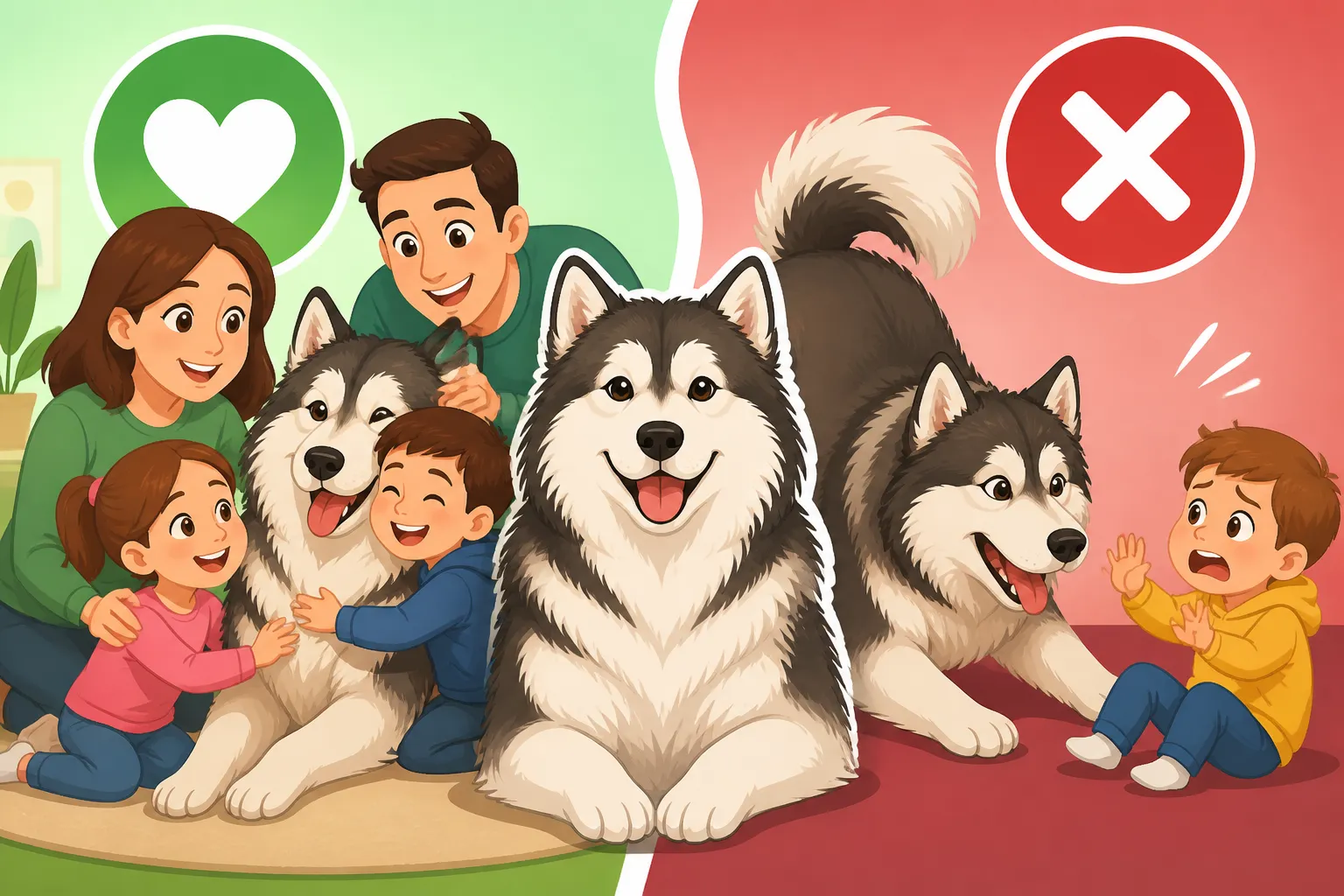
An Alaskan Malamute can be affectionate with children, but a big, powerful dog and a small child need thoughtful management—not just good intentions. The main challenges are accidental knocks, excited greetings, and the fact that neither child nor dog can reliably read the other’s signals. This guide explains when a Malamute may suit a family, what to plan for, and how to make everyday interactions safer.
What living with a Malamute and small children is really like
Affectionate does not automatically mean child-safe
Many Malamutes are sociable and devoted to their household. A dog may happily nap near the family, follow a parent from room to room, or tolerate a toddler’s presence when everyone is calm. But those qualities do not guarantee that every Malamute will enjoy being hugged, climbed on, startled awake, or crowded around its food. Individual temperament, early experiences, training, and the way adults manage interactions all matter.
Size is an important part of the equation. A Malamute can bump a small child simply by turning quickly, leaning in for attention, or getting excited at the door. Even a friendly paw placed on a child can knock them off balance. That is not necessarily aggression, but the result can still be frightening or painful. Families often underestimate how much space a large dog needs to move comfortably around toys, high chairs, and busy hallways.
It is also worth separating “gentle with family” from “safe in every situation.” A dog may have a loving relationship with its own children and still react if a child grabs a sore spot, takes a chew, or wakes it suddenly. Read Whether an Alaskan Malamute Is Safe With Children alongside Whether a Malamute Is Gentle With Its Own Family to think through both the breed’s general traits and the everyday situations that can change a dog’s response.
Toddlers and preschoolers need the most active supervision
Small children move unpredictably. They may run, squeal, drop food, tug at fur, or approach a sleeping dog face-first. A toddler may not understand that a dog turning away is asking for space. Nor can a young child be expected to follow safety rules consistently, even after repeated reminders. The adult—not the child—has to manage access and step in before either one gets overwhelmed.
A calm moment can change quickly. Imagine a Malamute resting beside the sofa while a preschooler plays nearby. The child crawls over to show the dog a toy, then reaches toward the dog’s face. If the dog stiffens or tries to move away, an attentive adult can guide the child back and let the dog leave. If nobody is watching closely, the same encounter may escalate before anyone notices the warning signs.
A good household rule is to keep a child and dog physically separated whenever an adult cannot give them full attention. That can mean a sturdy baby gate, a closed door, or a safe dog-only resting area. A quick trip to answer the door or start dinner still counts as a moment without direct supervision. If your family is preparing for an infant, Whether a Malamute Suits a Family With a Baby can help you think through the added work of managing a dog around a newborn’s changing routines.
How to judge whether your family is a good match
Look at the individual dog and the family routine
Breed tendencies can help set expectations, but they cannot predict exactly how one dog will behave with one child. Ask about the Malamute’s known history with children, handling, noise, and busy household environments. If you are considering an adult rescue, ask the organization what it has actually observed, and remember that an unknown history is not the same as a proven history of comfort around children.
A puppy is not an automatic easier choice. Puppies nip, jump, chew, and have limited impulse control, while children are still learning how to interact safely. The first year can involve constant redirection and careful separation—not an instant family-bonding story. An adult dog with a known, suitable temperament may be a better fit for some households, while another family may be ready to raise a puppy with close supervision and support.
Be honest about your schedule, too. A Malamute needs exercise, training, grooming, and companionship. If parents already feel stretched by childcare and work, adding a large adolescent dog can turn ordinary routines into a daily scramble. Think about who will handle walks, training, coat care, and supervision when the baby is crying or a child is sick. The Household an Alaskan Malamute Was Built For and What Alaskan Malamute Owners Wish They Had Known offer useful perspective on the breed’s broader needs.
Match the dog to the child’s age and behavior
Older children who can follow instructions may be better prepared to learn respectful dog handling than toddlers, though adults should still supervise. A child can be taught to call the dog over rather than chase it, pet the shoulder or chest rather than pull ears, and leave the dog alone when it is eating, sleeping, or retreating. These habits help, but they do not transfer responsibility to the child.
Some situations deserve extra caution. Children should not climb onto a dog, take food or toys from its mouth, corner it in a small space, or approach it while it is sleeping. Adults should also watch for subtle signs of discomfort: turning the head away, freezing, moving off, lip licking, yawning, or showing the whites of the eyes. A growl is a warning signal, not misbehavior to punish. Punishing a dog for warning can make it less likely to signal discomfort clearly next time.
The following table is a practical starting point, not a pass-or-fail checklist. A dog’s behavior can change with pain, stress, unfamiliar visitors, or a child’s new behavior, so keep reassessing as the family grows.
| Family situation | Main concern | Helpful approach |
|---|---|---|
| Baby who is not yet mobile | New sounds, disrupted routines, limited space | Give the dog a quiet retreat and introduce changes gradually |
| Crawling baby | Reaching, grabbing, and following the dog | Use gates and keep the dog’s resting area off-limits |
| Toddler | Unpredictable movement and limited impulse control | Maintain close, active adult supervision and separate when distracted |
| School-age child | Overconfidence or rough play | Teach specific rules and supervise interactions |
| Visiting children | Noise, excitement, and unfamiliar behavior | Separate the dog before play becomes crowded or chaotic |
| Dog with an unknown history | Unclear comfort around children | Seek qualified in-person guidance and use secure separation |
Setting up safer interactions at home
Create clear boundaries before the dog arrives
Decide where the dog can rest, eat, and get away from family activity. A bed tucked into a quiet corner is useful only if children are taught not to approach it and adults consistently protect that space. A crate can provide a retreat if the dog is comfortable using it; it should not become a place where children reach in or bother the dog.
Gates and closed doors make supervision practical rather than theoretical. For example, an adult preparing a meal can keep the dog and toddler in separate areas instead of trying to monitor both while handling hot pans. Before bringing home supplies, make a list of what your layout actually requires: a barrier for the kitchen entrance, a secure place for food bowls, and a separate area for toys or chews. Families who prefer to shop in one place may find Chewy useful for comparing basic pet supplies, but check dimensions and safety details against your home rather than buying on impulse.
Protect the dog’s access to food and valued items. Feed it where children cannot wander over, and pick up high-value chews when adults cannot supervise. Do not ask a child to “test” whether the dog will share. If a dog guards food or toys, separate the dog and child and consult a qualified behavior professional rather than trying to solve it through forced handling.
Teach both the dog and the child what to do
Training should make the safe choice easy for the dog. Useful skills include settling on a mat, moving away when called, waiting at a doorway, and calmly responding when an adult interrupts play. Keep practice short and reward the behavior you want. Avoid rough corrections or intimidation, especially around children; those methods can increase stress and make interactions less predictable. Why Force Fails on an Alaskan Malamute explains why a cooperative approach matters with this independent breed.
Children need a small number of clear, repeatable rules. “Let the dog come to you,” “hands off the food bowl,” and “leave the dog alone on its bed” are easier to remember than a long list of abstract instructions. Demonstrate gentle petting using a stuffed animal, then let a child practice with an adult guiding them. Praise the child for giving the dog space, not only for touching it gently.
Do not make the dog responsible for teaching a child manners. If a child is too excited to follow the rules, end the interaction and separate them. Likewise, if the dog is overexcited, tired, or trying to leave, give it a break. A well-managed introduction may look uneventful: the child stays with an adult, the dog has room to move away, and the interaction ends before either becomes frustrated.
Common risks and when to get extra help
Watch for stress, overexcitement, and changing behavior
A dog that has been comfortable with a child for months may still have a difficult day. Pain, illness, lack of sleep, visitors, or a sudden change in household routine can affect behavior. Watch for repeated avoidance, stiffness, guarding, growling, snapping, or difficulty settling around children. Do not dismiss these signs as the dog being stubborn, jealous, or “just playing.”
If your Malamute has growled, snapped, or bitten, create immediate physical separation and contact your veterinarian and a qualified behavior professional. A veterinary check can help identify pain or illness that may contribute to a sudden change. Until you have a plan, do not stage another interaction to see whether the dog will behave differently. The child’s safety and the dog’s ability to remain calm both depend on preventing a repeat incident.
Even without a serious incident, it may help to ask for guidance before bringing a dog into a home with young children. A credentialed trainer or veterinary behavior professional can assess your situation, suggest a management plan, and help identify warning signs. Consider this especially when adopting a dog with limited history, living with a child who is fearful or impulsive, or managing a dog that guards food or space.
Make the decision based on daily life, not an ideal picture
A Malamute may suit a family with small children when the adults have enough time, supervision, secure separation, and realistic expectations. It is a much harder fit when the plan depends on a toddler behaving perfectly, the dog tolerating constant handling, or a parent keeping watch while also managing several demanding tasks. A fenced yard does not replace supervision, and affection does not remove the need for boundaries.
Before deciding, walk through an ordinary weekday in detail. Where will the dog be when a child eats? Who takes the dog out when both parents are occupied? Can visitors follow the household rules? Is there room for the dog to retreat without being followed? What will happen during the energetic adolescent stage, when a large dog may be especially difficult to manage around a small child? How Much Exercise an Alaskan Malamute Needs can help you account for activity needs alongside family responsibilities.
If the answers feel manageable, prepare the home and agree on rules before the dog arrives. If they do not, waiting until children are older—or choosing a dog whose size, energy, and known temperament better suit your household—can be the kinder choice for everyone. That is not a failure to love the breed. It is a realistic decision about whether this particular family can meet a Malamute’s needs while keeping children and dog safe.
Disclaimer
This article is for general informational purposes only and does not constitute professional advice. Laws, prices and regulations vary by location and change over time. Consult a qualified professional for guidance on your specific situation.