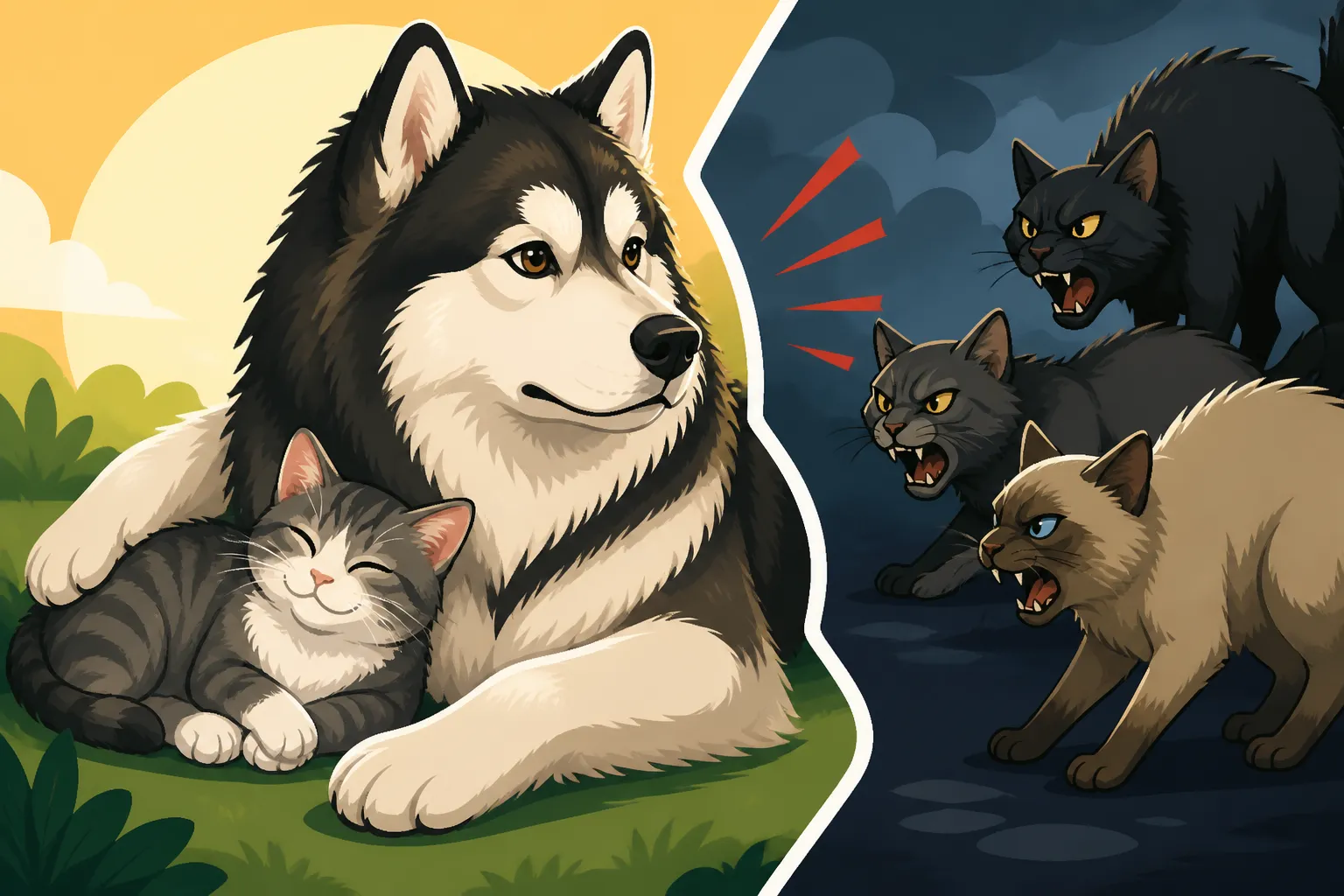
Why a Malamute Spares Its Own Cat and Not Others
It's a perplexing and often heartbreaking reality for many Alaskan Malamute owners: their beloved, majestic companion, who might happily coexist with the family cat, suddenly transforms into a focused, relentless hunter at the sight of a stray feline in the yard. This isn't a sign of hypocrisy from your Malamute, nor is it a personal failing on your part. It stems from deep-seated instinct, a nuanced understanding of "pack," and the very specific way these powerful dogs perceive their world. This guide will delve into the core reasons behind this contradictory behavior and offer insights into managing such a dynamic household.
The Deep Roots of a Malamute's Prey Drive
To truly understand why your Malamute differentiates between "their" cat and "other" cats, we need to go back to their ancestral purpose. Alaskan Malamutes were bred for a harsh environment, relying on their keen senses and robust physical abilities to survive and aid their human companions. This often involved hunting and scavenging. Their instincts are powerful, not just for pulling heavy loads but also for identifying and pursuing potential food sources or perceived threats.
The Hunter's Instinct and Territory
Malamutes possess an incredibly strong prey drive, a fundamental characteristic that dates back centuries. These dogs were developed to be self-sufficient and resourceful, and that included knowing how to find food. When they see a small, fast-moving animal, especially one outside their established territory, it triggers this ancient hunting sequence. The sight, the scent, the movement – it's all a powerful call to action for a Malamute. This isn't malice; it's instinct. It’s the difference between a dog seeing a squirrel in the park and seeing a pet rabbit in its hutch. The context fundamentally changes the perceived "status" of the small animal.
The territory aspect is crucial here. Your home, your yard, everything within your fence line – that's your Malamute's domain, and anything living within it, especially if introduced early and accepted by you, might be considered part of the extended "pack" or at least a non-prey item. An unfamiliar cat, however, crossing into that territory, or seen beyond its boundaries, is simply a small, mobile creature. It’s an unknown, and in the Malamute's ancestral programming, an unknown small creature is often synonymous with prey.
"Part of the Furniture" vs. "Moving Target"
Think of your own cat. It likely moves around the house in a predictable way, shares resources, and perhaps even interacts with your Malamute in familiar patterns. It has a scent your Malamute knows intimately. Over time, your Malamute has learned that this specific cat is not food, not a threat, and not something to chase. It's simply there, part of the daily landscape, much like the sofa or the mail carrier. This isn't necessarily affection in the human sense, but rather a profound understanding of its status within the home.
| Characteristic | Your Own Cat (in a Malamute Household) | Other Cats (Outside or Unfamiliar) |
|---|---|---|
| Familiarity | High. Known scent, predictable movements, established presence. | Low or None. New scent, erratic or evasive movements. |
| Perceived Role | Non-prey, possibly a low-ranking 'pack' member, 'part of the furniture.' | Potential prey, intruder, competition. |
| Owner's Presence | Owner is present, reinforcing boundaries and non-prey status. | Owner may not be present or not able to intervene effectively. |
| Emotional Trigger | Typically none, or mild curiosity. | Strong prey drive activation, excitement, focus. |
| Outcome | Peaceful coexistence (with proper management). | Strong urge to chase, catch, and potentially harm. |
An outside cat, on the other hand, embodies all the characteristics of prime prey. It's often unknown, moves quickly, and may try to flee, which instinctively triggers the chase response. It doesn't have the established "safe" status your resident cat has earned. For the Malamute, it’s not about recognizing "a cat" as a species, but distinguishing between "this specific, known, non-prey item that lives here" and "that generic, unknown, fast-moving thing that looks like food." This distinction is a vital point to grasp when living with these incredible dogs.
Socialization and Learned Behavior within the Home
The peace that often exists between a Malamute and its resident feline isn't accidental; it's usually the result of careful, consistent socialization and a clear understanding of boundaries. This isn't about eliminating the Malamute's prey drive, but rather about teaching them to inhibit that drive in very specific circumstances and towards very specific individuals.
Early Exposure and Acclimatization
Introducing a Malamute puppy to a cat at a very young age, ideally before 12-16 weeks, is often the most successful strategy. During this critical socialization window, puppies are more open to new experiences and more likely to accept a cat as a non-threatening, non-prey entity. The puppy learns from day one that the cat is part of the family, a housemate, not something to be chased or harmed. Even with early exposure, however, vigilance is key. It's about constant, positive reinforcement when the puppy is calm around the cat and immediate, calm redirection if the puppy shows too much interest or tries to play too roughly.
This is where a good puppy training program, such as those offered by BAXTER & Bella, can be invaluable. While their programs focus on typical puppy behaviors, the underlying principles of positive reinforcement, impulse control, and structured exposure are crucial for any multi-pet household. The goal is to build a foundation of respect and calm around all family members, regardless of species. How to Introduce a Malamute Puppy to a Cat is a delicate dance, requiring patience and consistency, but it builds the foundation for their unique bond.
The Role of Routine and Supervision
Once established, the peaceful coexistence between your Malamute and your cat is often maintained through consistent routine and constant, never-ending supervision. The Malamute understands the rules of the house. They know when the cat is allowed in certain areas, when they'll get fed, and what behaviors are acceptable. This predictable structure helps manage their instincts. However, it's crucial to understand that this is a learned inhibition, not an eradication of the prey drive.
Many owners mistakenly believe that because their Malamute has lived peacefully with a cat for years, the prey drive has somehow disappeared. This is rarely the case. It means the Malamute has learned to control that drive specifically around that particular cat in that particular environment. This fragile truce can easily be broken if routines change, if the Malamute is over-aroused, or if the cat suddenly acts in a way that mimics prey (e.g., darting quickly from around a corner). This is why even well-integrated households still require owners to be present and observant.
Management and Training Strategies for a Multi-Pet Household
Living with a Malamute and a cat, whether you have one already or are considering the possibility, requires a proactive and diligent approach to management and training. You're not trying to change their fundamental nature, but rather guide their behavior and create an environment where everyone can thrive safely.
Constant Supervision and Physical Barriers
The golden rule for Malamutes and small animals, especially cats, is "never unsupervised." This means if you can't actively watch them, they should be separated. This isn't a judgment on your dog; it's acknowledging their powerful, hardwired instincts. Tools like baby gates are your best friend in a multi-pet home. You can create cat-only zones where your feline friend can retreat and relax without fear of being chased. Crates are also essential. When you leave the house, or if you simply need a break from monitoring, your Malamute should be safely crated. These physical barriers found easily on platforms like Amazon, prevent accidents and reinforce boundaries.
Even when you are present, be observant. Look for subtle cues from your Malamute – a fixed stare, a stiff body, a low crouch. These can all be precursors to a chase. Interrupt these behaviors immediately and redirect your Malamute's attention to an appropriate activity, like a puzzle toy or a short training session. Remember, the key is prevention, not correction after the fact.
Training for Impulse Control (Not Eradication)
While you can't "train out" a Malamute's prey drive, you can certainly train for impulse control. This means teaching a strong "leave it" command, a solid recall, and encouraging calm behavior around small, moving objects. These are foundational skills for any dog, but they are absolutely critical for a Malamute living with a cat. Practice "leave it" with tempting items, gradually increasing the distractions. Reward heavily for ignoring temptations and for choosing calm.
A "place" command, where your Malamute learns to go to a designated spot and stay there until released, can be incredibly helpful. This provides a safe, controlled way to manage interactions, especially during times of heightened activity or when the cat needs to move through a shared space. Why a Malamute Cannot Be Broken of Chasing outside is a reality, so focusing on indoor management and control is paramount.
Understanding the Limits of a Malamute's Prey Drive
The distinction your Malamute makes between your cat and other cats is a stark reminder of their unique nature. It highlights that even with the best training and socialization, certain instincts remain deeply embedded.
The Reality of a High Prey Drive Breed
Malamutes are a primitive breed, meaning they retain many of the natural instincts of their wild ancestors. One of the strongest of these is the drive to hunt. When an unfamiliar cat dashes across their path, it's not a question of good or bad behavior; it's a hardwired response. Expecting a Malamute to view all cats equally, regardless of familiarity or context, is unrealistic. This is why An Alaskan Malamute in a Home With Cats or Small Dogs requires extraordinary commitment and a comprehensive understanding of the breed.
The unfortunate truth is that a Malamute's prey drive often means they cannot be trusted off-leash in unfenced areas, especially where small animals might be present. Even the most well-trained Malamute can have that instinct suddenly override their obedience. This is why a secure fence and diligent leash handling are non-negotiable for these magnificent dogs. Why an Alaskan Malamute Will Never Have a Reliable Recall in the face of strong prey drive is a painful lesson many owners learn the hard way.
When Coexistence Isn't Possible (and What to Do)
While many Malamutes can and do coexist peacefully with their resident cats, it's important to be realistic. Sometimes, despite all best efforts, the risk is too great, or the stress on either the dog or the cat (or both) is simply too high. If you find yourself in a situation where constant vigilance isn't enough, or if your Malamute shows signs of aggression towards your own cat, it's crucial to seek professional help. A certified professional dog trainer or behaviorist, especially one with experience with Nordic breeds, can assess the situation and provide tailored strategies.
In some rare but heartbreaking cases, it might be necessary to consider rehoming one of the animals for their safety and well-being. This is a last resort, but an important one to consider if you cannot guarantee the safety of all pets in your home. The well-being of all your animals should always be the top priority. The Risk a Malamute Poses to a Small Dog is similar to the risk to a cat, and these considerations extend across species. Understanding this breed means understanding their strengths and their limitations, and always putting safety first.
Disclaimer
This article is for general informational purposes only and does not constitute professional advice. Laws, prices and regulations vary by location and change over time. Consult a qualified professional for guidance on your specific situation.